Khaberni - Ireland, Spain, Slovenia, and the Netherlands have announced their withdrawal from the Eurovision 2026 contest, following the European Broadcasting Union (EBU)'s green light for Israel's participation in the upcoming contest, despite increasing calls from several participating bodies to exclude it due to the war in Gaza.
During the union's general assembly held on Thursday, no vote was taken on Israel's participation. Instead, members voted to approve new rules aimed at limiting government and external interference in the excessive promotion of songs, which could influence public voting.
The union stated in a release: "A significant majority of the members saw no need for further voting on participation, and that the Eurovision 2026 contest should proceed as planned, with the addition of the new safeguards."
In direct response, the "Irish Broadcasting Authority" (RTE) announced it will neither participate in the contest nor broadcast it, considering Ireland's participation "unacceptable in light of the appalling losses in Gaza and the humanitarian crisis threatening civilian lives."
The "Spanish Broadcasting Authority" (RTVE) also announced that it will not broadcast the contest or its preliminary stages in Vienna next year, describing the decision-making process as "insufficient" and raising "doubts."
The Spanish Broadcasting Authority, along with 7 other countries, had requested a secret vote on Israel's participation during the Geneva meeting. However, they said the union's leadership refused the request, increasing "mistrust" in the contest management and affirming the surrounding political pressures.
The Spanish Minister of Culture, Ernest Ortason, supported the boycott decision, saying: "It is not possible to whitewash Israel's image in the light of the genocide in Gaza. Culture should stand for peace and justice. I am proud of the Spanish Broadcasting Authority which prioritizes human rights above any economic interest."
The "Dutch Broadcasting Authority" (Avrotros) also announced its withdrawal, stating that participation "cannot be reconciled with the institution's fundamental public values." Meanwhile, the "Slovenian Broadcasting Authority" (RTVSLO) - the first to signal a boycott - stated that participation "conflicts with the values of peace, equality, and respect."
Members discussed during the meeting new rules aimed at preventing governments and external entities from excessively promoting songs to influence voting. These concerns arose after Israel topped the public vote in last May's contest and finished second in the final standings after adding the jury vote.
Although these amendments were considered an attempt to assuage the concerns of the countries demanding Israel's exclusion, they were not sufficient to convince most of the countries considering the boycott.
65% of participants voted in favor of the changes, while 23% opposed and 10% abstained from voting.
Among the supporting countries are Norway, Sweden, Finland, Denmark, and Iceland, all of which confirmed their continued participation, stating in a joint statement that they support "addressing the deficiencies" in the voting system with the necessity of maintaining "ongoing dialogue to protect the union's and competitions' credibility."
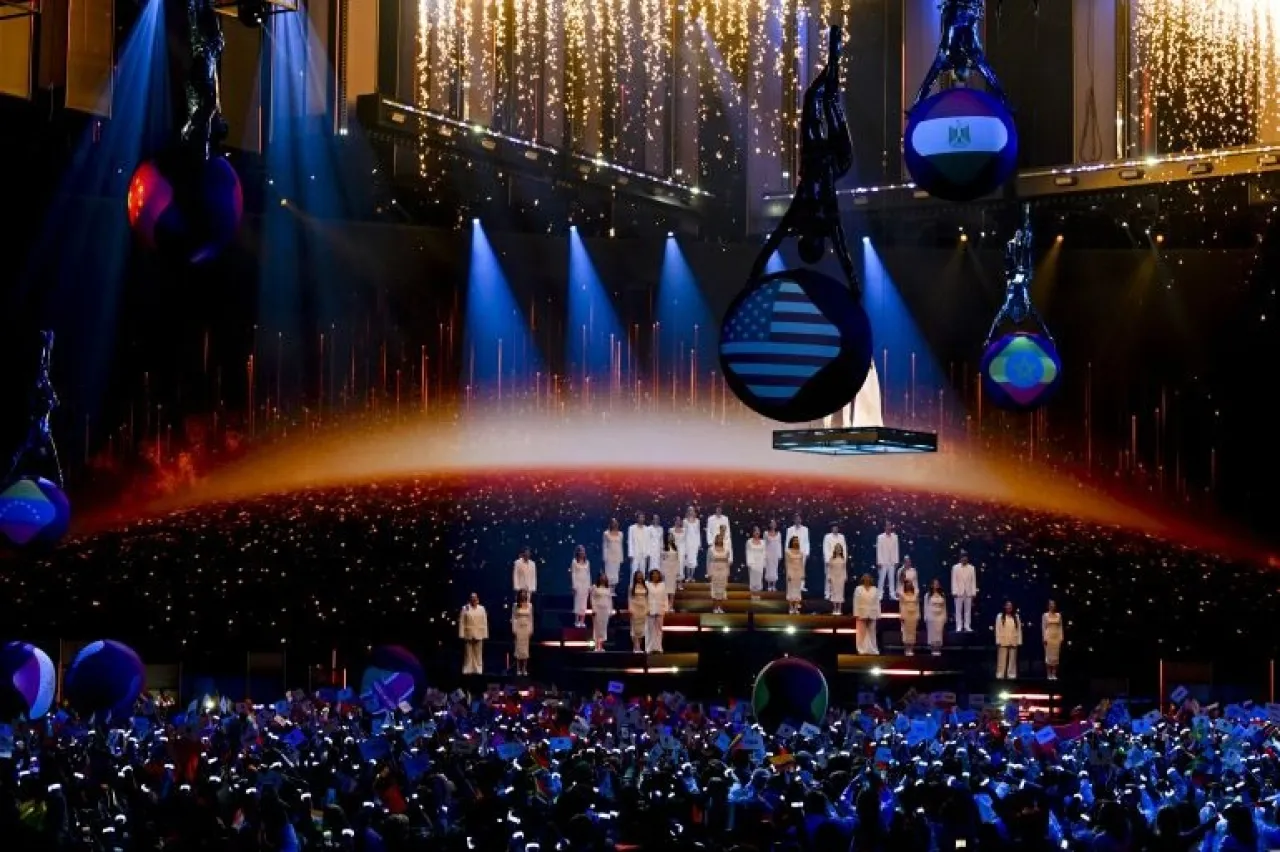
The Eurovision 2026 contest will take place in Vienna following the victory of Austrian singer "JJ" (JJ) in this year's edition. In Germany, prominent politicians have called for the "German Broadcasting Authority" (SWR) to withdraw if Israel is excluded, while the "Austrian Broadcasting Authority" (ORF) supported Israel's participation, confirming its desire for all eligible countries to participate.
Russia was banned from participating in 2022 after invading Ukraine, while Israel has maintained its participation over the past two years despite heated controversy. Israel has won the contest four times since joining in 1973.