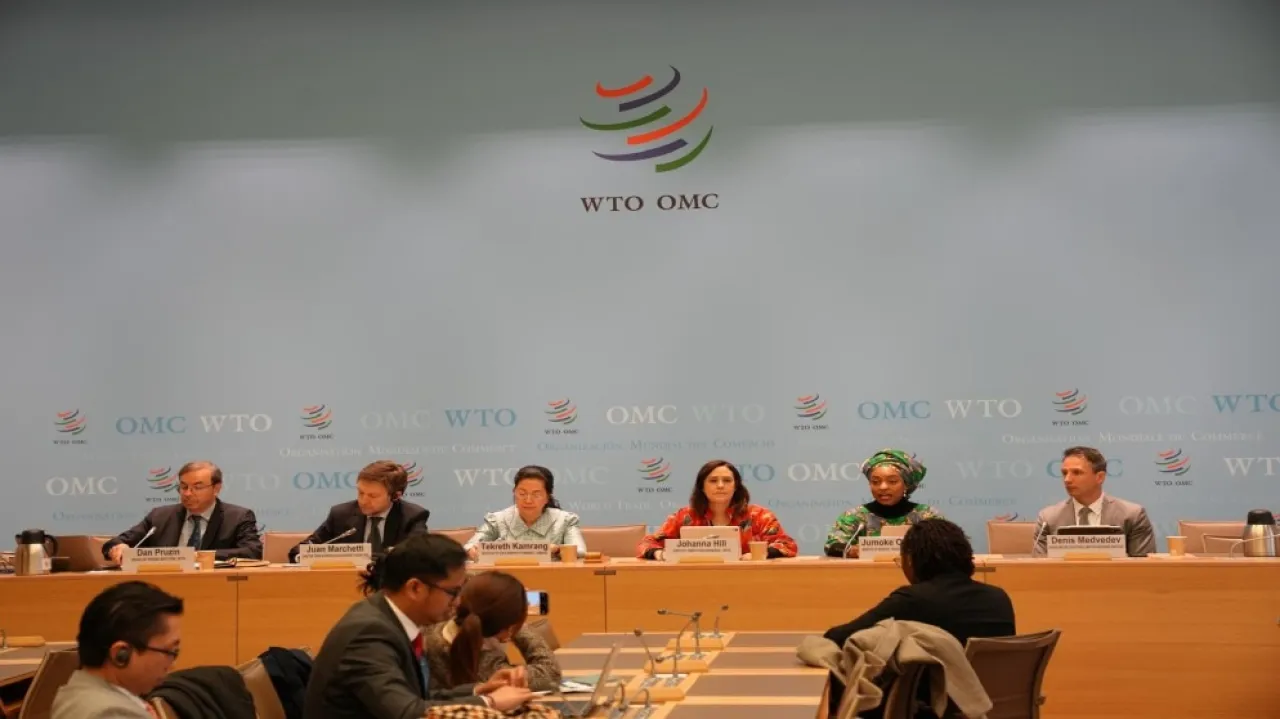
Khaberni - Deputy Director-General of the World Trade Organization, Johanna Hill, stated that service trade is expected to see accelerated growth during this year and the coming years, driven by digital transformation and the spread of artificial intelligence technologies.
She explained, during the "Trade in Services for Development" TS4D conference, that the latest forecasts of the organization indicate a global growth of commercial services trade by 4.6% in 2025, and 4.4% in 2026, compared to much slower growth of goods trade at 2.4% and 0.5% for the same periods, respectively.
Hill emphasized that digital services, specifically, have become the fastest driver of trade growth, with projections showing an increase of 6.1% in 2025 and 5.6% in 2026, pointing out that artificial intelligence "is reshaping the nature of service trade" and enhancing their integration into manufacturing processes. She added that the World Trade Report issued by the organization estimates that artificial intelligence alone could increase trade flows by about 40% by 2040.
Hill said that the growing role of services makes their integration into national development strategies "a necessity, not a luxury," given their link to diversification, productivity, and economic resilience. However, she stressed that transforming the potential of service trade into an actual growth engine "is not automatic," prompting the organization and the World Bank to establish the "Trade in Services for Development" TS4D initiative to provide practical tools for developing countries.
Hill introduced a new toolkit under the umbrella of the initiative, notably the "Service Trade Competitiveness Dashboard" which enables governments to diagnose strengths and weaknesses and set policy priorities, a guide for good regulatory practices, and a tool for diagnostics and planning for reform, in addition to expanding the database of service trade policies and the service trade restriction index, as well as presenting preliminary results of a joint study on promoting service exports in developing countries, explaining that the common goal of these tools is "to make service trade work more effectively for the benefit of people's lives and livelihoods."
The conference then moved to present the vision of the World Bank, where Denis Medvedev, the incoming director of the Trade, Competition, and Business sector, said that global trade uncertainty and stable trade levels simultaneously open opportunities for countries in removing non-tariff barriers and deepening regional integration, confirming that full implementation of the African Continental Free Trade Agreement could double intra-regional exports by 2035, and that the Regional Economic Partnership for East Asia is capable of increasing trade among its members by 12%.
Medvedev noted that services have become "the most dynamic part" of global trade, and they account for more than half of the added value in trade, while the services sector holds 72% of the balance of foreign direct investment. He confirmed that the cooperation between the organization and the World Bank focuses on supporting countries in implementing service sector reforms, including the implementation of the service trade protocol in the African Continental Free Trade Area.
During her interventions, Nigeria's Minister of Industry, Trade and Investment, Jumoke Oduwole, explained that services constitute 58% of the Nigerian economy and provide more than 45% of formal jobs, highlighting Nigeria as a leader in financial, creative, and technological services among African countries.
However, she pointed out that Africa's contribution to global service trade is still only around 2%, emphasizing Africa's need to enhance the added value in services and expand digital trade.
Oduwole detailed her country's efforts in updating intellectual property policies and developing the regulatory framework for digital trade in cooperation with the Secretariat of the African Continental Free Trade Area.
The State Secretary at the Ministry of Commerce of Cambodia, Tekreth Kamrang, confirmed that service trade is a major driver of the Cambodian economy, representing more than 40% of the GDP and employing 36% of the workforce, but she noted that the country faces challenges including skill gaps, digital infrastructure, and market access difficulties, emphasizing the importance of continued technical support from the organization to enhance integration into the global economy.