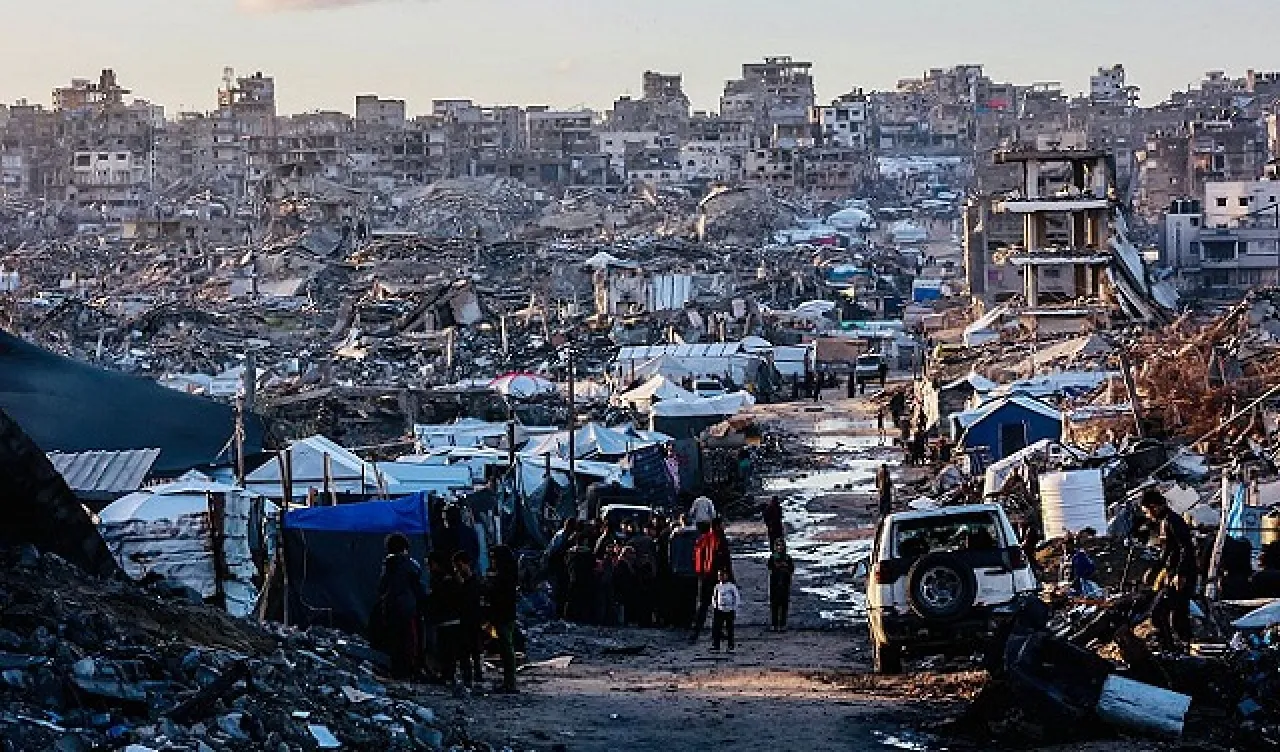
Khaberni - Significant challenges obstruct the formation of the international force to secure Gaza after the war of extermination on the sector, which is planned as per the American plan and a resolution issued by the United Nations Security Council, amid reports of a retreat in the commitments of the countries slated to participate, ambiguity in the mechanisms for disarming Hamas, and delays in implementing the central provisions of President Donald Trump’s plan.
According to "The Washington Post," which reviewed internal discussions, diplomatic pressures, and American attempts to rally forces within the "International Stability Force" (ISF), authorized by the Security Council resolution on November 17th to "disarm," secure borders, protect civilians, and relief operations.
A regional official familiar with the deliberations said: "A month ago, things were in a better state," referring to the declining momentum that accompanied the initial announcement of the plan. The newspaper reported that the Trump Administration is moving to persuade countries to send forces, although many countries, even those seeking to bolster their relations with Washington, are still hesitant.
The newspaper highlighted pressing questions posed by these countries, particularly regarding how to "secure the disarmament of Hamas" amidst ongoing Israeli raids and attacks on the sector despite the ceasefire agreement that came into effect in October.
The Washington Post quoted a senior official from the Indonesian Foreign Ministry saying, "They want the international stability force to enter Gaza and restore what they call 'law and order' and remove any resistance... That is the issue. No one wants to do that."
Under the American plan, the "International Stability Force" will be a "long-term solution for internal security" in Gaza, and its deployment should happen "immediately," while the rules of engagement and the scope of the mandate are still being prepared.
An individual familiar with the American planning mentioned that the goal is to deploy three teams, or up to 15,000 soldiers, while another conveyed that the number may reach up to 20,000. An American official noted that the deployment is expected in "early 2026," and the process of selecting the countries "is still a fluid operation."
The American official added: "There are commitments under study. No country will send its soldiers before knowing the details of the mission."
The newspaper mentioned that Indonesia, which had previously announced readiness to send up to 20,000 personnel, has revised its stance. An Indonesian Defense Ministry spokesperson clarified that the figure referred to "the overall peacekeeping capacity" and not a specific commitment for Gaza.
An Indonesian Foreign Ministry spokesperson said that the number "relates to Indonesia's general readiness." According to the Indonesian official who spoke to the newspaper, preparations are underway to send only about 1,200 soldiers as a first batch, and their deployment may require six months.
He noted that "some officers are very hesitant" fearing engagement in armed clashes with Palestinians. The official added that governments in the Middle East "chastised" Jakarta for advancing them in announcing the dispatch of forces. According to his statement, Indonesia is now talking about "health and construction tasks" instead of combat roles.
Indonesian Army Commander, General Agus Suprianto, stated that the force would consist of three brigades commanded by a three-star general with air and naval support, sending a "reconnaissance team" first to determine deployment locations.
The newspaper also mentioned other countries showing initial readiness such as Azerbaijan, Pakistan, and Italy. Reuters conveyed that Baku would participate only if the fighting completely stopped. The Azerbaijani Foreign Ministry and the mission to the United Nations made no additional comments, and Pakistani figures declined to comment.
A senior Italian government official stated that his country is "evaluating the most effective ways to contribute," indicating interest in mine removal operations and expanding Palestinian police training programs.
According to the newspaper, the stability force still lacks "crucial support" from Gulf countries. A regional official mentioned that these countries "retreated" from previous preparations.
The newspaper quoted Emirati advisor Anwar Gargash, stating he "does not see a clear framework" for the force, while an Emirati political analyst mentioned that "the ambiguity is not comforting in Abu Dhabi." It became "unlikely" that any Gulf country would deploy soldiers inside Gaza, despite the possibility of contributing to coordination from the outside, according to an informed diplomat.
The formation of the force is part of the "second phase" of the Trump plan, which also includes a "Peace Council" chaired by him to manage Gaza for two years, a Palestinian technocratic committee to manage the sector's daily affairs, an additional Israeli withdrawal, and the disarmament of Hamas.
An individual familiar with the efforts said: "We thought that after the Security Council decision, the Peace Council would be announced within 48 to 72 hours... But nothing happened, even unofficially." The plan has not yet named other members of the Peace Council, although Trump said the council would include "heads of major states."
Another American official noted that the goal is to launch both the Peace Council and the international force "in the coming weeks," but he acknowledged that big questions remain unanswered, especially those related to disarmament mechanisms and coordination with the Palestinian police force that is supposed to be formed under the plan.
The newspaper reported that Hamas orally agreed during last month's ceasefire negotiations to a mechanism for disarmament, according to Egyptian advisor Khaled Akasha. However, the movement has "hardened its position" since then, according to a former Egyptian official, with the possibility of handing over heavy weapons and retaining light weapons.
A former Egyptian diplomat stated: "The whole world knows that disarmament takes years," emphasizing that it cannot be executed without addressing Gaza's political future. He added that Egypt, despite its central role in the plan, "will not participate" in the force as long as Israel continues its military operations in the sector. He warned: "What would happen if Israel killed a number of the force's soldiers, whether from Egypt or elsewhere? It would be a disaster."
The newspaper reviews other questions related to the deployment locations of the force and whether it will remain in areas under Israeli control or enter areas where Hamas is active. Despite the withdrawal of Israeli forces under the ceasefire agreement, they still control more than half the sector.
According to an internal document in the Indonesian Army, which the newspaper had access to, the deployment of forces in areas not under Israeli control is being considered.
The newspaper also disclosed that it has yet to be decided whether the international force will be responsible for protecting "safe areas" planned by Israel within the areas it controls, described as "small cities" containing institutions and essential services to encourage people to relocate there with international support. The newspaper points out that Jared Kushner is leading this project.
The newspaper quoted Israeli Prime Minister Benjamin Netanyahu, stating that he "doubts" the ability of any international force to disarm Hamas, adding: "They said that international forces might do it... Well, you can try."
Israeli researchers believe that Tel Aviv operates on the premise that it "will eventually have to disarm Hamas itself," and the newspaper quoted an Israeli researcher saying "all indications say that no country is prepared to bear this responsibility... The bottom line: It is unlikely that the ISF, if established at all, will lead to disarming Gaza."