Khaberni - Deputies from the Finance Committee called for an inventory of the financial receivables due from companies and contractors, and establishing clear mechanisms for their repayment to ensure avoiding the accumulation of obligations.
They also provided notes concerning the need to enhance the supervision of implemented projects, especially in the sectors of education, health, and services, to ensure compliance with specifications and achieving the highest benefit from the projects.
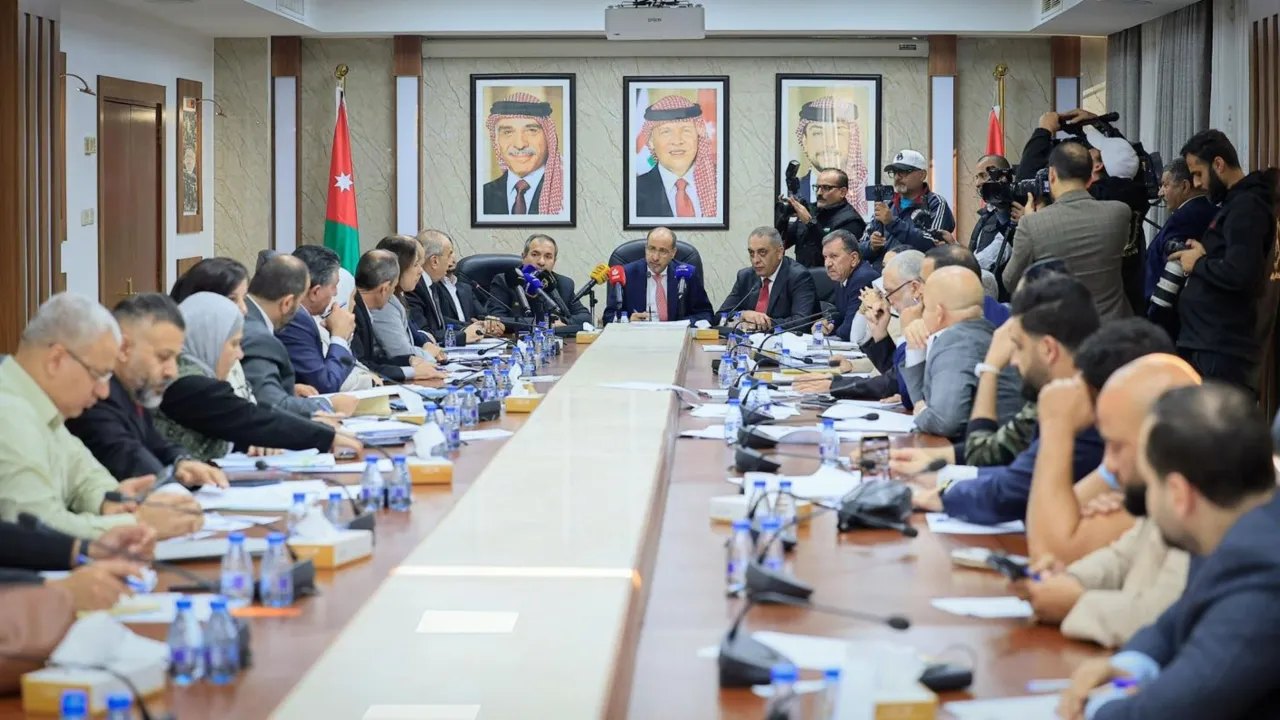
This came during the discussion by the Finance Committee, chaired by Deputy Dr. Nimir Al-Salihat, yesterday, Thursday, about the budget of the Ministry of Public Works and Housing and related departments for the year 2026, in the presence of the Minister of Public Works Engineer Maher Abu Samen, the acting Director-General of the Government Tenders Department Fadia Qiqieh, the Director-General of the General Corporation for Housing and Urban Development Engineer Jumana Al-Attiyat, and the acting Director-General of the General Budget Department Ayman Abu Al-Rub.
Salihat confirmed that the ministry's budget reflects clear priorities in improving the roads sector and the services provided to citizens, pointing out that the committee viewed the reality of the road network and its geographical distribution, smart road projects, and mechanisms for evaluating project outcomes after their implementation.
He indicated that the allocations for the ministry's projects amounted to about 155.2 million dinars, an increase of nearly 24 million dinars over the previous year, which enables the ministry to expand its scope of work in constructing and maintaining roads and improving infrastructure.
He also mentioned that current expenses reached about 45 million dinars, an increase of 4.6 million dinars, reflecting the rise in operational and technical requirements.
He confirmed that these allocations will contribute to improving traffic safety, reducing travel time, and enhancing the effectiveness of transport.
In turn, members of the Finance Committee emphasized the necessity of increasing the allocations directed at projects, especially main road projects in the provinces, pointing out that increasing funding has become necessary to enable the ministry to implement expansions at city entrances and construct new roads.
In turn, Abu Samen said that the responsibilities of the ministry are significant and include a road network of more than 15,000 kilometers, over 360 bridges, and thousands of hydraulic structures.
He added that the ministry implemented 176 road projects in the past three years worth 127 million dinars, and achieved a financial saving of 6 million dinars through direct supervision by its cadre.
He explained that the ministry carried out extensive reforms in restructuring and administrative organization, introduced new departments, appointed hundreds of employees, and trained more than 12,000 participants inside and outside Jordan.
It also renewed vehicles and equipment for the first time in more than 20 years, purchasing dozens of vehicles, alongside upcoming tenders for equipment worth 5 million dollars.
Abu Samen pointed out that the ministry achieved advanced results in the mystery shopper survey that exceeded 93% in 2025 and ranked third on the National Integrity Index, in addition to developing significant instructions related to underground service permits, selecting contractors, and organizing billboard regulations.
In her turn, Al-Attiyat presented an overview of the reality of the General Corporation for Housing and Urban Development, stating that the expected revenues of the institution for the year 2026 amount to about 15.6 million dinars with an increase of 5.2 million dinars, while expenses are about 13.9 million dinars with an increase of 5.4 million dinars, most of which are concentrated in capital expenditure supporting housing projects.
She explained that the committee viewed the institution's real estate portfolio, existing and stalled projects, and services that the institution is working to develop, alongside its executive plans and the expected number of beneficiaries during the years 2025 and 2026.
In her turn, Fadia Qiqieh from the Government Tenders Department provided a comprehensive presentation on the department's role in issuing tenders, classifying contractors and evaluating bids, affirming that the department enhanced the transparency system and raised the efficiency of public spending by updating classification procedures and licensing companies and developing the general and special contract terms.
She pointed to a significant expansion in electronic services that facilitate the procedures for purchasing tender documents and submitting bids, noting that the department's budget amounted to about 3.5 million dinars, an increase of 697 thousand dinars, which enabled it to develop its technological infrastructure and improve its supervisory and administrative capabilities, in line with the growing volume of government tenders.