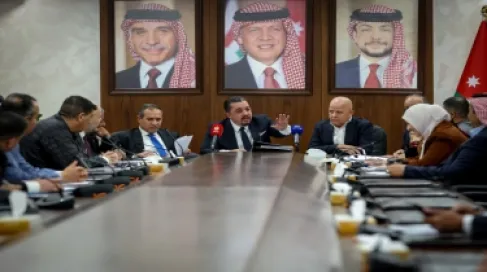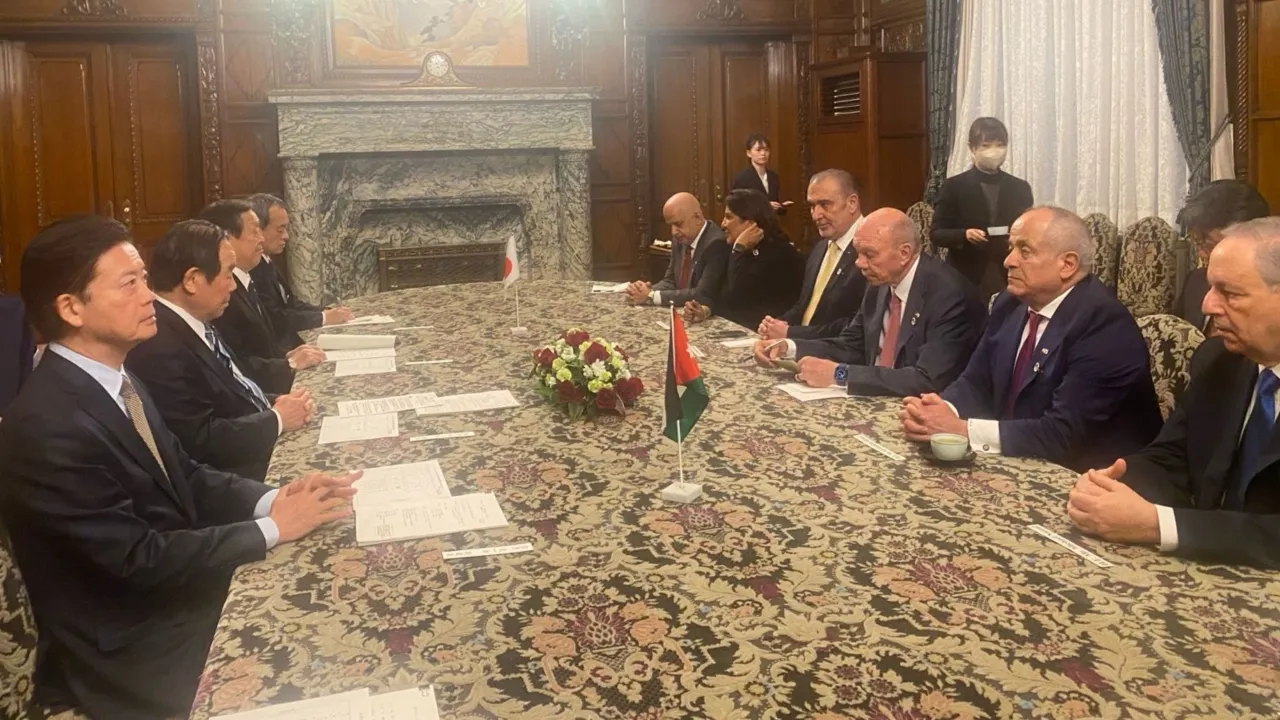
Khaberni - President of the Senate, Faisal Al-Fayez, held discussions with the Speaker of the Japanese House of Representatives, Fukushiro Nukaga, during a visit to Japan, at the official invitation of the President of the Japanese House of Councillors Masakazu Sekiguchi.
The discussions were attended by Senators Ali Al-Ayed, Khawla Al-Armouti, Michel Nazzal, Khalil Hajj Tawfiq, and the Jordanian Ambassador to Japan, Nasser Al-Sharida, according to a statement from the Senate.
Al-Fayez said, "While we reject the continuation of the aggressive and expansionist policies of the Israeli occupation, we welcome the ceasefire agreement in Gaza as an important step towards achieving security and stability in the Middle East and ending the Palestinian-Israeli conflict."
During the discussions, he called on the international community, to take practical measures and actions that compel the Israeli occupation to implement all clauses of the ceasefire agreement and to stop the aggressions against Palestinians in the West Bank, and the violations against Islamic and Christian sanctities in Jerusalem.
Al-Fayez emphasized that Jordan, led by His Majesty King Abdullah II, always strives to establish just and comprehensive peace in the Middle East, believing that peoples will not live in peace with the presence of conflicts and disputes, which have exhausted them and left tens of thousands of victims.
He indicated that His Majesty the King constantly reaffirms that there is no stability in the region, nor security for Israel without returning to peace talks, and that the only path to peace to end the conflict is for Israel to accept a two-state solution, and the establishment of a Palestinian state that can live in peace with Israel, and its capital being East Jerusalem.
He referred to the depth and solidity of Jordanian-Japanese relations, confirming that the relationships between the Hashemite family and the imperial family are strong, reflecting the solid friendship bonds based on mutual respect and shared interests between the two friendly countries.
Al-Fayez added that his visit to Japan comes within the framework of enhancing joint parliamentary cooperation, building on the bilateral relations in various political, economic, and cultural fields, and expressing the great appreciation for the level of historical relations between the two friendly nations, stressing the importance of the work of both the Senate and the Councillors to enhance the strategic partnership, in addition to coordinating efforts to restore security and stability to the Middle East region.
He explained that Jordan is a strong state politically and security-wise, but it faces economic challenges due to the conflicts around it, the continuing aggressive and expansionist policies of the Israeli occupation, its recent aggression against the Palestinian people, and the presence of approximately 1.3 million Syrian refugees in Jordan, who are fully cared for despite the international community's abandonment of its commitments to support Jordan and the Syrian refugees therein, noting that Jordan has now become the largest host country for refugees.
Al-Fayez touched on the importance of enhancing economic cooperation and increasing Japanese investments in Jordan, through signing more joint cooperation agreements and building new economic partnerships, appreciating the support provided by Japan to help Jordan cope with the effects of regional crises, and supporting its response plan to the Syrian crisis.
In turn, the Speaker of the Japanese House of Representatives stressed the importance of Jordan's role in supporting the security and stability of the region, and the effective efforts led by His Majesty King Abdullah II, to achieve comprehensive and just peace in the region, pointing to the need to continue cooperation between the two friendly countries in various fields and at all levels.
He emphasized his country's keenness to deepen the strategic partnership with Jordan, praising the economic reforms implemented by the Kingdom under the directives of His Majesty King Abdullah II.
The Japanese parliamentarian noted the importance of forming joint committees between Japan and Jordan, in order to develop the business environment and encourage investment in Jordan, and support Japanese companies operating in the Kingdom, and encouraging Japanese investors and businessmen to establish new investments in Jordan, which enjoys security, stability, and a safe investment environment.
Meanwhile, Al-Fayez and the accompanying delegation, in the presence of Ambassador Sharida, met with the president and members of the Japanese-Jordanian Parliamentary Friendship Committee in the House of Councillors, the Deputy Minister of Economy of Japan, the president and members of the Committee on Economy and Industry in the House of Councillors, and the president of the Chamber of Commerce and Industry of Japan, each separately.
Al-Fayez spoke during separate meetings about the importance of parliamentary friendship committees in enhancing Jordanian-Japanese relations, calling for activating their roles to enhance bilateral parliamentary relations, lifting Jordanian-Japanese relations, and removing any obstacles that may hinder them in service of the interests of the two countries and the friendly peoples.
He pointed out that Jordanian-Japanese friendship relations have always been solid and based on mutual respect, and that the Senate is keen to enhance these relations and work towards broader prospects for bilateral cooperation, and maintain coordination and consultation on various current issues in the Middle East region.
Al-Fayez called for more economic support for Jordan, to enable it to continue its pivotal role as a country striving for peace, and to also enable it to confront the challenges surrounding it, through enhancing economic partnership, activating the signed bilateral agreements, signing more of them, increasing trade exchange and investments, and Japanese investments in Jordan in various sectors, especially in the tourism, transportation, energy, and water sectors.
He appreciated Japan's supportive positions for the efforts of His Majesty King Abdullah II, aimed at achieving peace in the Middle East, appreciating its support for the two-state solution, and for the Hashemite custodianship of Islamic and Christian sanctities in Jerusalem.
Al-Fayez emphasized, "Any solutions to the Palestinian issue that target Jordan and its national constants, are rejected solutions, and Jordan rejects the forced displacement of Palestinians from their land, as it is a violation of international law and a war crime, paving the way for more conflicts in the region."
He presented the efforts made by His Majesty King Abdullah II to find a political horizon that can end the Palestinian-Israeli conflict, affirming that there is no security for Israel, nor stability in the Middle East region, without resolving the Palestinian issue according to a two-state solution, and enabling the Palestinian people to their legitimate rights.
Al-Fayez reviewed the comprehensive reform process in Jordan, which is being carried out by the Kingdom under the directives of His Majesty King Abdullah II despite the challenges it faces and the surrounding conflicts, pointing out that the comprehensive reform process is based on three axes, political, economic, and administrative, targeting the enhancement of political and party life, reaching parliamentary governments, in addition to empowering youth and women in society, and improving the economic reality and services provided to citizens.
He touched on many available investment opportunities in Jordan, which is ideal for establishing investment projects in various sectors, especially in the fields of telecommunications, digital economy, artificial intelligence, water and mining projects, renewable energy, oil and gas exploration, and in the field of tourism and public transport.
Al-Fayez affirmed that Jordan enjoys security and stability, and has a secure and attractive investment environment, supported by its legislations that protect investors and their rights, Jordan also offers investment and tax incentives and customs benefits, Jordan's investment environment possesses the necessary elements for investment, emphasizing the Kingdom's keenness for investors, businessmen, and Japanese companies, to have priority for investment in Jordan and to take advantage of the available investment opportunities.
Al-Fayez also highlighted that Jordan enjoys a strategic location in the region, with several development and economic zones, and it is linked by free trade agreements with several economic blocs, such as the United States, Canada, European Union countries, Arab countries, and Singapore.
He explained that these characteristics enable Japanese companies, which establish factories in Jordan, to benefit from the custom exemptions included in these agreements, when exporting their products to these countries, these features also serve as a launching point for Japanese companies in the process of rebuilding Syria and the Gaza Strip, and other countries in the region.
Al-Fayez and the delegation members proposed establishing a Jordanian-Japanese business council, including major companies from both countries, from various commercial, industrial, and service sectors, indicating that forming the council would play a significant role in developing bilateral economic relations in various fields, including benefiting from Japanese expertise in supporting small and medium enterprises and innovation.
They also called for the establishment of a Jordanian-Japanese digital business platform, serving as an information bank benefiting businessmen in both countries, containing investment opportunities and incentives, alongside the possibility of holding a regular Jordanian-Japanese business forum every year.
For their part, Japanese officials praised the high level of Japanese-Jordanian relations, their keenness to maintain and build on them in various fields, affirming the importance of joint work to enhance investment and economic relations, building new economic partnerships, and strengthening existing Japanese investments in Jordan.
They expressed their appreciation for the significant and pivotal role played by Jordan under the leadership of His Majesty King Abdullah II, in the work for peace, affirming that His Majesty's leadership has enabled Jordan to overcome the challenges facing the Middle East region, making Jordan a fundamental pillar in the security and stability of the Middle East region.