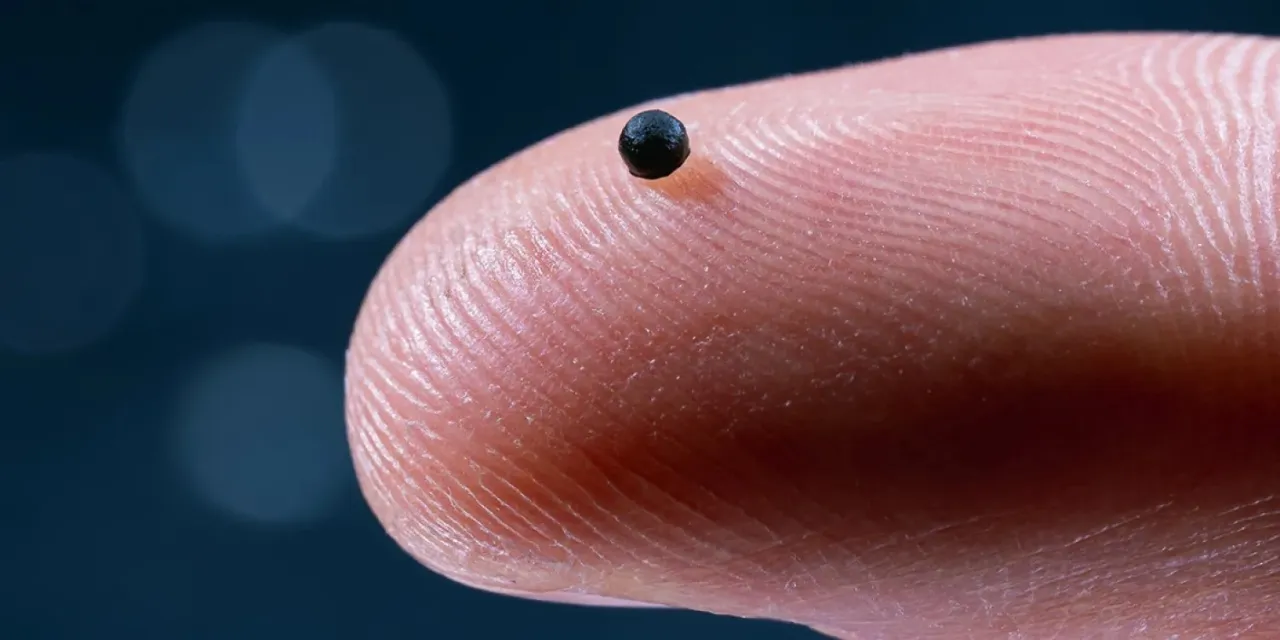
Khaberni - Scientists in Switzerland have developed a sand-sized robot controlled by magnets, capable of delivering drugs to precise locations inside the human body. This innovation represents a leap forward aimed at reducing severe side effects that prevent the progress of many drugs in clinical trials, according to the "Washington Post".
Bradley J. Nelson, the author of the study published in the journal "Science" and a professor of robotics and intelligent systems at the Swiss Federal Institute of Technology in Zurich, said: "We are still at the beginning of the road." He added, "I think surgeons will look at this robot. I'm sure they have many ideas on how to use it."
Nelson reported that this magnetically controlled capsule could also be useful in treating aneurysms, severe brain cancers, and abnormal connections between arteries and veins known as arteriovenous malformations.
The capsules have been successfully tested on pigs that have blood vessels similar to those in humans, and on silicone models of human and animal blood vessels. These silicone models are used in medical training.
Nelson noted that it could take between 3 and 5 years before such precise drug delivery robots are tested in clinical trials.
The problem faced by many drugs under development is that they spread throughout the body instead of targeting only the intended area. For example, when we take aspirin to treat a headache, it is absorbed into the bloodstream and spreads throughout the body.
One of the main reasons for side effects in patients is the migration of drugs to parts of the body that don't need them.
However, the surgeon can guide the capsules developed in Switzerland to precise locations using a tool not much different from a "PlayStation" controller. The steering system includes 6 electromagnetic coils placed around the patient, each about 8 to 10 inches in diameter.
The coils create a magnetic field, which can be used to push the capsule in one direction or pull it in the opposite direction.
Nelson said, "By integrating these fields and controlling them individually, you can achieve the precise type of movement you want through the blood vessels or cerebrospinal fluid."
The magnetic field is strong enough to move the capsule even when it moves against the direction of blood flow.
The capsules are made of materials safe for use in other medical devices. These materials include tantalum, a dense silver metal used for contrast so doctors can see the capsule in X-ray images, and tiny particles made from iron and oxygen with magnetic properties.
Although the capsule moves quickly in the body, doctors are able to track its path through the blood vessels via X-rays.
Nelson said that when the capsule reaches its destination in the body, "we can stimulate the capsule to dissolve."
This study published in the journal "Science" has sparked excitement in the field of robotics.
Howie Choset, a professor of robotics and biomedical engineering at Carnegie Mellon University, said: "I try not to exaggerate, but this work - in terms of its ability to deliver high-precision care - is the most exciting of all the research I've seen."