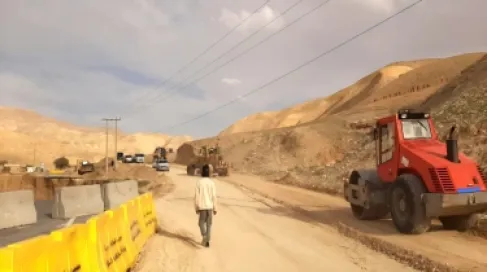
Khaberni - Al-Wala Dam, which underwent a drought condition during the previous season, has received nearly 400,000 cubic meters of rainfall since the onset of the recent unstable weather conditions, according to the Secretary-General of the Jordan Valley Authority, Hisham Al-Haysa, who described these figures as "promising" at the start of the rainy season.
Al-Haysa explained that the recent rains also helped increase the storage capacity of several dams, with Al-Boayda Dam in Al-Ramtha District reaching its full storage capacity as one of the water-harvesting sites.
He indicated that these rains will positively reflect on the agricultural sector and the water sector and the Jordan Valley Authority by improving the quality of trees and fruits ultimately.
He pointed out that the Authority's personnel worked on maintaining water supplies to King Abdullah Canal, opening spillways, and drainage channels, drawing attention to the fact that Jordan suffered from severe drought last season, causing significant stress on water resources across various regions.
In this context, the Ministry of Water and Irrigation stated in an announcement on Sunday that the long-term annual average of rainfall had risen by Sunday morning to 4% of the annual average of 8.1 billion cubic meters, adding that the quantities of rainfall entering the dams since the onset of the depression from Thursday evening until Sunday morning reached 1.8 million cubic meters.
The largest share of these quantities was at Al-Wala Dam, amounting to 400,000 cubic meters, which raised the total storage to 5.3% of its capacity of 25 million cubic meters.
Conversely, the rest of the amounts were distributed across various dams except for Unity Dam, which did not record any new flow, reaching a total storage in the main dams of 43 million cubic meters, representing 15% of their capacity, compared to 57 million cubic meters (20%) for the same period last year.
The spokesperson for the Ministry of Water, Omar Salama, told "Al-Mamlaka" that 1805 complaints related to rainwater blockages were addressed, urging citizens not to connect rainwater to sewer network gutters to avoid sewage water flow mixing with rainwater and flowing towards the dams.
Salama emphasized the importance of benefiting from the rainfall in light of Jordan's suffering from drought and the effects of climate change, while the Ministry mentioned that it had activated emergency plans during the weather depression, dealing with 1804 complaints, most of which were linked to sewer flooding.