Khaberni - The media consultant for the United Nations Relief and Works Agency for Palestine Refugees (UNRWA), Adnan Abu Hasna, said that the delivery of aid to the Gaza Strip is subject to severe restrictions connected to Israeli legislation.
He noted that the health situation in the Gaza Strip is "catastrophic," with most of the population drinking water that is polluted with rates of nitrates and salinity exceeding global averages by nine times, leading to the spread of hepatitis, meningitis, gastrointestinal and respiratory diseases, as well as increased cases of kidney failure and cancer.
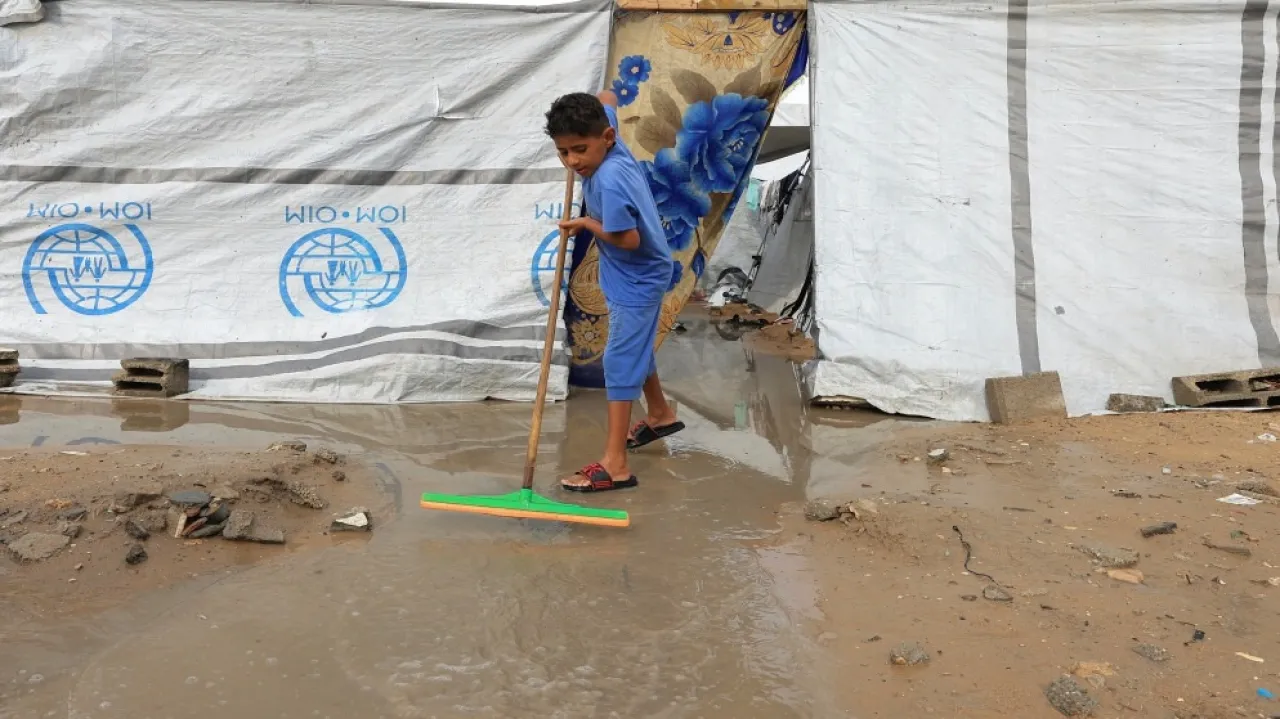
Abu Hasna added that hundreds of dilapidated tents that have reached the end of their lifespan, and temporary shelters in Gaza, were flooded with rainwater, and thousands of families became vulnerable to harsh weather conditions. He explained that UNRWA owns hundreds of thousands of blankets, mattresses, and tents sufficient for a million people, but accessing them is extremely difficult due to the occupation's restrictions, which control 54% of the sector.
He pointed out the existence of hundreds of buildings within what is called the "yellow line" that the agency cannot reach to provide aid, thereby exacerbating the humanitarian crisis in Gaza. He emphasized that Israel had rejected about 23 requests to bring essential supplies to Gaza, including tents. Therefore, it is essential to exert urgent international pressure to allow these critical aid supplies with the onset of winter, and there are warnings of the risk of weather fluctuations in the coming days as rainwater drowned the worn-out tents of displaced people on the beaches of Gaza, and the residents have recovered whatever could be salvaged from their belongings, confirming the immediate need to introduce relief aid as we have the logistical capacity and experience to distribute relief assistance and provide all the essentials of life, and without UNRWA there would be chaos and humanitarian failure.
Abu Hasna clarified that there are about 16,500 patients in need of medical care outside the Gaza Strip, and that 90% of the Gaza population suffers from various levels of malnutrition.
He said that so far, we do not know the mechanism that will be put in place for the reconstruction process of Gaza, but what is certain is that UNRWA possesses enormous experience in this field; it has previously built many housing projects, as well as dozens of schools and infrastructure within the camps and tens of thousands of homes in Gaza during previous wars.
He added that the destruction in the Gaza Strip this time is completely different from previous wars; we are talking about total destruction and entire cities like Rafah, which is still subjected to heavy bombing despite the ceasefire, in addition to Beit Hanoun and Beit Lahia. There are unexploded ordnances in various parts of the sector posing a serious threat to those present, and the reconstruction project exceeds the capabilities of UNRWA, but the agency is ready to participate and contribute with its capacities.
Abu Hasna stressed that those who want to change the nature of UNRWA's mandate or vote to change its programs can go to the vote on extending UNRWA’s mandate for the next three years during the upcoming session of the United Nations General Assembly, explaining that next Wednesday the agency's advisory committee will hold an important meeting in the Jordanian capital Amman to ensure the continuity of its services and its stability and to preserve the human dignity of Palestinian refugees, as well as meetings of the conference of supervisors of Palestinian affairs in the Arab host countries. Therefore, UNRWA will continue to provide its services because its collapse means the collapse of a massive humanitarian system that is the largest in the world.
He said, maintaining UNRWA's operations requires providing sustainable financial funding as it is the fundamental guarantee for the continuation of its services in education, health, and social service sectors, and what it provides of relief amidst escalating humanitarian needs after the aggression on Gaza. He appreciated the position of the European Parliament and member states in the Union for increasing funding for the agency, confirming that this step reflects a political and humanitarian awareness of the importance of UNRWA's continuous operation, as it also represents a practical response to campaigns that attempt to delegitimize the agency or affect its international mandate.
Abu Hasna pointed out that this challenging phase requires doubling international efforts and intensifying relief support, affirming the vital role of UNRWA in providing humanitarian services to refugees, being the largest, most important, and most capable of providing services and assistance in its operational regions across five regions, thanks to its experience over 76 years and the expertise of its staff. UNRWA provided more than 60% of the humanitarian aid during the genocide on the Gaza Strip.