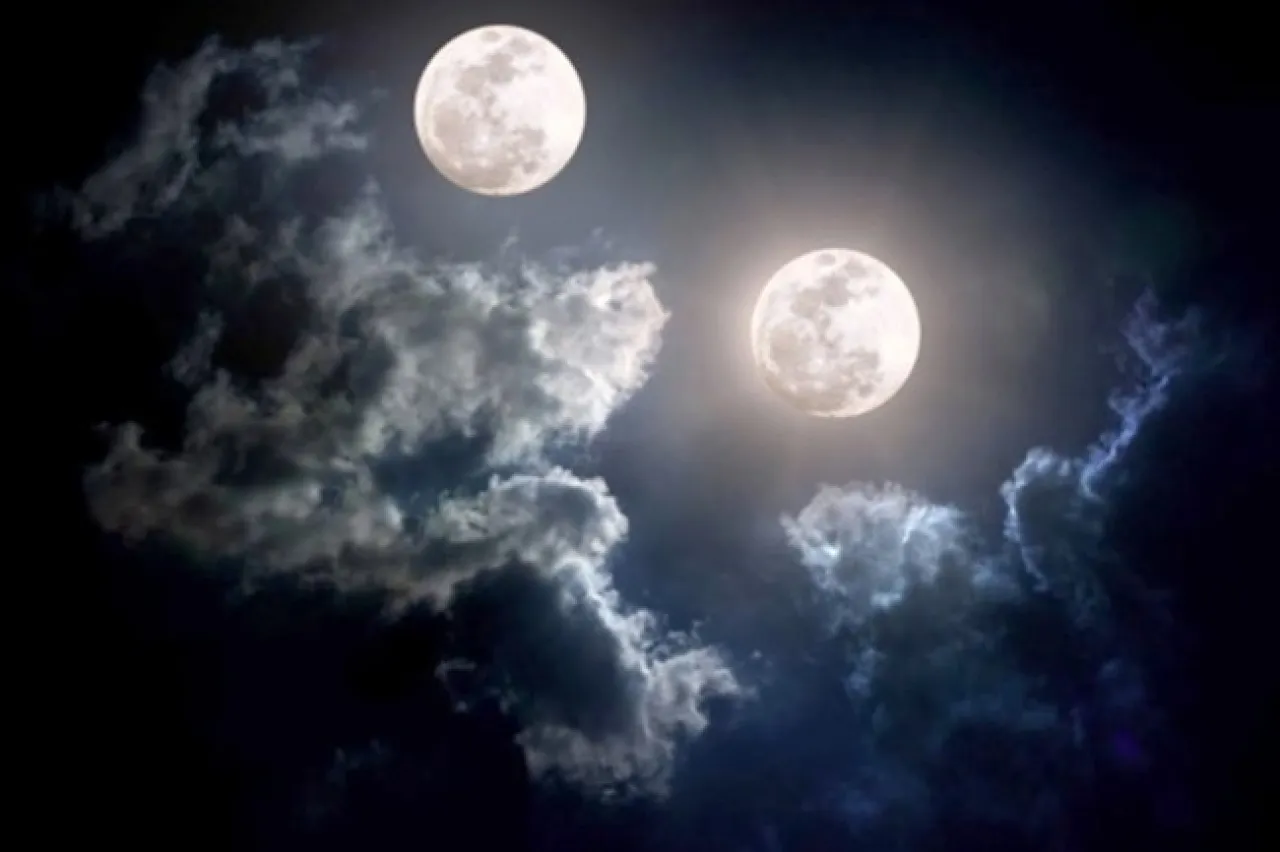
Khaberni - Since man first lifted his head towards the sky, the moon has been one of the most fascinating and admired celestial bodies. It appears on dark nights, shining with its silvery light, and changes its shape from crescent to full moon and then wanes again in an endless cycle. For many, the moon represents a symbol of beauty and tranquility, but it is also a source of several mysterious astronomical phenomena that have puzzled scientists and amateurs alike.
Sometimes, some people hear about a strange phenomenon known as "seeing two moons in the sky," meaning that the eye sees two moons instead of one! This raises questions: Are we facing a real astronomical phenomenon? Or is it just an optical illusion caused by light reflection or vision distortion? And is there a scientific explanation that confirms this mysterious scene?
In this article, we will delve deeper into this exciting phenomenon, and we will try to understand its real causes, distinguishing between science and superstition, and between reality and deceived vision.
What is meant by the "two moons in the sky" phenomenon?
People sometimes say "I saw two moons in the sky" when they observe a scene that appears to have two similarly sized and bright celestial bodies, either opposite or adjacent to each other on the night horizon. These observations may be true in terms of the visual impression, but they do not mean that there are two actual moons orbiting the Earth.
The scientific fact is that the Earth has only one moon, the known moon, and there is no other celestial body orbiting it in the same way or seen in the same size from the Earth's surface. However, sometimes visual or atmospheric conditions may lead people to think they are seeing two moons.
This phenomenon may appear in multiple scenarios:
When the atmosphere is filled with fog or dust, creating a light reflection.
Or due to light refraction that occurs when light passes through non-uniform layers of air.
Or even due to vision problems such as diplopia (Diplopia).
All these reasons make the "two moons" phenomenon just an optical illusion and not a real astronomical event.
How does the story begin? From observation to astonishment
Imagine you are walking on a quiet night, looking up at the sky, and you see two luminous moons side by side. The scene is astonishing, and it might prompt you to take photos immediately or share what you saw on social media. Indeed, over the past years, dozens of photos have spread on the internet, claimed by their owners to have seen two moons in the sky.
However, astronomers have repeatedly confirmed that all these images are either fabricated or the result of known optical phenomena. For example, when the moon is captured through double-layer glass, the light can reflect on the glass's inner surface, showing an additional, illusionary moon.
Also, some pictures taken by smartphones show "two moons" due to light reflection inside the camera lens, known as lens flare, where bright light (from the moon, for example) reflects inside the lens and produces a ghostly second image beside it.
Optical illusion and its role in the two moons phenomenon
Optical illusion is not just a trick used in drawings or advertisements, but rather a legitimate scientific phenomenon resulting from the brain's processing of visual information. Sometimes, when the lighting is weak or non-uniform, the brain cannot accurately analyze the image and "guesses" its shape based on available information.
In the case of the moon, any reflection or refraction of light can confuse the eye, especially when the moon is very bright in the dark sky, making the image appear as if there are two moons similar in shape and color, but one of them is a fake version created by optical illusion.
Some of the most prominent types of optical illusion related to this phenomenon include:
Atmospheric refraction: When moonlight passes through layers of air of different densities, it slightly deviates from its path, creating a secondary illusory image.
Reflection on thin clouds: Sometimes, the high clouds reflect moonlight, making it appear as if there's another "moon" dimly next to it.
Shadows and artificial lighting: High city lights or glass towers can reflect the moon or create a doubled glow for it.
Astronomical phenomena similar to this
While the two moons phenomenon is not a real astronomical event, there are astronomical phenomena close to it that make some people confuse reality and illusion, such as:
Lunar Halo:
A light circle surrounds the moon when high clouds made of ice crystals pass in front of its light. The rays break and reflect in a special way that exhibits the moon as if surrounded by a magical circle or another pale moon at its periphery.
Supermoon:
When the moon comes closer to the Earth in its orbit, it appears larger and brighter than usual. Some people see it exaggeratedly and think there are two moons of different sizes in the sky, especially when looking at pictures taken from different angles.
The Mars and Moon phenomenon:
In some years, fake news spreads on the internet that Mars will appear as big as the moon, as if there are two moons in the sky. However, this is scientifically incorrect as Mars, despite its relative proximity, cannot appear as big as the moon to the naked eye.
The moon and the sky: The relationship between light and darkness
The moon does not emit light itself, but reflects sunlight. This simple fact plays a big role in the optical phenomena associated with it. When the reflection angle of the light is ideal, any slight change in the atmosphere can create a visual illusion.
For instance, on nights when the atmosphere is loaded with dust or moisture, the reflected light from the moon breaks in various ways, creating shadows or double images of it. Also, the proximity of the moon to the horizon makes it appear larger or more distorted—an illusion known as "moon illusion"—where people see it larger when it is near the horizon, although it always has the same angular size.
The human eye: A precise but limited machine
Humans rely on both the eye and the brain to interpret what they see, but this process is not always accurate. The eye can easily be deceived when dealing with strong light sources in a dark background, like the moon.
In some cases, people suffer from diplopia, a medical condition that makes a person see two images of the same object at the same time. If this happens while looking at the moon, it will appear as if there are two real moons, although the cause is organic in the eye or nervous system and not an astronomical phenomenon.
In addition, improperly adjusted lenses or glasses can cause a slight double image of distant, luminous objects—like the moon.
Is there a scientific possibility of a second actual moon?
A question often asked: Is it possible for the Earth to have a second real moon?
The scientific answer: There is no permanent second moon for the Earth, but there are some small celestial bodies known as Temporary Moons, which are small asteroids that enter Earth's orbit for a short period and then leave it.
For example, in 2006, a celestial body called "2006 RH120" was discovered, which is a small space rock that orbited the Earth for a few months before continuing on its path. However, these bodies are very small and cannot be seen with the naked eye, and therefore do not explain the two moons phenomenon that some people see.
The internet and myths around the two moons phenomenon
With the spread of social media, strange news spreads quickly. Almost every year, posts say: "Get ready tonight to see two moons in the sky!"—claiming that Mars will appear as big as the moon! But the truth is that this information is completely false.
Mars may be brighter in some seasons, but it can never be seen like the moon. The apparent size of the moon in the sky is about half a degree, while the apparent size of Mars, even at its closest point to Earth, does not exceed 0.01 degrees. It is about 50 times smaller!
So, everything published about seeing two real moons is just a myth or fabricated photos, exploiting human curiosity towards strange astronomical phenomena.
The phenomenon is optical, not astronomical
In conclusion, it can be said that seeing two moons in the sky is an optical phenomenon, not an astronomical one.
The eye may be deceived by reflections or refractions or even lenses, but the real moon remains one, orbiting its fixed path around the Earth for more than 4 billion years.