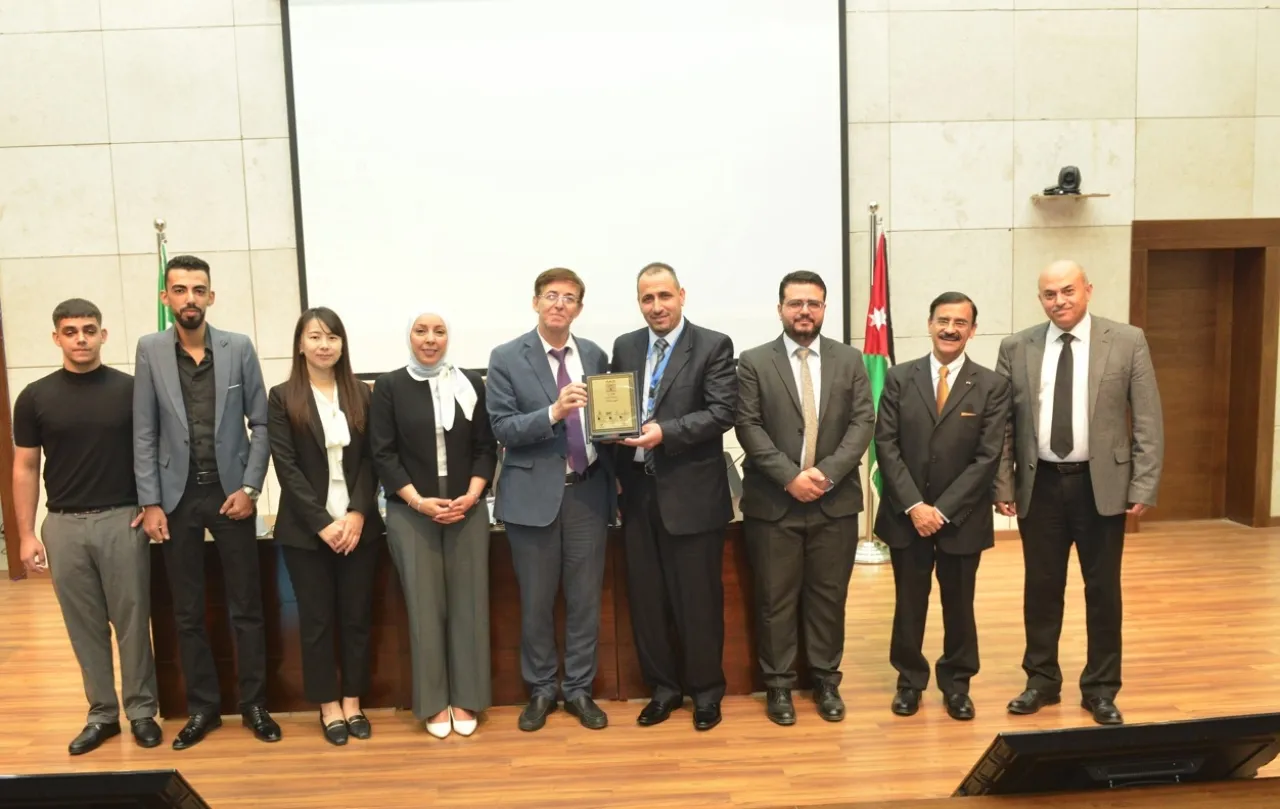
Khaberni - The Faculty of Arts and Sciences at Petra University, in collaboration with the Nature Poets Club and under the patronage of Professor Dr. Rami Abdel Rahim, President of the University, organized an introductory lecture titled "Japanese Nature Poetry – Haiku", presented by the President of the Nature Poets Association, Professor Essam Wazuz, in the presence of Ms. Yamada Mika, Cultural Attaché at the Japanese Embassy in Amman, Professor Dr. Mohammad Mutouq Abudiya, a member of the University's Board of Trustees, and the Dean of the Faculty of Arts and Sciences, Professor Dr. Mahmoud Salman, and the Dean of the Faculty of Pharmacy and Medical Sciences, Professor Dr. Riyadh Awad, and the Assistant President of the University for International Cooperation, Dr. Kenza Mansour, along with a group of faculty and administrative members and university students.
Professor Wazuz expressed his gratitude to Petra University for hosting this cultural activity, praising its role in supporting creativity and openness to global cultures. He presented a comprehensive overview of the origin and development of Haiku poetry in Japan since the eighth century AD, explaining that this literary art is based on reflection, simplicity, and deep expression of the fleeting moment in nature in a concise and succinct style.
Wazuz explained that the founder of this art form is the Japanese poet Matsuo Basho, who imparted a spirit of clarity and contemplation to the Haiku, making his poem a mirror of human unity with nature. He also discussed the requirements for writing Haiku and its aesthetic principles based on scenography, brevity, and immediacy, presenting examples from Basho's texts and a number of Jordanian Haiku poets.
Dr. Amani Suleiman, from the Department of Arabic Language and Literature, who moderated the lecture, indicated that this meeting aims to introduce students to this unconventional poetic form in Arab culture, and to highlight its artistic and intellectual value, affirming that Haiku represents a model of human cultural exchange between the East and the West. She also reviewed the experience of the Arab poet Izz ad-Din al-Manasirah in writing Arab Haiku, which he later named "Signatures", describing it as a form of condensed poetry that combines conciseness and depth.
In turn, Dr. Ahmed Al-Othmane, from the Faculty of Pharmacy and a graduate of Japanese universities, talked about his experience living in Japan and his deep understanding of the spirit of Haiku, explaining that this art is not limited to just three short poetic lines, but represents a life philosophy based on reflection on natural beauty and inner tranquility.
Al-Othmane emphasized that Haiku represents a way of seeing the world with clearer and more grateful eyes, mentioning that translating it into Arabic contributes to enhancing cultural dialogue between Japan and the Arab world.
At the conclusion of the meeting, there was an extensive discussion among the attendees about ways to adopt Haiku poetry in Arab culture, and the possibility of developing an Arab poetic form that draws on the characteristics of this global art while preserving the spirit of Arab poetry and its aesthetic identity.