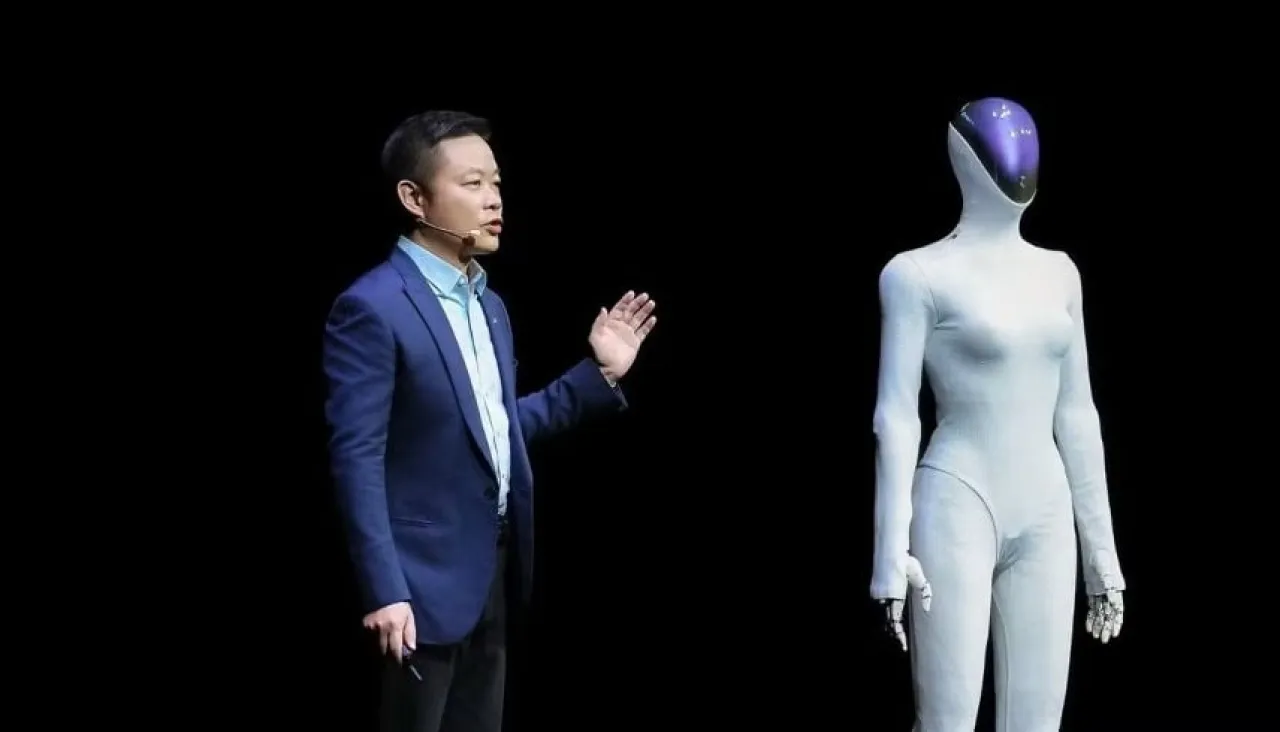
Khaberni - The Chinese company XPENG unveiled its new humanoid robot "IRON" during the Technology Day 2025 event, stunning the audience with the realism of its appearance and the agility of its movements, which were described as cat-like, before the company had to reveal its internal components in front of cameras to prove it was not a real human.
The robot sparked widespread controversy in and outside of China, prompting the company to post a video the following day, confirming that the model is fully robotic and not a person in a suit.
The video, broadcasted by the company on social media, showed the robot moving with remarkable flexibility, which made some viewers express their astonishment at its realism. However, some commentators remained skeptical, considering it could be remotely controlled.
In China, the clips posted on the CEO's account, Xiao Peng on the "Douyin" platform, generated a wave of comments from users who couldn't believe that the displayed entity was just a robot and not a real human.
Xiao Peng responded by posting an explanatory video in which he revealed the design details to the audience, saying: "Those who attended the presentation among more than 500 people from the media and friends realize that it's not human, but through the video alone, it’s hard to tell; when standing near it, you can hear the cooling system and the sound of the fans."
To completely remove any doubts, he invited the engineering team to the stage saying: "Look at this hand, its size is smaller than a human hand," then pointed to ear-like cavities on the sides of the head explaining that they are microphones functioning as sound sensors, and asked the staff to open the robot’s back zipper on camera to display its internal mechanical structure, confirming that the design is fully robotic with no human inside.
The IRON robot features a unique internal design, which includes a spine similar to the human one, bionic muscles, and customizable flexible skin, and has 82 degrees of freedom of movement that give it extraordinary ability to walk naturally and perform complex movements resembling a fashion model.
It is also equipped with hands containing 22 degrees of freedom, meaning they can perform 22 precise independent movements that mimic the human hand in gripping, holding, rotating, and moving fingers separately, providing it with unprecedented flexibility in handling objects.
The robot is also equipped with industry-first solid batteries, offering lightweight, high energy density, and safety.
The company confirmed that the robot will initially be used in service areas such as reception, assisting shoppers, and security patrols, noting that their goal is to reach the highest degree of human resemblance because "the environment humans live in is designed for humans, and the more human-like the robot acts, the easier it integrates into those environments."
XPENG explained that the new model represents a complete upgrade compared to the first generation, whether in bionic design, artificial intelligence, or energy structure.
The robot operates on three Turing AI chips with processing power reaching a trillion operations per second. It relies on an integrated model of VLT, VLA, and VLM systems to enable it to think, converse, and make autonomous decisions.
Industry experts see the new robot as a significant advancement in the field of "embodied intelligence". Analyst Ma Jiuhua stated that highly realistic humanoid robots will play a significant role in healthcare, education, and hospitality fields, stressing that realism in appearance and movement can only be achieved with strong artificial intelligence.
Meanwhile, analyst Liu Dingding considered that the XPENG robot surpasses the industrial average in fluidity and motion balance, with a deep integration between sensing, control, and algorithm modeling. He added that China's development in this field paves the way for integrating artificial intelligence into the physical world in various forms, from smart vehicles to artificial limbs and humanoid robots.