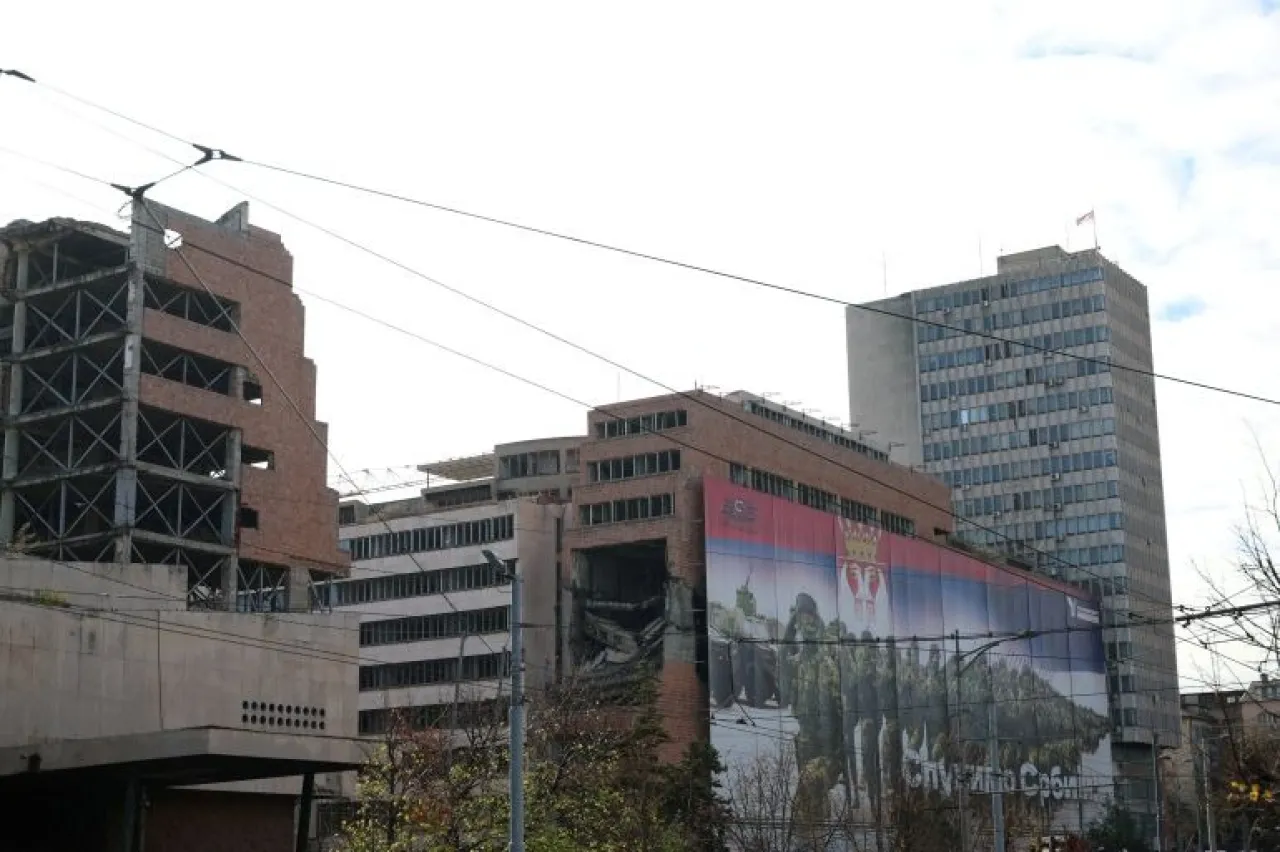
Khaberni - The Serbian Parliament ratified yesterday, Friday, a bill that paves the way for accelerating the demolition procedures of the former Yugoslav Army headquarters in central Belgrade, where a luxury hotel financed by an investment company linked to Jared Kushner, son-in-law of the US President Donald Trump, is expected to be constructed in its place, despite widespread public opposition and legal obstacles.
The construction date of this military complex, which was partially destroyed in the NATO bombing that ended the Kosovo war in 1999, dates back to the mid-20th century.
Opinion among the Serbian public is divided over the project linked to Kushner's "Affinity Partners" company based in Miami, which aims to develop the site into a towering hotel.
"Affinity Partners" signed an agreement with the Serbian government to invest in the site for 99 years, shortly after last year’s government decision to remove its protected status and declassify it as a "cultural asset" of the country.
The project was stalled in May due to allegations that a government official used forged documents to remove the heritage protection from the building, and investigations are still ongoing.
However, a special law ratified by the Serbian Parliament yesterday and published on its website accords urgency to the redevelopment of the site, mandating state institutions to issue the necessary permits and approvals without delay.
Widespread Opposition
After days of heated debate and street demonstrations by opponents of the development plan, the bill was approved by 130 votes against 40 objections in the parliament consisting of 250 members.
The special law, named in Latin "Lex Specialis", allows authorities to push forward with work on the site, including demolishing what remains of two sprawling buildings considered key examples of mid-20th century architecture in former Yugoslavia.
While the populist Serbian government, which supports Trump, says the project will boost the economy and relations with the current US administration, the plan has faced fierce opposition from experts due to the architectural significance of the building, and because it symbolizes resistance against the NATO bombing led by the United States, widely regarded in Serbia as "unjust aggression."
At a press conference held outside the building earlier this week, Milian Salata, an architect and member of the Serbian Association of Architects, said, "We stand before a unique architectural and urban masterpiece," affirming that the building is safe and can be restored and preserved for public use and turned into a memorial for the victims of the NATO bombing.
In contrast, Serbian President Aleksandar Vucic, who has hosted Kushner several times in Belgrade, expressed his personal support for the project.