Khaberni - Following the assassination of the Austrian crown prince Franz Ferdinand in Sarajevo and the failure of negotiations with the Serbs, the Austro-Hungarian Empire did not hesitate to declare war on Serbia on July 28 (July) 1914, thereby triggering a global conflict. Quickly, Moscow responded and declared war on Vienna due to Russian Tsar Nicholas II's reaffirming his support for the Slavic peoples. With Russia's declaration of war on Austria, a policy of alliances was activated in Europe, thus expanding the conflict to other areas.
With this war, the Austrian army did not last long and gradually became a burden on its German ally. After years of failed campaigns, the Austrians received blows towards the end of the war that ended their naval presence.
Austrian losses
Upon entering Serbian territory, Austria believed in the possibility of achieving a swift victory and then focusing on the Russians. To that, Austrian dreams quickly dissipated.
From the beginning, the Austrians suffered heavy losses, especially in the battles of Cer and Kolubara. Thanks to that, the Serbs managed to stop the attack and expel the Austrians from their territory by December (December) 1914. On the Russian front, the Austrians unexpectedly intervened in Ukrainian territories, which were part of Russia, believing in the ease of overcoming the Russians. In the following months, the Austrians suffered heavy losses and were forced to retreat great distances. Thanks to German intervention, Austria managed to impose some stability on the Russian front.
Throughout the war, Austria faced numerous difficulties on various fronts. Moreover, their situation became even more complicated after Italy entered the war alongside France, Britain, and Russia, where the Austrians found themselves before a new battlefront in the south.
By the end of the war, Austria was experiencing a rise in the number of deaths and the spread of famine and lack of food and medicine as daily food rations for the soldiers at the front, who were then likened to skeletons covered in skin, were reduced. On the other hand, the Austrian navy also experienced a poor state. After being confined to the Adriatic Sea throughout the war due to the Italian and British blockade in the Mediterranean, the Austrian navy lost its most important warships in simple ways that angered the Austrians and fueled their hostility to the regime.
Ship explosion
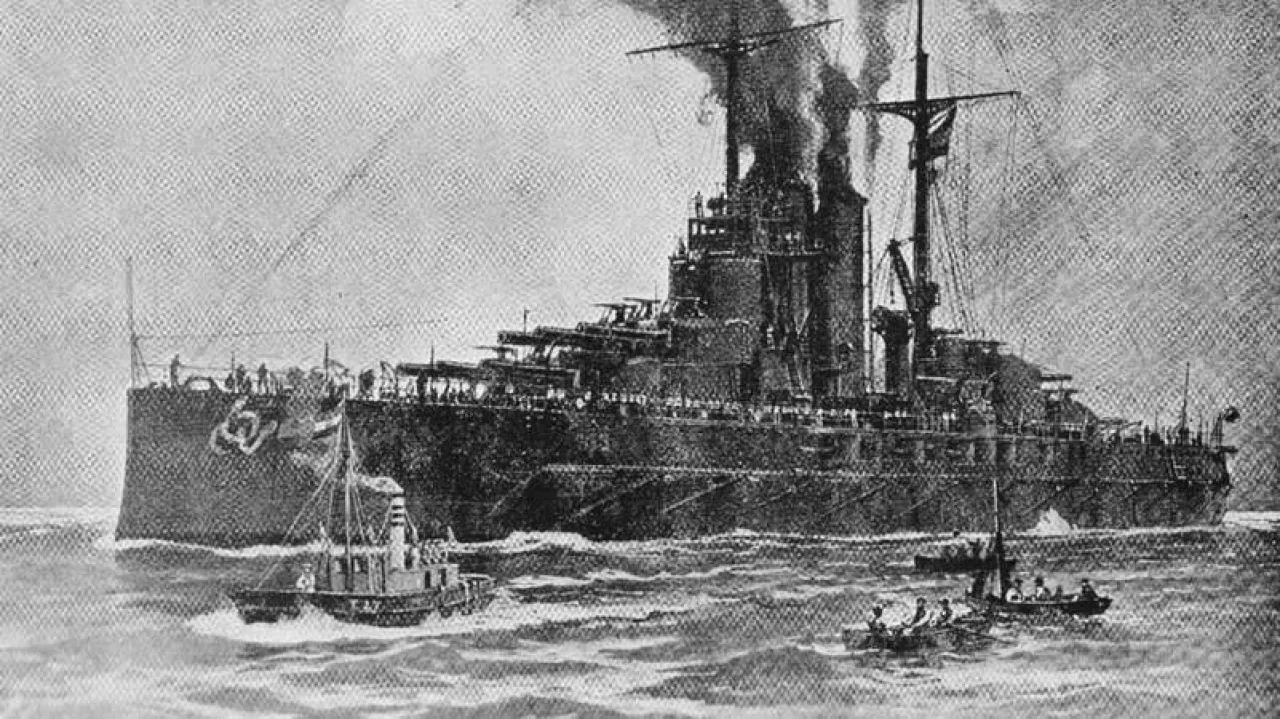
As it neared surrender, Austria feared the possibility of its naval fleet falling into the hands of the Allies. Instead, Austria preferred to surrender a number of its ships for free to the newly emerged state of the Slovenians, Croats, and Serbs, which appeared over a number of former Austrian territories. Among these warships was the battleship Viribus Unitis, which was a giant ship weighing 20,000 tons and equipped with four 305 mm guns and 12 150 mm guns and 12 70 mm guns.
In addition, this battleship met an unexpected end, although it had not participated in any significant battles throughout World War I, hours after it was handed over to the state of the Slovenians, Croats, and Serbs. During the night between October 31 (October) and November 1 (November) 1918, two Italian soldiers sneaked into the port of Pula and placed an explosive charge on the side of the ship and another below the dock deck. According to the plan, these two charges would automatically explode around six-thirty in the morning.
To this end, the Italians were unable to escape and were arrested by the forces of the state of the Slovenians, Croats, and Serbs. Following their interrogation, the two men admitted to the explosives and the timing of the detonation.
By the scheduled time, these two bombs did not explode. For this reason, the military official Janko Vuković doubted the veracity of the statements of the Italian detainees. Later, this military official accompanied about 400 soldiers aboard the ship to ensure that there was no bomb on it.
By six forty-four, the bombs exploded late causing the destruction of the battleship Viribus Unitis and its sinking and damaging another military carrier. Meanwhile, this incident resulted in the death of more than 300 soldiers, including Janko Vuković.
At the end of the war, the two Italian soldiers returned to their country. In Italy, these two men received official honors in addition to the country's highest military medal.