Khaberni - Egyptian President Abdel Fattah el-Sisi witnesses this Saturday evening the opening of the Great Egyptian Museum, with the participation of 79 official delegations, among them 39 delegations headed by kings, princes, and heads of state and governments, according to a press release.
The opening of the Great Egyptian Museum represents "an exceptional event in the history of culture and human civilization that reflects the international community's interest in the ancient Egyptian civilization and the unique cultural and humanitarian role that Egypt plays," according to a statement from the Egyptian presidency on Friday evening.
After extensive preparations and several postponements, the Great Egyptian Museum in Cairo is officially opened this Saturday evening, an occasion that promises to be a major milestone that crowns the efforts of the authorities to develop the tourism sector.
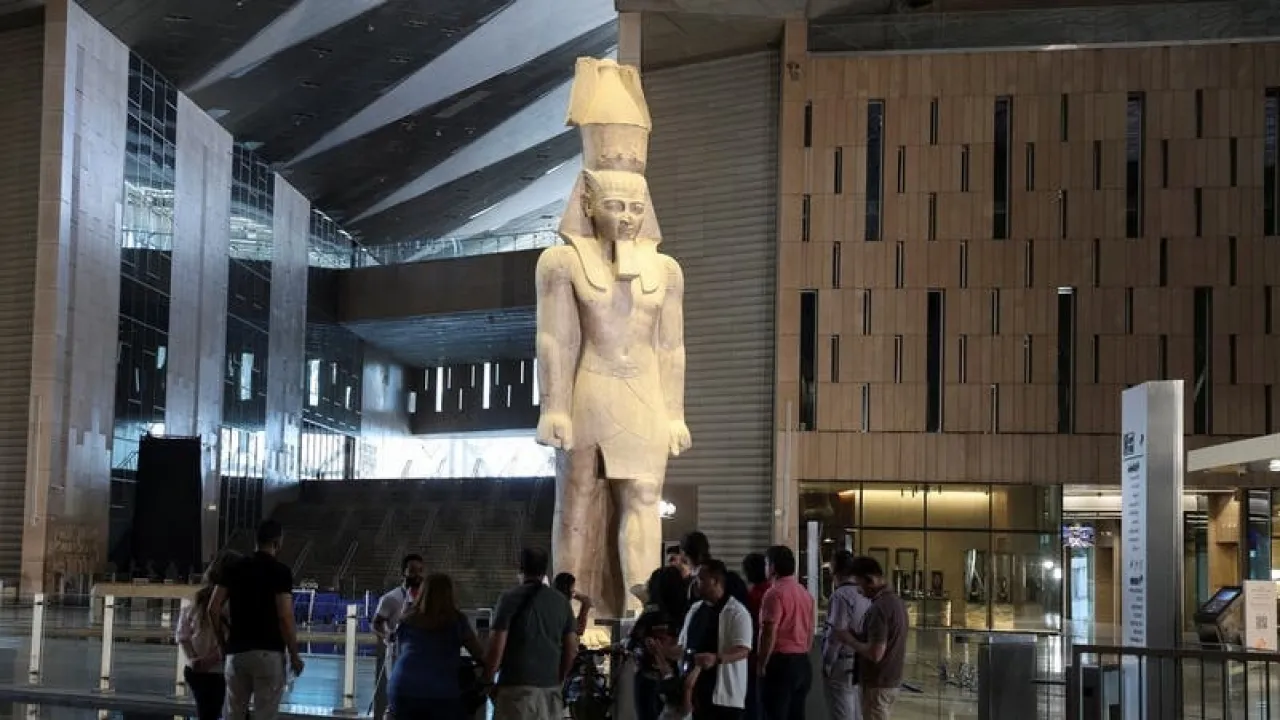
The massive museum is dedicated to the Pharaonic civilization, with its history spanning more than 30 dynasties and 5,000 years, and it offers a panoramic view of the Giza Pyramids.
Building the museum, which features a contemporary design and massive high-ceilinged halls, took over 20 years, and its construction cost exceeded one billion dollars. It is expected to attract 5 million visitors annually to wander through halls housing archaeologically significant artifacts, including some displayed for the first time.
The official spokesperson for the Egyptian presidency, Ambassador Mohamed El-Shenawi, clarified that the participating delegations include kings, queens, crown princes, princes, and members of the ruling families from Belgium, Spain, Denmark, Jordan, Bahrain, Oman, UAE, Saudi Arabia, Luxembourg, Monaco, Japan, Thailand.
Presidents of Djibouti, Somalia, Palestine, Portugal, Armenia, Germany, Croatia, Cyprus, Albania, Bulgaria, Colombia, Equatorial Guinea, the Democratic Republic of the Congo, Ghana, Eritrea, and the Knights of Malta, as well as the head of the Libyan Presidential Council, and the head of the Yemeni Leadership Council, will also participate.
The event will also see the participation of prime ministers from Greece, Hungary, Belgium, the Netherlands, Kuwait, Lebanon, Luxembourg, and Uganda.
He added that the ceremony would also include high-level ministerial and parliamentary attendance from Uzbekistan, Azerbaijan, Algeria, Qatar, Morocco, Tunisia.
He noted that similar delegations would come from Switzerland, Sweden, Finland, Slovakia, Austria, the United Kingdom, France, the Vatican, Malta, Romania, Russia, Ireland, Serbia, Turkey, Italy, Singapore, India, Kyrgyzstan, China, Sri Lanka, and Pakistan.
Ministers and parliamentarians from Zambia, Angola, Cote d'Ivoire, Cameroon, South Africa, Gabon, Chad, Kenya, Rwanda, Togo, as well as Brazil, Canada, and the United States will also participate.
The official spokesperson mentioned that the event will also be attended by representatives of regional and international organizations, including the Secretary-General of the Arab League, and the Secretary-General of the Organization of Islamic Cooperation. The chairperson of the African Union Commission and the High Representative for the Alliance of Civilizations will attend on behalf of the UN Secretary-General, along with the head of the Arab Parliament and JICA president, and several heads and representatives of major global companies.
The official spokesperson mentioned that this representation and attendance, "unprecedented for the opening of the world's largest museum dedicated to a single civilization, reflects the international interest in the Egyptian state's vision of combining the ancient past with modern creativity and future prosperity." It also "emphasizes Egypt's unique position as a cultural bridge between all peace-loving cultures and peoples of the world."
Egyptian authorities and the media have recently celebrated the museum, which represents "Egypt's gift to the world," marking its opening as "a historic event" and "a new chapter in the history of Egyptian civilization," and "a dream befitting Egypt, with its civilization extending through thousands of years."
Details of the preparations remained confidential, and the authorities have not disclosed the opening program or even the main attraction of the museum: the treasures of Tutankhamun, discovered in 1922 in a tomb in the Valley of the Kings in Upper Egypt.
Upon opening its doors to the public, starting Tuesday, visitors to the museum will be able to explore 4,500 funeral artifacts out of a total of 5,000 that have until now been distributed across various locations, including the Egyptian Museum in Cairo's Tahrir Square.
Last week, President Sisi chaired a meeting with several senior officials to follow up on the preparations for the museum's opening.
Sisi emphasized, according to a statement from the presidency, the necessity of organizing an opening ceremony "worthy of Egypt's status, reflecting its leadership in the field of museums and global culture, and contributing to promoting tourism in the country."
He stressed the need for the ceremony's image to not only reflect the grandeur of this global edifice but also "the magnitude of achievement and progress the Egyptian state is witnessing in various fields, appropriate to its civilizational position in the world."
The Prime Minister, Mostafa Madbouly, visited the museum on Tuesday night to follow up on "the final touches" in preparation for the "majestic" opening ceremony, according to the Prime Minister's office, which relayed his necessity for its execution "to be in line with Egypt's status and civilizational heritage."
Madbouly noted that "the world is waiting for what Egypt will present next Saturday," in his words.
The opening of the Great Egyptian Museum was postponed several times for various reasons, some related to the "Arab Spring" protests or the COVID-19 pandemic. After setting July 3, 2025, as the opening date, authorities decided to postpone it again due to regional tensions at the time, particularly the war in Gaza and the post-war period after the Iran-Israel conflict.
Madbouly stated at the time: "In light of what is happening in the region at this time.. we found it appropriate to postpone this major event to maintain its global momentum and ensure it occurs under suitable circumstances."
The tourism sector, vital to Egypt's economy, has begun to recover in recent years.
Tourism revenues reached $14.4 billion in the fiscal year 2023-2024, up 34.6 percent from the previous year, with a record number of tourists since the pandemic.
Egypt welcomed 15 million visitors during the first nine months of the year, a 21% increase compared to the same period last year, with revenues reaching $12.5 billion (up 14.7%), according to official figures.
The authorities expect the number of tourists this year to reach 17.8 million people, and to rise to 18.6 million in 2026, thanks to beach tourism and cultural tourism.