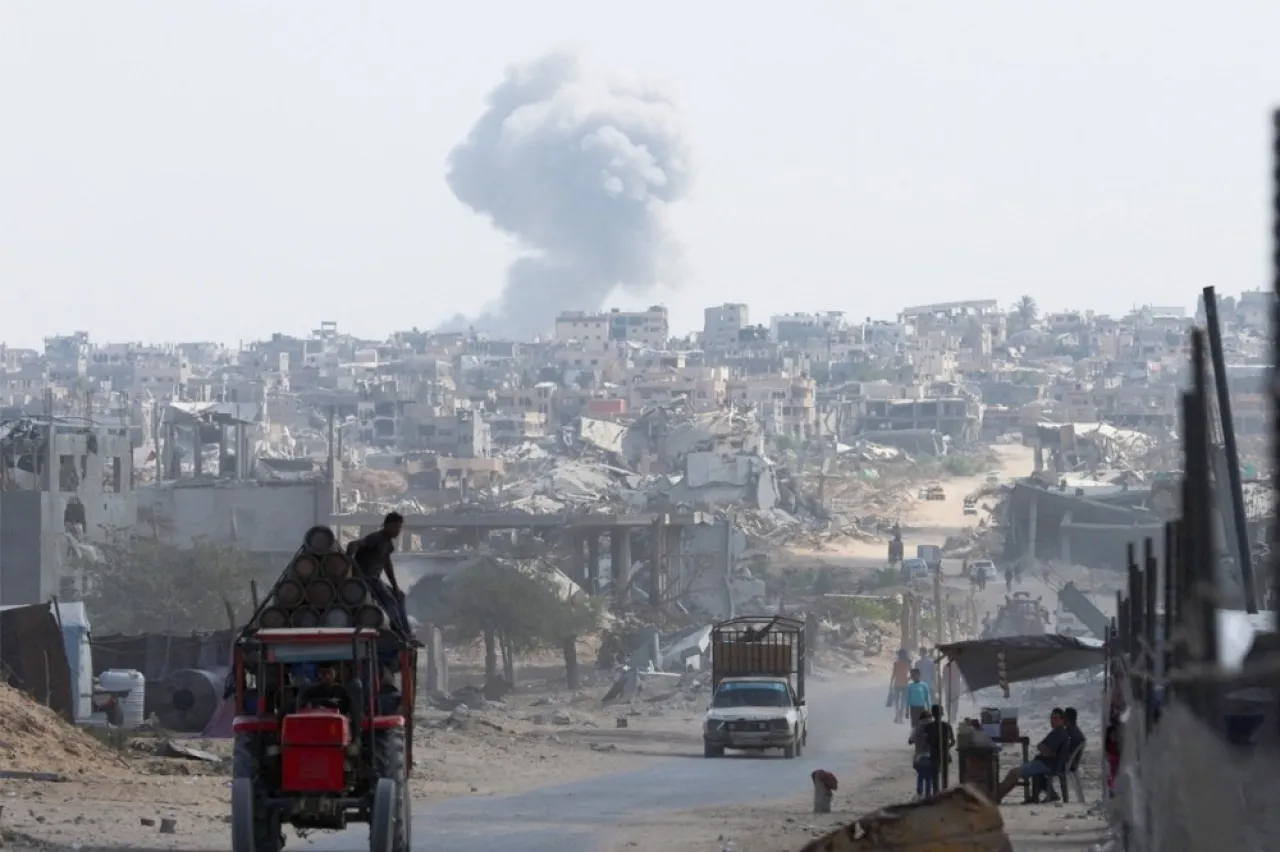
Khaberni - During their visit to Israel last week, U.S. Vice President J.D. Vance and Donald Trump's son-in-law Jared Kushner reiterated that if the Islamic Resistance Movement (Hamas) continues to refuse to disarm, the United States and Israel will work on a plan to only start rebuilding eastern Gaza.
The Yellow Line currently divides Gaza into two parts: the west, controlled by Hamas and densely populated with over two million people, and the eastern areas still under Israeli military control, populated by only thousands of residents.
Vance considered this idea could provide a safer alternative place for the Palestinians living in Gaza to live until Hamas surrenders, while an American official told The Wall Street Journal "this is a preliminary idea and updates will be provided in the coming days."
Promotion of the idea
Therefore, it was not surprising that Israeli Prime Minister Benjamin Netanyahu - wanted by the International Criminal Court for committing war crimes in Gaza - tweeted this Thursday on the X platform, after meeting senior American military officials at the Military Civil Coordination Center in Israel, including the commander of the Central Command Admiral Brad Cooper, and General Patrick Frank responsible for the center.
In his tweet, Netanyahu said "we are working together on a plan that ensures Gaza does not pose any threat to Israel, and the control will remain in our hands, a principle that will not change," confirming "the alliance between Israel and the United States forms a strategic asset of the highest order."
Al Jazeera Net observed the beginning of efforts to promote the idea of dividing the Gaza Strip into two parts, and the site "Jewish Insider," concerned with American Jewish affairs, close to the Israeli government’s editorial policies, promoted this plan by a report based on the vision of a number of experts strongly supporting the idea of division.
Post the Yellow Line
Meanwhile, David May, director at the Foundation for Defense of Democracies, known for its proximity to the Israeli side, stated that Israel has developed technology to identify Hamas fighters, allowing non-combatants access to the area under Israeli control east of Gaza.
May told Jewish Insider, "The tunnel system dug by Hamas sprawling all over Gaza, undoubtedly crossing the Yellow Line and serving as a ceasefire line, limits Israel's ability to provide a safe area in eastern Gaza."
He added "If there are running water, sewage, electricity, internet, fixed roads, and infrastructure, if there is something resembling jobs and economic opportunities, with screening procedures for accepting incoming civilians to that area, there could be a way to slowly drain the population from west Gaza."
May touched on the scenario of the Yellow Line becoming a permanent boundary, saying "Since cease-fire lines in the Middle East tend to become permanent borders, Israel needs to plan for the possibility that the Yellow Line becomes a long-term regional border."
Meanwhile, John Hanna, an expert at the American Jewish Institute for National Security at a Washington think tank, said "east Gaza under Israeli military control will become a Hamas-free area, gathering the world to support the emergence of new political, social, and economic institutions, where the lives of regular Gaza residents can thrive."
He added "In contrast, west Gaza controlled by Hamas will be condemned to suppression, stagnation, and ongoing misery. Over time, the east will become a major attraction point for the vast majority of Gaza's residents," which will lead to isolating and undermining Hamas’s rule and legitimacy, according to him.
The Jewish Insider report noted that despite many challenges, finding ways to move Palestinians to east Gaza could isolate Hamas in the west, a strategy that Israel could use to undermine Hamas's authority from one side and on the other, bring international support for reconstruction, and at the same time, the half of the sector could remain a buffer zone that could also serve Israel's security interests if fighting resumes.
International Forces
At the same time, Republican Senator Lindsey Graham, a staunch supporter of Israeli positions, and close to President Trump, tweeted on X platform expressing skepticism about the effectiveness of international forces in the Gaza Strip.
Graham said "The second phase envisions Trump's plan for an international force consisting of troops from intermediary countries, to stabilize the Gaza Strip.
Trump's peace plan calls for the formation of a committee of technocrats to manage Gaza and an international force for security, though details have yet to be determined, as Arab countries demand the Palestinian Authority be allowed to administer the sector."
Meanwhile, researcher Ahmed Al-Sharawi at the Foundation for Defense of Democracies, known for adopting Israeli views, warned against allowing Hamas to appoint half of the members of the technocratic body.
In his participation on the foundation’s website, Al-Sharawi demanded "the United States and Arab partners such as Jordan, Egypt, Saudi Arabia, and the UAE must play a fundamental role in developing a final list—in consultation with Israel—to ensure post-war Gaza is free from Hamas's influence."
He added "The White House must make clear to these partners that it expects them to avoid steps that would open the door to Hamas."
In reality
After a press team from The Wall Street Journal visited "the new Yellow Line" in Gaza accompanied by the Israeli military, doubts increased about the permanence of this dividing line between east and west Gaza.
The report in the newspaper noted the Israeli military digging along the ceasefire line within Gaza, reinforcing fortifications, and establishing infrastructure that further divides the area into two parts, and journalist from The Wall Street Journal observed along the line Israeli forces establishing new sites surrounded by barbed wire and sand barriers.
The line of division was implemented as part of the first phase of Trump's peace plan, according to which Israel is supposed to withdraw from all the lands of the Gaza Strip once an international security force is present on the ground and after the disarmament of Hamas.
Despite Hamas's agreement to Trump's plan, they conditioned the disarmament on handing it over to a Palestinian authority within a national Palestinian consensus.
The Wall Street Journal highlighted Israeli military officials preparing for the possibility that the Yellow Line remains their defensive stance in the foreseeable future.