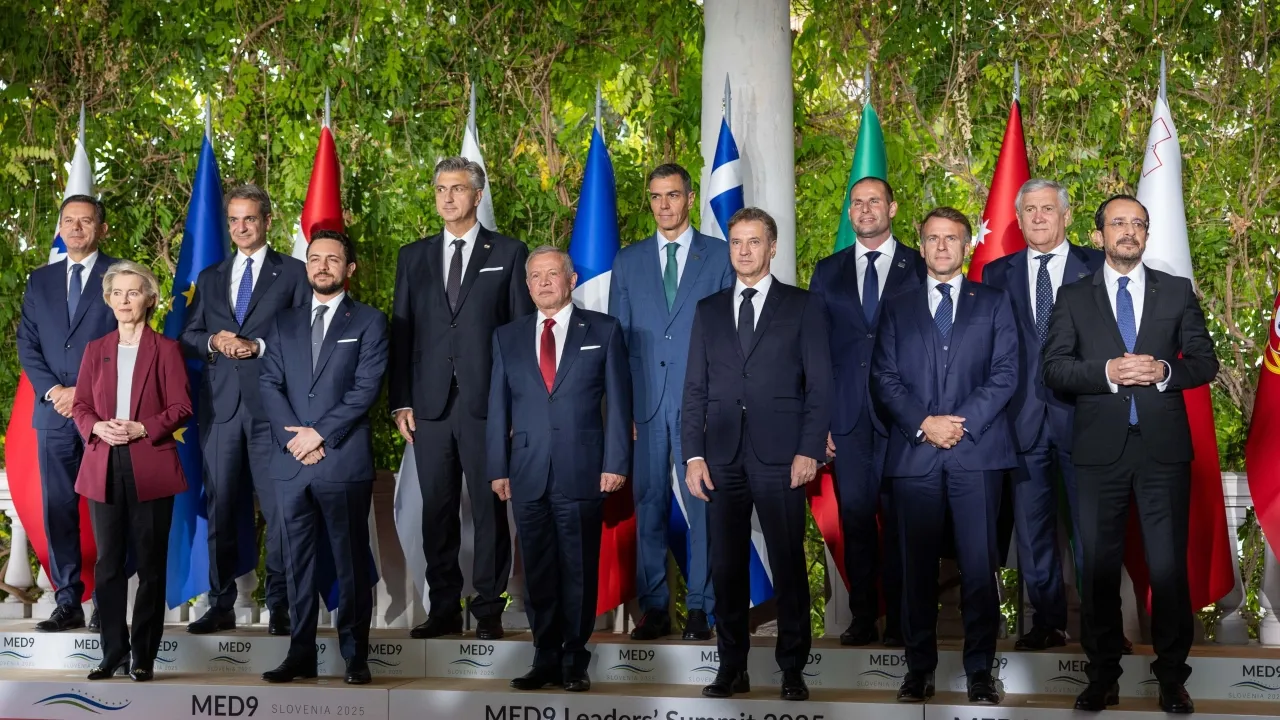
Khaberni - Today, Monday, Jordan and the "Med 9" group issued a joint statement on the Middle East, following the summit of the southern European countries "Med 9", hosted by the Slovenian city of Portorož. Here is the text:
"A joint statement on the Middle East issued by His Majesty King Abdullah II and the leaders of the "Med 9" group
(Portorož, October 20, 2025)
At the invitation of the Prime Minister of Slovenia, Robert Golob, His Majesty King Abdullah II bin Al Hussein, King of the Hashemite Kingdom of Jordan, participated in a meeting with the heads of state and government of the southern European Union countries "Med 9", which include Croatia, Cyprus, France, Greece, Malta, Portugal, Slovenia, Spain, and the Deputy Prime Minister of Italy. The meeting addressed the situation in the Middle East, particularly the latest developments in Gaza.
The "Med 9" leaders expressed their appreciation for Jordan as a reliable and credible partner that plays a key role in establishing peace, stability, and security in the Middle East and the Mediterranean region.
The countries of "Med 9" and Jordan have a common commitment to promoting peace, security, and stability in the Middle East and the Mediterranean region in general, and each recognizes the other's continuous efforts to achieve these goals.
The "Med 9" leaders expressed their appreciation for the leadership of US President Donald Trump and his proposal to end the war and rebuild Gaza and prevent the displacement of the Palestinian people, as well as his announcement of the rejection of plans to annex the West Bank.
The leaders welcomed the convening of the Sharm el-Sheikh Peace Summit, the signing of the ceasefire agreement, the release of hostages, and the humanitarian response in Gaza, and praised the diplomatic efforts and negotiations that led to the agreement, led by the United States with support from several countries including Egypt, Jordan, Saudi Arabia, Qatar, Turkey, and the United Arab Emirates. They emphasized the importance of implementing the first phase of the ceasefire agreement, including the release of hostages and detainees, calling on all parties to fully commit to implementing all stages of the agreement to end the war in Gaza and refrain from any action that could jeopardize this agreement.
Regarding the management of the sector, the leaders emphasized the need for Palestinians to play a fundamental role in it, expressing their support for the rapid takeover of the Palestinian Administrative Committee as approved by the Arab League in Cairo, and called for the participation of the European Union in the Peace Council in light of the ongoing support of the European Union for efforts to achieve comprehensive peace.
The leaders expressed grave concern about the catastrophic humanitarian situation in Gaza and stressed the need to ensure the delivery of sufficient and sustainable humanitarian aid to the sector without restrictions, emphasizing the need to fully respect international humanitarian law at all times.
They underscored the indispensable role of the United Nations Relief and Works Agency for Palestine Refugees in the Near East (UNRWA), reaffirming their commitment to continuing to support the agency in providing services to 5.9 million Palestinian refugees in accordance with its mandate from the UN General Assembly resolution 302 (1949), and welcomed its commitment and ongoing efforts to implement the recommendations of the Kolona report.
In this context, the "Med 9" countries acknowledged the importance of Jordan as a regional hub for humanitarian aid to Gaza and efforts to rebuild the sector, and they reaffirmed the priority of land corridors, noting that all land, air, and sea routes, including the Cypriot maritime corridor, are of great significance in helping to meet the massive humanitarian needs of civilians in Gaza.
The "Med 9" countries reiterated their strong condemnation of the continued deterioration of the situation in the West Bank, including East Jerusalem, following the escalation of the Israeli military operation, settler violence, and expansion of settlements, which are considered illegal under international law. They affirmed the necessity for Israel to stop the E1 settlement plan and the immediate release of Palestinian tax revenues.
The "Med 9" countries reaffirmed their firm commitment to achieving lasting and sustainable peace based on the internationally agreed standards, in accordance with international law and relevant United Nations Security Council resolutions, the New York Declaration on the Peaceful Settlement of the Palestinian Issue and the implementation of the two-state solution, emphasizing their readiness to contribute to all efforts aimed at achieving this solution, and urging all parties to refrain from any action that could undermine the viability of the two-state solution.
The leaders expressed their support for the stability of Lebanon and the essential role played by the United Nations Interim Force in Lebanon (UNIFIL), reaffirming the need to respect Lebanon's sovereignty and territorial integrity, and calling on all parties to fully implement Resolution 1701 and the ceasefire agreement concluded in November 2024.
The leaders reaffirmed their support for the Syrian people and government in their efforts to rebuild Syria on a basis that guarantees its security, stability, unity, sovereignty, and territorial integrity, while working towards an inclusive political process that meets the aspirations of all Syrians and preserves their rights.
They also emphasized the importance of intensifying international efforts, coordinated among various parties, to create favorable conditions for the safe, voluntary, and sustainable return of Syrian refugees. Mentioning the substantial financial support provided by the European Union, the "Med 9" leaders emphasized the urgent need to increase international support for United Nations agencies and host countries, especially Jordan, which continues to bear a burden beyond its capabilities, in order to maintain essential services and strengthen the resilience of refugees and host communities.
The countries of "Med 9" supported the roadmap announced by Jordan, Syria, and the United States to end the crisis in Sweida and stabilize southern Syria, calling for the full implementation of this roadmap, and expressed their appreciation for Jordan's role in ending the crisis in Sweida Province."