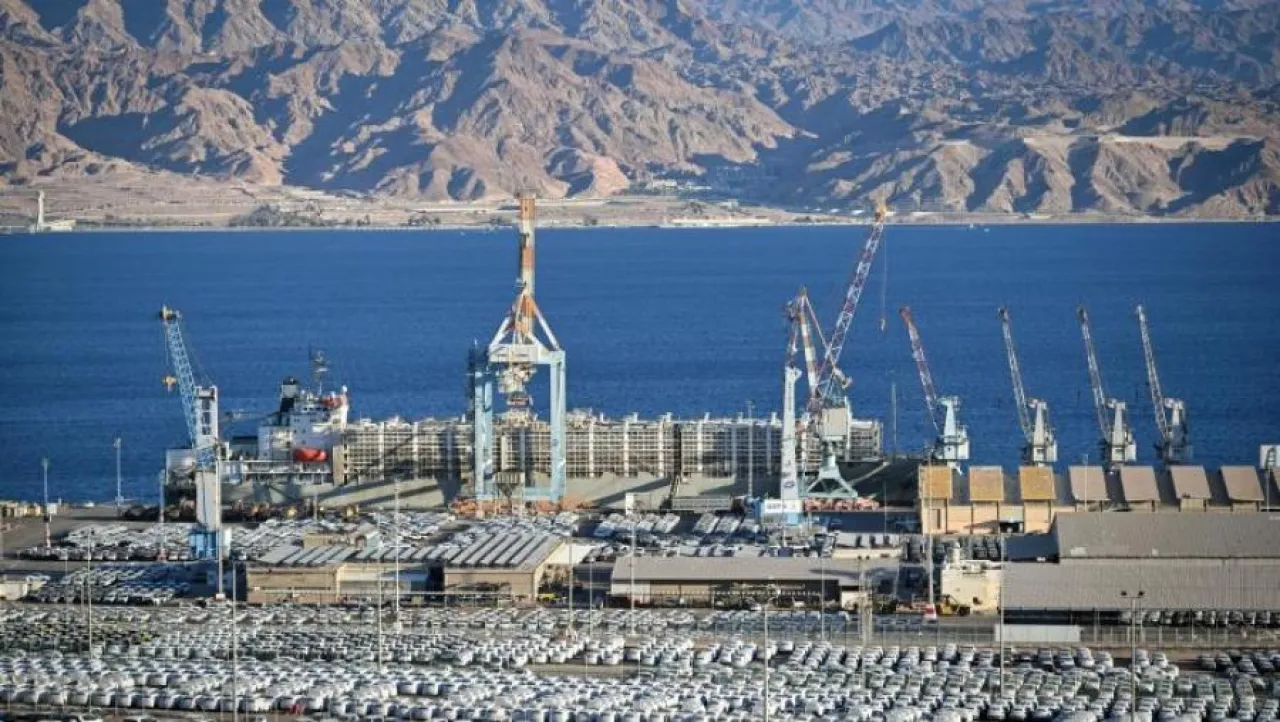
Khaberni - Israeli media disclosed that Eilat Port requested help from Egypt to pressure the Houthis to stop launching missiles at the port and the city.
According to the Israeli newspapers "Yedioth Ahronoth" and the economic newspaper "Calcalist," Eilat Port, despite the ceasefire, continues to suffer damage due to the Houthis targeting the Suez Canal and intimidating ships coming to and from the port.
Hebrew newspapers revealed that officials from the Israeli port have been in contact with the US Embassy in Israel in recent days and have also requested communication with the Egyptian government to press the Houthis.
"Yedioth Ahronoth" clarified that despite the announcement of the end of the war and ceasefire, Eilat Port has not returned to normal yet, as the Houthi threat persists. They added that although the Houthis declared they would not continue firing at Israel as long as the agreement between Hamas and Israel continues, they did not commit to stop attacking ships passing towards the Suez Canal.
The Hebrew newspaper indicated that the Houthis have previously threatened that any shipping company passing through ships without their permission would make their ships a target anywhere in the world, even far from the Middle East. Following this threat that affected the canal, Eilat Port, managed by "Pfau" shipping company, has been almost completely closed since November 2023, and its revenue has dropped by 80%.
The Hebrew newspapers explained that in the absence of a statement from the Houthis to stop their attacks on ships, international shipping companies refuse to pass through the Suez Canal and arrive at Eilat Port or Arab countries.
In the same context, the site of newspaper "Calcalist" learned that officials at Eilat Port contacted the American Embassy, requesting to include the Suez Canal issue in the agreement signed under the sponsorship of President Donald Trump, and also communicated with the Maritime Navigation Authority to request the mobilization of international entities to help remove the Houthi threat to this important maritime passageway.
The Hebrew newspaper report added that Eilat Port management is not just settling with this, but also seeks to communicate with Egypt, the owner of the Suez Canal, hoping that the Egyptians would cooperate with Arab countries and the United States to pressure the Houthis and convince them to lift the blockade on maritime navigation.
"Calcalist" stated that the Israeli port realizes that the Houthis' control over the canal negatively affects not only Israel but also Egypt, which imposes tolls on passage through the canal, and hopes to find a partner there to address this issue.
They mentioned that since the beginning of 2024, European ships have not approached the Suez Canal. Only Russian and Iranian ships are allowed to pass through it, provided they do not carry goods to Israel, while Chinese ships manage to cross the canal occasionally by finding solutions like changing flags or paying and taking risks.
The Suez Canal had generated revenues for Egypt of about 8 billion dollars in 2022, and in 2023, the revenues jumped to 10.25 billion dollars. However, in 2024, the income dropped to only 3.99 billion dollars. Last summer, Arab sources reported that Egypt lost about 60% of its income from the Suez Canal in 2024 and 2025.
According to Hebrew reports, this is a severe loss, as before the war, nearly a third of Egypt's budget depended on the income from the Suez Canal, which was an important and stable source of income for Egypt for years.
The International Monetary Fund had warned that the decrease in canal income poses a significant challenge to Egypt's income and that it must achieve a balanced budget and find a way to reduce its dependence on foreign income.
This recommendation led the Egyptian government to implement reforms that included, among other things, improving the country's tax collection system and reducing subsidies for fuel, electricity, and food. In addition, Egypt received billions of dollars in support from Gulf countries, partly to counter the loss of Suez Canal income.
"Calcalist" stated that as a result, by the end of 2024, Egypt was able to achieve a budget surplus of about 13 billion dollars, but this only occurred after deciding to achieve a surplus in the budget before paying off the interests on its numerous debts, as a tool for economic stability in times of emergencies. These steps improved its situation and created a positive image, although they are not classified as a spectacular success.
According to the Hebrew report, Egypt still faces inflation and high debts, and, of course, the Houthis' threat to one of its main sources of income.
They added that Eilat Port hopes that the Egyptian pressure on Arab countries, which will lead to pressure on the Houthis, would extract a declaration from them to stop targeting the maritime passageway and allow ships to reach Eilat.
"Calcalist" noted that since the beginning of the crisis in Eilat Port, Israel has transferred 15 million shekels to the port, part of this amount is allocated to pay off state debts and property taxes to Eilat municipality.
The Histadrut – the General Federation of Laborers in Israel – has provided loans from its aid fund. However, the port seeks to return to its full activity and prove its profitability, not just to survive.