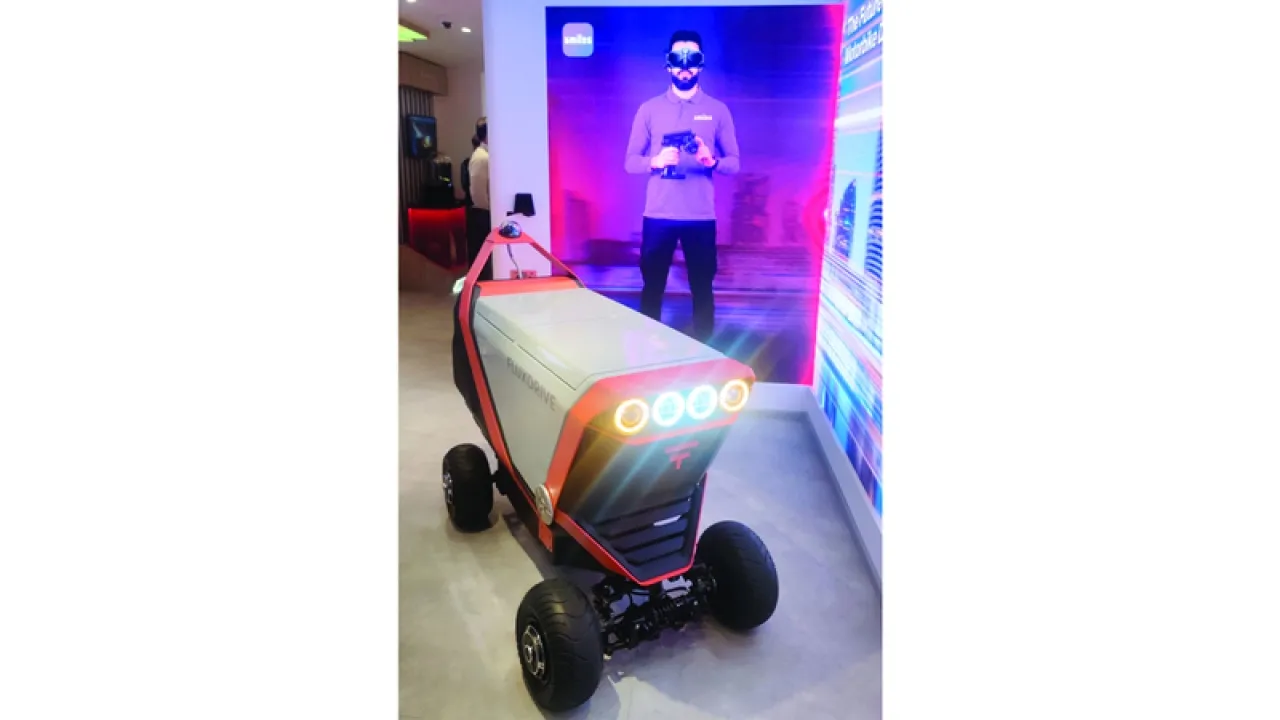
Khaberni - The events at the "GITEX Global" exhibition witnessed the introduction of a semi-autonomous smart vehicle, manufactured in Dubai, which will start being used beginning next year in residential complexes in Dubai to deliver food and grocery orders.
Emirates Today observed, on the sidelines of the "GITEX" exhibition, which recently concluded at the Dubai World Trade Centre, the introduction of technological company models for smart mobility vehicles.
Experts and officials in technology companies informed "Emirates Today" that the vehicles for the future of smart mobility are becoming closer to application with the availability of models for those vehicles expected to be introduced soon into the UAE market.
In detail, the General Manager at "Tele Flux," Eva Zariva, informed "Emirates Today" that "the vehicle is called a 'drone,' and it is the first street- and roadway-specific drone, not in the traditional concept of a drone that flies in the sky. It was manufactured at the company's headquarters in Dubai and is equipped with advanced smart specifications and technologies."
She stated, "The vehicle is semi-autonomous, with driving operations provided to the officials in control rooms, so that the orders, whether food meals or groceries, can be delivered to homes. It features two areas for storing hot and cold meals."
Meanwhile, the Head of Engineering Growth at "Tele Flux," Tariq Hakanin, said that "the smart vehicle, which operates as a 'drone' on the streets with remote control, has been equipped with smart cameras and sensors and will operate using advanced fifth-generation network technologies."
He explained that "the vehicles will start being used at the beginning of next year in residential complexes in Dubai, and they are also planned to be used in residential complexes in Abu Dhabi. This will follow after concluding a joint agreement with 'Smiles', and there is an ongoing exploration to expand with other companies for delivering food and grocery orders in the country to establish partnership agreements with them. These vehicles serve as a phased alternative to traditional motorcycles commonly used for order delivery, but with the difference that the driver, or what is called the pilot, will remotely control using a joystick and goggles for vehicle tracking." He added that "these vehicles are environmentally friendly by using electricity in charging operations, and are characterized by safety and security specifications, with the necessary technologies to support the vehicle, reaching a speed of 90 kilometers per hour, and a designated range of up to 200 kilometers," noting that "the vehicle is expected to be gradually introduced to the UAE markets in the upcoming period, designed to be an alternative to motorcycles in delivering orders."
Technology expert and founder and CEO of "The End Automation", Nitin Ahuja, said that "artificial intelligence has offered immense capabilities in the transition to smart vehicle patterns, as the use of advanced artificial intelligence, machine learning technologies, and analytics provide deep insights into performance and driving pattern improvement strategies, offering safer and more secure features for drivers, which is currently being practically implemented."
The Sales Director at "Airea" for technology, Jelio Zaher, stated that "his company has introduced models for artificial intelligence systems used in cars, including race cars, which allow the gathering and analysis of data, offering more efficient standards for safety and security," considering that "these technologies are trending towards an expansion in their use in the upcoming periods."
Additionally, the Senior Project Manager at "K2" for technology, Shenjwa Xiu, mentioned that "the company has introduced models of smart vehicles supported by artificial intelligence technologies, advanced, and equipped with sensors, which can be used for various purposes."
Lastly, the Regional Sales Manager for Middle East at "Aris" International for technology, Mohammed Bakir, mentioned that "smart vehicles have become an important and realistic part of the smart city patterns reliant on artificial intelligence and IoT technologies, which have led companies to expand the introduction of extended models of them, including models that are being applied during close periods," considering that "artificial intelligence has provided a significant leap in the transition towards smart mobility patterns."