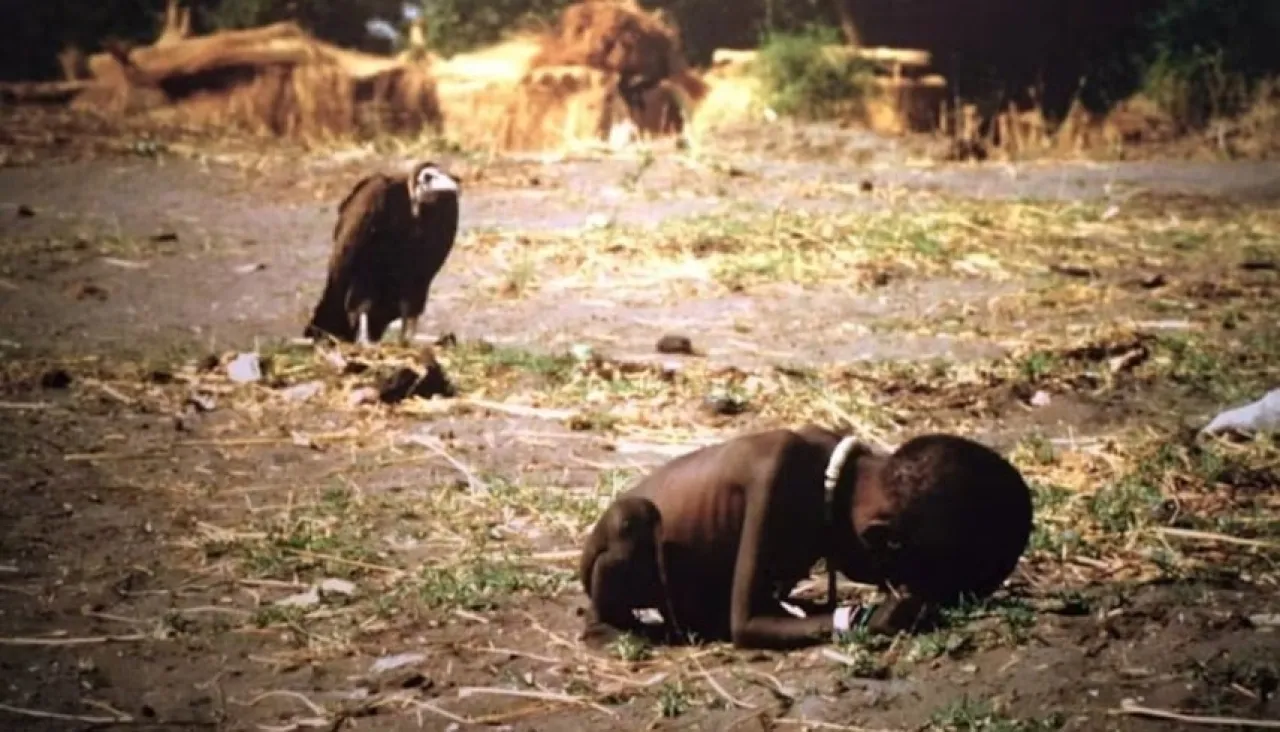
Khaberni - The "Child and the Vulture" picture was not just an ordinary journalistic snapshot, but a scene that summarized the cruelty of the famine in Sudan in 1993, and immortalized its South African photographer Kevin Carter's name in history, before it cost him his life just one year later.
The photo, which captured a gaunt child collapsing to the ground from hunger while a vulture watched waiting for him to die so it could feed on him, won the highest journalistic awards and ignited world conscience. However, at the same time, it left its owner with a wound that never healed, ending with his suicide in July 1994, at the age of 33.
Carter, a member of the group of photographers known as the "Bang-Bang Club," had traveled to Sudan in 1993 to document the civil war and the famine that ravaged the country.
During his visit to the village of Ayod, he wandered a bit away from the feeding center, to encounter a frail child no older than two, struggling to crawl towards the center before collapsing from hunger and exhaustion.
While Carter was observing the scene, a vulture landed near the child, seemingly waiting for his death, then the photographer took his famous shot after waiting twenty minutes for the bird to come closer, before scaring it away to allow the child to continue crawling towards the center.
The photo was published in The New York Times on March 26, 1993, and won the Pulitzer Prize the following year, becoming a symbol of Africa's suffering.
But professional glory did not bring Carter peace; he faced criticism and accusations of indifference after readers questioned what happened to the child, and some attacked him saying that "the man who adjusted his lens to document suffering was no better than the vulture itself."
Although Carter insisted that journalists were advised not to touch the famine victims for fear of spreading infection, the sense of guilt never left him.
His depression worsened after being haunted by the images of the hungry and the dead he had documented in Africa, until he decided to end his suffering only four months after winning the Pulitzer Prize, ending his life in 1994 by committing suicide in his car in a suburb of Johannesburg, by inhaling exhaust gases.
He left a note that read: "I am really sorry, the pain of life surpasses any pleasure.. I am haunted by images of the hungry and the dead, and the anger and pain.. I can no longer bear."
Later, his story inspired the Welsh rock band Manic Street Preachers to write a song titled "Kevin Carter," addressing the moral and psychological conflict faced by the photographer between his humanitarian duty and his professional neutrality.
After many years of controversy over the fate of the child, a journalistic investigation in 2011 revealed that the child, named Kong Nyong, was not a girl as initially thought, and had indeed survived and reached the feeding center, but later died in 2007 from fever.