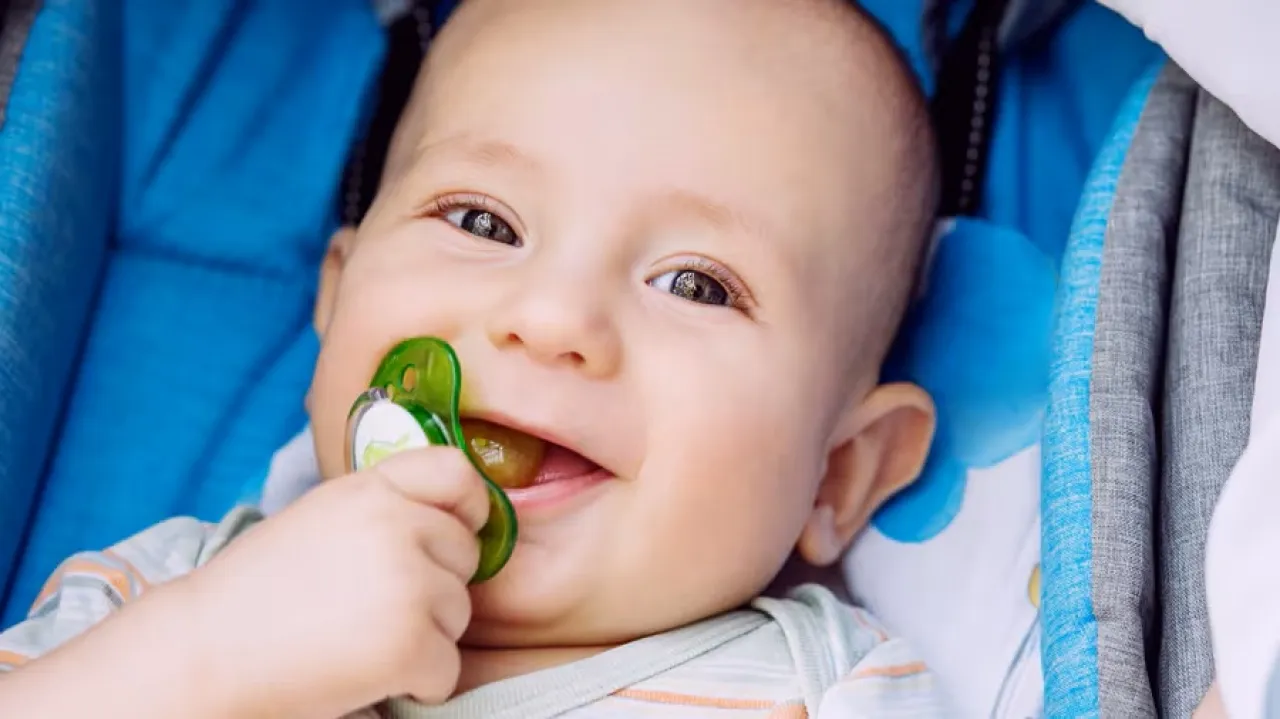
Khaberni - Recent research indicates that a chemical linked to impaired sexual development, obesity, and cancer has been found in children's pacifiers manufactured by three major European brands.
It has been found that pacifiers manufactured by the multinational Dutch company "Philips", the Swiss oral health company "Curaprox", and the French toy brand "Sophie la Girafe" contain bisphenol A (BPA), according to laboratory tests conducted by the Czech consumer protection organization "D Test".
Philips reported that it conducted subsequent tests and did not find any bisphenol A, while "Sophie la Girafe" stated that the amount found was negligible.
The three pacifiers were distributed as either "BPA-free" or "natural rubber". Bisphenol A is a synthetic chemical used in the production of plastics, but its composition resembles that of the female hormone estrogen, which mimics its structure in the bodies of humans and other animals.
In this regard, Chloe Tubing, an activist at the organization "Chem Trust", who was not involved in the research, said: "The health effects of bisphenol A are widespread: breast cancer, prostate cancer, endometritis, heart disease, obesity, diabetes, immune system disorders, reproductive effects, brain growth, and behavior, including children's behavior."
Tubing added that children are particularly at risk "as they are still in the growth phase, and their organs are very sensitive to disturbances", with exposure to bisphenol A at an early age or in the womb linked to reduced sperm counts and early puberty. She added, as reported by The Guardian, "The problem with chemicals that cause endocrine disruption... is that they can act at very low concentrations."
The researchers purchased 19 baby pacifiers from stores in the Czech Republic, Slovenia, and Hungary, and two from the "Timu" online market, which are manufactured by a children's products company in Foshan Cedah". To simulate conditions inside a baby's mouth, they placed each dummy in a solution of artificial saliva for 30 minutes at a temperature of 37 degrees Celsius (98.6 Fahrenheit). The extracts were analyzed to determine the bisphenol content.
Among the four pacifiers in which bisphenol A was discovered, the highest concentration was found in a Curaprox Baby Groolf pacifier, despite being marketed as "BPA-free". The researchers found a bisphenol concentration of 19 micrograms per kilogram (microgram/kg), which violates the European Union's maximum limit of 10 micrograms for children's pacifiers.
The second highest concentration was found in a Sophie la Girafe pacifier made of "natural rubber". Laboratory tests revealed a bisphenol concentration of 3 micrograms/kg in the product. A concentration of two micrograms/kg was also found in a Philips Avent Ultra Air pacifier, which is also marketed as "BPA-free", and one pacifier from "Timu".
Coradon, the manufacturer of the "Curaprox" range, stated that the result of the pacifier "was surprising". The company conducted its own tests which confirmed this result. The company spokesperson said: "In our commitment to your safety and aligned with our quality commitment, Coradon company has decided to proactively recall the pacifiers from the market and offer compensation to all affected customers immediately".
Philips company stated that product safety is "our top priority", ensuring this through "full compliance with all applicable safety requirements... and following the highest standards".
The current European Union legislation regarding bisphenol in pacifiers is ambiguous. EN 1400 standard sets a maximum limit for bisphenol migration from pacifiers at 10 micrograms/liter, but the European directive on toy safety, which also includes pacifiers, sets a maximum limit of 40 micrograms/liter.
Since 2011, European Union law has completely banned the use of bisphenol in baby bottles, and these rules were expanded in 2018 to include the production of food containers and bottles for children under three years of age. Karolina Prabkova from the Czech organization "Arnika" said: "It is illogical that bisphenol is banned in baby bottles, but not in pacifiers that children use intensively, and in some cases for long years.