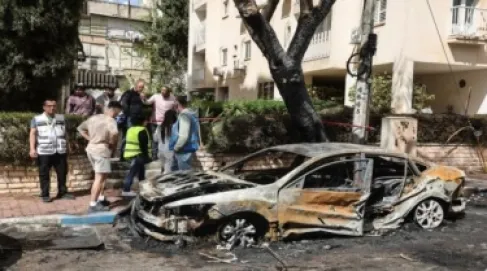
Khaberni - Thousands of Gazans are returning to their neighborhoods after the ceasefire, and many of them know that their homes no longer await them after the destruction caused by the war that lasted two years.
The prospect of rebuilding homes, commercial shops, all institutions, and necessary services to return to normal life in Gaza is extremely arduous by all standards; the United Nations estimates the damage at around 70 billion dollars.
As Professor Andreas Krieg, Middle East security expert at King's College London, says: "It is worse than starting from scratch, because here you do not start from the ground, you start from the rubble."
Meanwhile, Jakob Sellar, the special representative for the United Nations Development Programme for the Palestinians, says that the destruction rate in the sector "is now around 84 percent. In some areas of the sector, such as Gaza City, it reaches 92 percent."
This destruction has left enormous amounts of rubble. Assessments conducted by the BBC fact-checking team, based on recent satellite data, suggest that more than 60 million tons of rubble in Gaza are waiting to be removed.
Debris Removal
The millions of tons of debris now scattered across the Gaza Strip are not just piles of concrete and twisted metals, but also contain human remains and unexploded bombs.
As former executive director of "JCB," Philip Bouverat, says: "From a safety and humanity perspective, the first thing to do is to secure the sites that have been bombed."
This will be followed by a process of sorting, separating, and crushing the debris. After the removal of materials like plastic and steel, the remaining concrete can be ground and reused.
This will lay the foundations for construction, but construction efforts will require extensive importation of materials.
Bouverat adds: "And this will not happen by trucks crossing the borders, but through the construction of a deep-sea port that can receive thousands of containers."
He explains that once the sites are cleaned up, it will be possible to restore basic services such as water, sanitation, and electricity.
Water and Sanitation
Clean water is an urgent and immediate need for the people of Gaza.
According to UNICEF estimates, more than 70 percent of the water and sanitation facilities in the sector, numbering 600, have been damaged or destroyed since October 7, 2023.
After the recent ceasefire announcement, Israeli soldiers took pictures in front of a sewage treatment plant in Gaza City that had been set on fire. The damage occurred shortly before the Israeli army withdrew from a nearby site.
Sewage treatment is crucial to prevent the accumulation of sewage and the spread of diseases. Doctors have reported that Gaza suffers from high rates of diarrheal diseases, which can be fatal for children, in addition to the risk of cholera in some areas.
Satellite images show the damage to the vital towers at the Sheikh Ajlin sewage treatment plant in Gaza City, which are key components used in sewage treatment.
There are six sewage treatment plants in Gaza, but "all of them are damaged," according to Maher Najjar, deputy director of the Coastal Municipalities Water Utility in Gaza, the institution that oversees water infrastructure repairs in the sector and manages them.
Najjar says: "Since the beginning of the war, repair efforts have been severely hindered by the direct threat posed by Israeli airstrikes and artillery, as well as a lack of tools."
Some facilities were attacked again after being repaired.
The Israeli army states that its actions "are based on military necessity and in accordance with international law," in an effort to prevent Hamas from "threatening Israeli citizens."
In addition to sewage treatment facilities, Gaza has separate facilities for providing clean drinking water, which were also severely damaged.
Satellite images taken in April 2024 show the desalination plant that was supplying the north of the sector and Gaza City, which was still intact; but by early May, it had been destroyed.
Najjar adds: "We are talking about damaged water wells, water networks, tanks, and transmission lines. Knowing where to start is extremely difficult. Initially, we need at least 50 million dollars to restore about 20 percent of the services to the population."
The total loss is estimated at "about a billion dollars, or maybe more."
Housing
Satellite images show the destruction in the Sheikh Radwan area, a neighborhood located northeast of Gaza City.
In August, before the Israeli army occupied the city, which it described as "Hamas's last stronghold," many streets appeared largely intact.
By last week, vast areas of the neighborhood had been leveled to the ground with a military base constructed.
During the war, the UN Center for Satellite cited that 282,904 homes and apartments across Gaza had been damaged or destroyed.
However, these figures are likely lower than reality; they do not yet include the recent military operations in Gaza City, which led to the destruction of the Sheikh Radwan neighborhood.
The rate of home damage increased sharply in mid-2024, coinciding with Israeli military operations in Rafah, leaving massive destruction in the city. A significant increase is likely to have occurred due to the occupation of Gaza City.
The Gaza City municipality stated that 90 percent of its roads had also been damaged.
According to Shelley Culbertson, senior policy researcher at the RAND Corporation based in Washington, reconstructing homes in Gaza "could take decades."
She says: "After the Israeli bombing of Gaza in 2014 and 2021, the reconstruction of homes was slow; because Israel did not allow large quantities of construction materials to enter, as they have dual uses."
She adds, "If rebuilding now occurs as it did in 2014 and 2021, it would take 80 years. But with good planning, it could take less time."
She clarifies that "good planning means designing camps that can be transformed into neighborhoods, in addition to helping people return to their damaged homes and rebuild."
Electricity
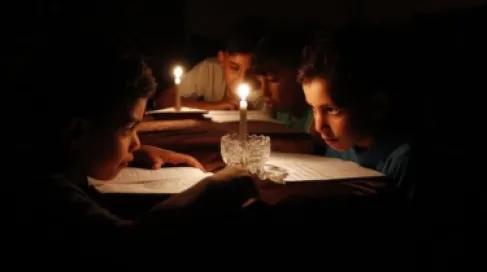
The electricity system in Gaza was under severe pressure before the last war, with frequent outages. Thus, most residents of Gaza lived with limited hours of electricity daily.
Most of Gaza's power supply came from power lines connected to Israel, the diesel-fueled power station in Gaza, and some solar panels on rooftops and public facilities added in recent years.
Since October 11, 2023, Gaza experienced nearly complete power outages after Israel cut off the external electricity.
One of the exceptions was the direct feeding of the southern Gaza desalination plant, which provides clean drinking water.
Israel restored its supply to this plant on November 14, 2024, then cut it off again on March 9, 2025, before restoring it once more.
Gaza's power station also stopped operating due to a lack of fuel, and solar power facilities sustained widespread damage.
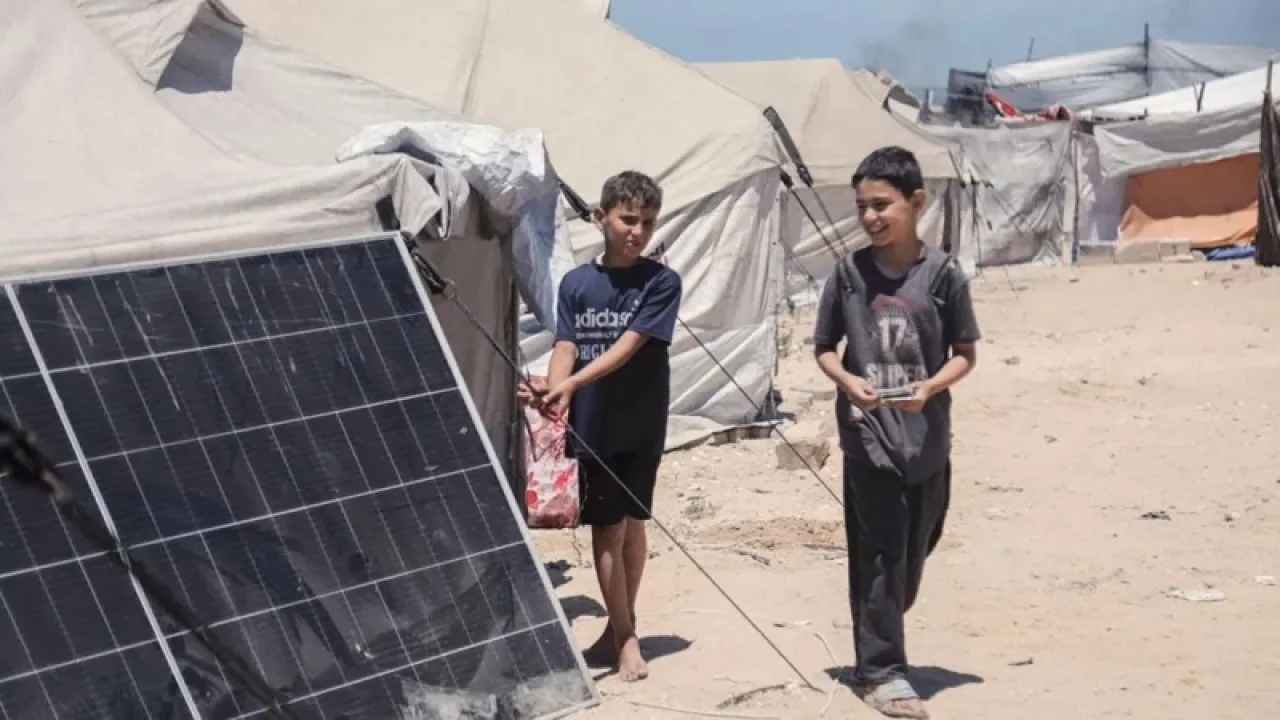
With the power grid largely disrupted, essential services relied on limited diesel generators and remaining solar panels.
A joint assessment conducted earlier this year by the World Bank, the European Union, and the United Nations estimated that more than 80 percent of the assets for generating and distributing electricity have either been destroyed or disabled since the war began, with damage costs estimated at more than 494 million dollars.
The Gaza Electricity Distribution Company, the company responsible for managing electricity supplies in the Palestinian sector, announced that 70 percent of its buildings and facilities had been destroyed since October 2023.
At the end of last month, we verified a video showing the bombing of the company's headquarters.
In a statement following the incident, the company said the attack "directly impacted the company's ability to manage its administrative and technical operations."
Agriculture
Satellite images over the region east of Jabaliya show how four square kilometers of crops, likely olive trees and citrus, were annihilated during the war.
The images show a road created by the Israeli army across destroyed land east of Jabaliya, facilitating access to the northern regions of neighboring Gaza City, likely.
Analysis by Professor He Yin from Kent State University found that 82.4 percent of annual crops and more than 97 percent of tree crops in the Gaza Strip were likely damaged since the war began up to August 10 this year.
The decline in agriculture, along with long-term restrictions on aid, has led to a severe food security crisis throughout the period of the conflict, peaking with the declaration of a famine in Gaza City in September.
"UNOSAT" attributes this decline to "activities such as land leveling, heavy vehicle activity, bomb shelling, and other conflict-related factors."
Bouverat says that to recover agriculture, it is "extremely urgent" to clear the land from unexploded bombs, shells, and mines.
He adds: "If they can grow their crops themselves, they will be able to feed themselves, and the sooner we do that, the better."
Education
About half of Gaza's population before the war were under eighteen years old. Therefore, rebuilding schools is essential for a return to normal life.
School buildings were transformed into shelters for displaced Palestinians throughout the conflict and were often targeted by Israeli military forces under the pretext of housing "command and control centers" for Hamas and its affiliated groups.
The UN Relief and Works Agency (UNRWA), which was managing 288 schools in Gaza, says 91.8 percent of school buildings will require "complete reconstruction or major rehabilitation works to be operational again."
Higher education institutions also did not escape destruction.
For example, in December 2023, Israeli forces blew up Al-Azhar University south of Gaza City. The site is now part of Netsarim corridor, one of the many military areas created by the Israeli army during the war.
The same fate befell the Israa University, located less than two kilometers from Al-Azhar, which the Israeli military demolished after it served as a temporary military base for several weeks.