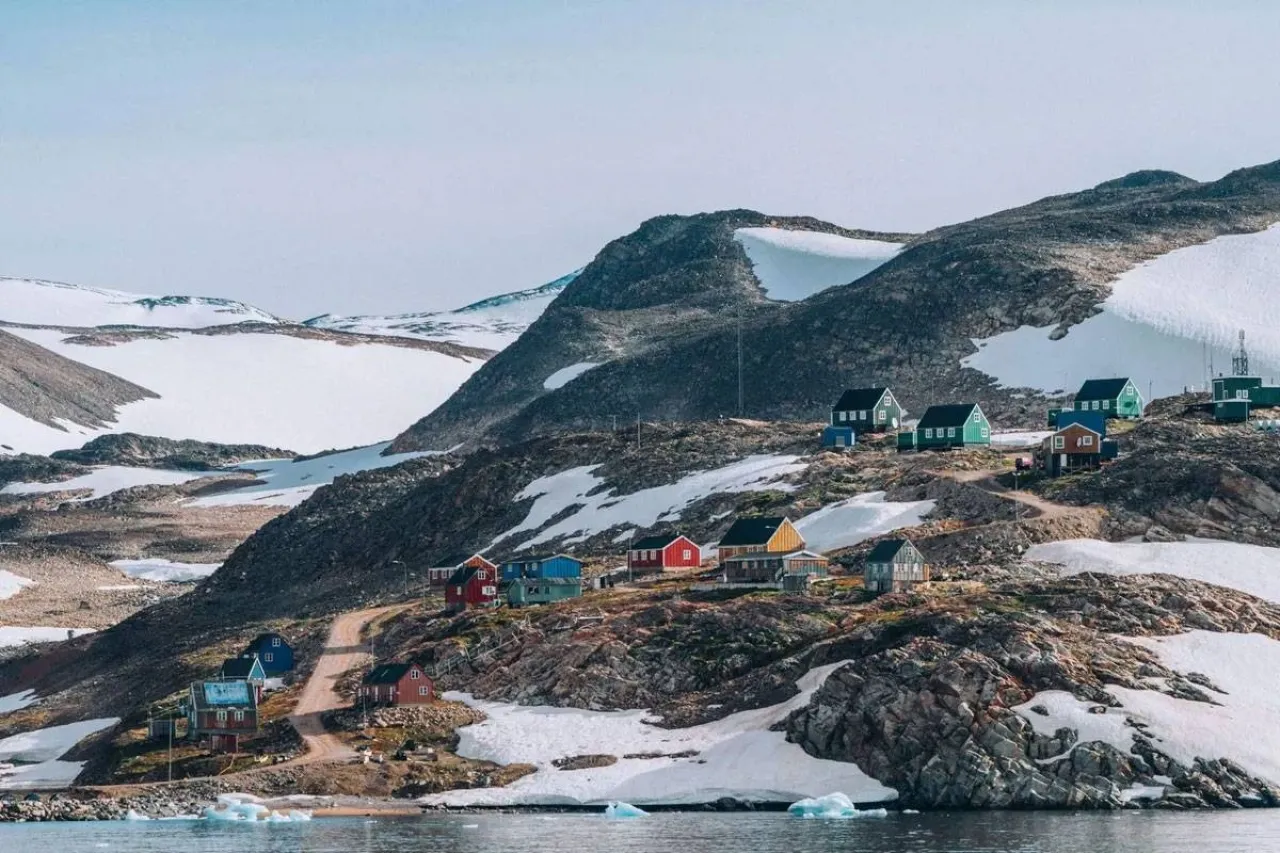
Khaberni - In a phenomenon that astounded scientists, researchers revealed stunning transformations occurring on Greenland, the largest island in the world, showing that it is slowly moving northwest and gradually shrinking in size. These findings, coming after decades of precise data analysis, highlight a complex interaction between deep ice melting and Earth's crust movement, making Greenland one of the most geologically active regions on the planet.
Scientists say the island is not only moving but also changing shape due to changes in glacial pressure and the rebound of the earth beneath it. This new discovery unveils a geological puzzle that has been hidden for thousands of years, opening the door to a deeper understanding of climate and geological impacts on our ever-changing planet's features.
Greenland, the largest island in the world, is witnessing remarkable geographical and geological transformations; its area is shrinking and it is slowly moving northwest at a rate of about two centimeters per year over the past twenty years. This notable change is not just a surface phenomenon but is the result of a complex interaction between the melting of the ice and the deep alteration of the Earth's crust that supports the island.
Since the peak of the last Ice Age about 20,000 years ago, the melting of massive ice sheets has eased the immense pressure on the surface of the island, causing its rocky base to rebound and its tectonic plate to deform. These processes have caused parts of Greenland to shrink and subside, while other areas extend and rise, literally reshaping the island from the inside out.
Researcher Dangal Longfors Berg from the Technical University of Denmark and NASA's Jet Propulsion Laboratory says: "Greenland has become slightly smaller at the moment, but this trend may change in the future with the acceleration of ice melting."
He added, "Modern ice melting has pushed parts of the island to rise and expand, but the effects of ancient ice melting are still driving it in the opposite direction, causing shrinkage in other areas."
Greenland covers an area of approximately 2.1 million square kilometers, located on the North American tectonic plate, part of a vast geological system that moves slowly over the Earth's mantle—a layer of hot, semi-solid rocks flowing slowly like thick syrup. This deep interaction between ice, rocks, and the mantle explains why the island continues to change even today.
The research team relied on precise data from 58 GPS stations distributed around the island, which tracked changes in its location, elevation, and deformation of its rocky base over twenty years.
After integrating this data into a geological model that covers 26,000 years of Earth's history, scientists discovered that the movement is not uniform as previously thought. While some areas are rising due to the relief of pressure from recent ice melting, other areas are contracting due to the balance of deep forces between the crust and the mantle.
These results show that Greenland is not just an ice-covered island, but a living geological system that breathes and moves continuously, responding slowly but remarkably to Earth's and climatic changes through the ages.