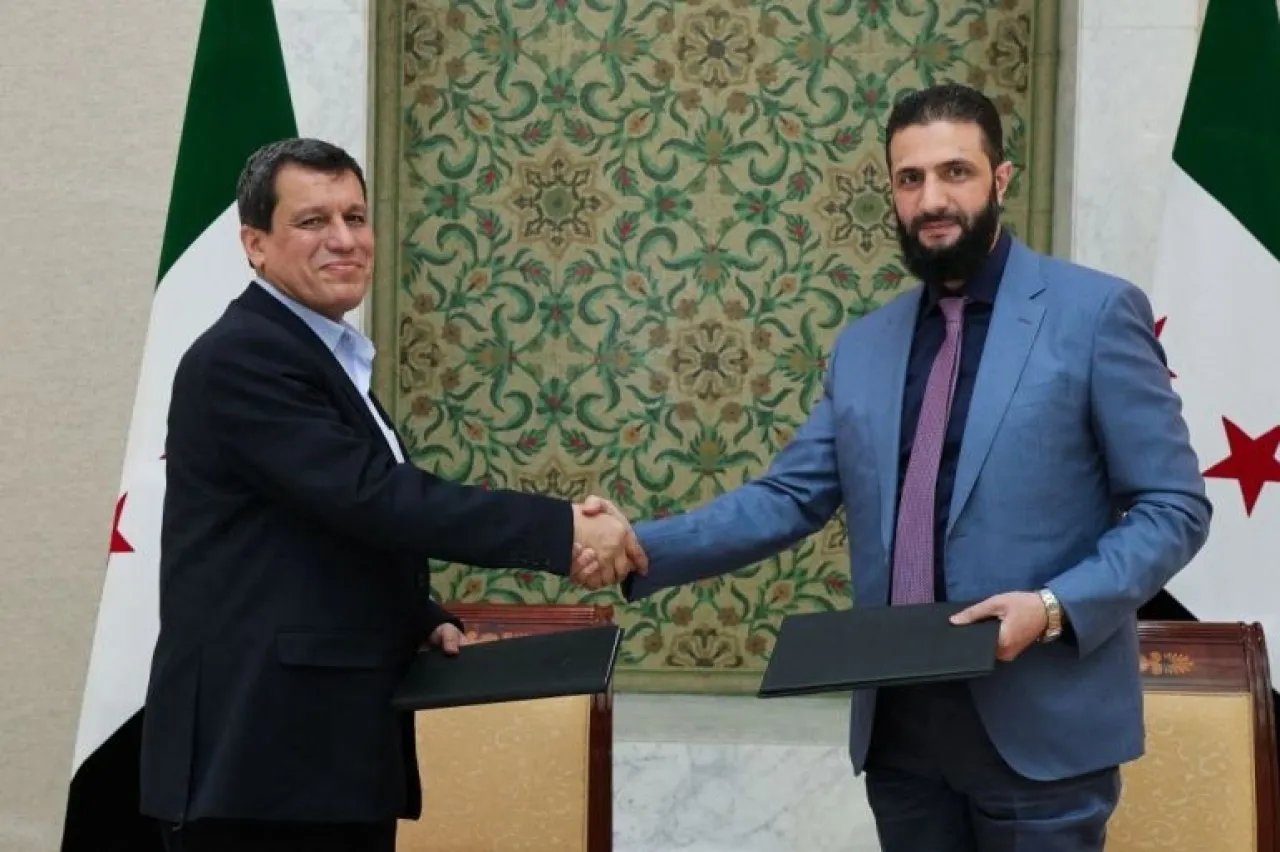
Khaberni - The leader of the Syrian Democratic Forces (SDF), Mazloum Abdi, announced a "preliminary agreement" with the Syrian authorities regarding the mechanism for integrating his forces into the Syrian Ministries of Defense and Interior.
In an interview with the French Press Agency inside a military base in the city of Al-Hasakah, he explained that discussions are currently underway between the two parties in Damascus.
Abdi and President Ahmad al-Shar’ signed an agreement on March 10, which included several provisions, at the forefront of which was the integration of the military and civilian institutions of the Autonomous Kurdish Administration into the national institutions by the end of the year, including the transfer of control of border crossings, an airport, and oil and gas fields to Damascus. However, the implementation is slow amid mutual accusations.
Last week, a meeting was held in Damascus that included Abdi and al-Shar’, attended by the American envoy Tom Braak and the commander of the US Central Command in the Middle East (CENTCOM), Brad Cooper, as part of Washington's efforts to advance the talks.
Abdi said late Sunday, "The new thing in our recent talks in Damascus is the joint insistence and strong will to accelerate the implementation of the terms" of the agreement, adding that "the most important point is reaching a preliminary understanding regarding the mechanism for the integration of the SDF and Kurdish internal security forces within the framework of the Ministries of Defense and Interior."
Currently, according to Abdi, there are military and security delegations from his forces in Damascus to discuss their integration mechanism within the Ministries of Defense and Interior.
The SDF and security forces - built by the "Autonomous Administration" successively in its areas of influence in northeastern Syria - include about 100,000 members.
Abdi clarified that the "SDF will be restructured during its integration within the structure of the Ministry of Defense" in several formations, and it will have a "new name" to match the system used in the Ministry of Defense, while emphasizing that the name of his forces will remain "a historical name" after having "written heroic epics against ISIS and all the aggressors" in the region.
Syrian Unity
In response to a question about the role of Turkey, the biggest supporter of the new authority, which was visited by the Syrian Ministers of Defense and Interior yesterday, Abdi confirmed that "any success of negotiations will definitely be linked to Turkey's role," hoping that it will play a "supportive and contributive role in the ongoing negotiation process."
For his part, Turkish President Recep Tayyip Erdogan last Wednesday urged the "SDF" to "abide by its promises and complete its integration" within the institutions of the new authority.
Turkey has launched several attacks over the past years in northeast Syria to push Kurdish fighters away from its borders. Turkey has always described the Kurdish units leading the SDF as a "terrorist organization."
Abdi said, "We demand a decentralized system in Syria, which is not yet acceptable, and we have not agreed upon it," adding, "We are still discussing finding a common and acceptable formula for everyone."
He emphasized that "the common points we have agreed upon are more than the points of dispute," explaining, "We agree on the unity of Syrian territory, the unity of national symbols, the independence of political decision-making in the country, and combating terrorism."
He continued, "We all agree not to return Syria to an era of wars, and there should be stability and security, and I believe these factors are sufficient for us to reach a permanent agreement."
Kurdish Rights
Abdi said that during the latest meeting with al-Shar’, he demanded a "change or addition of some terms to the current Constitution especially regarding the "guaranteeing the rights of the Kurdish people in the Constitution," adding, "There was a response to this matter, and we hope that it will take place in the near future."
Al-Shar’ praised the role of the United States, particularly, and also France, as a mediator in the talks with the transitional authority in Damascus, which is trying to consolidate its security grip and launch a reconstruction process.
The Syrian authorities announced on Tuesday the achievement of a "comprehensive ceasefire" with the Kurds in the north and northeast of the country following a meeting between Abdi and al-Shar’ in Damascus, the day after clashes between government forces and Kurdish ones in the city of Aleppo resulted in the death of two people.
The ceasefire announcement comes while significant disagreements between the transitional authorities and the Autonomous Kurdish Administration have delayed the implementation of an agreement reached in March, which included several provisions regarding the integration of the civil and military institutions of the Autonomous Kurdish Administration into the national institutions.
Damascus particularly needs to manage the major oil and gas fields located in areas under the control of the Autonomous Kurdish Administration.
Abdi said, "We have not yet discussed the oil file, but it will certainly be addressed in the upcoming meetings."
He continued, "We consider the oil file and other subterranean resources in northeast Syria to be the property of all Syrians, and their revenues and incomes should be fairly distributed across all the Syrian provinces."