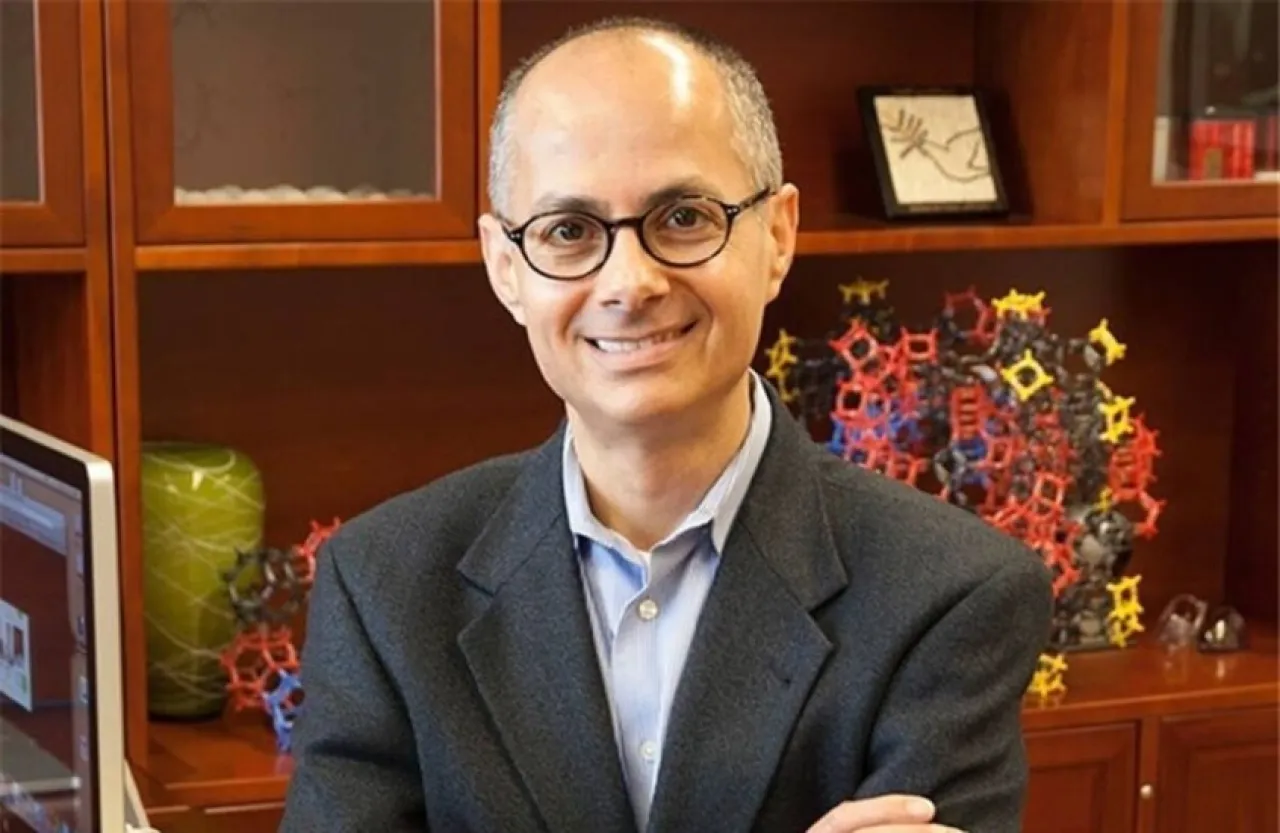
Khaberni - Today, Wednesday, Jordanian chemist Omar Yaghi won the Nobel Prize in Chemistry, so who is this Jordanian scientist?
Omar Mounis Yaghi, born (1965), is a Jordanian chemist who also holds Saudi and American citizenship. He is a Professor holding the James and Neeltje Tretter Chair for Chemistry at the University of California, Berkeley, a scientist affiliated with Lawrence Berkeley National Laboratory, the founding director of the Berkeley Global Institute for Science, and an elected fellow of the US National Academy of Sciences and the Leopoldina, the German National Academy of Sciences. He was ranked number 2 among the most notable and best scientists and engineers globally for the period between 1998 and 2008. He was granted Saudi citizenship by a royal decree of November 11, 2021. He also won the Arab Genius Award in 2024.
Omar Yaghi won the Nobel Prize in Chemistry in 2025, along with scientists Susumu Kitagawa and Richard Robson, in recognition of their contributions to the invention of a new form of molecular architecture known as Metal-Organic Frameworks (MOFs).
Biography
Yaghi was born in Amman, Jordan, in 1965. He grew up in a household with many children, under somewhat tough living conditions.
At the age of 15, he migrated to the United States, encouraged by his father. He began attending classes at Hudson Valley Community College, despite his limited English proficiency. He later moved on to the University of Albany to complete his education. He then began his master's studies at the University of Illinois, earning a Ph.D. in 1990 under the supervision of Professor Walter G. Klemperer. He became a fellow at the National Science Foundation at Harvard University from 1990 until 1992, with Professor Richard H. Holm. He was also at the colleges of the University of Arizona (from 1992 until 1998) and the University of Michigan (from 1999 until 2006) and the University of California, Los Angeles (from 2007 until 2012).
He moved in 2012 to the University of California, Berkeley, becoming a professor of chemistry. He is the founding director of the Berkeley Global Institute for Science. His achievements in designing and manufacturing new materials were honored by the American Chemical Society and Exxon (1998), and the Sacconi Medal from the Italian Chemical Society (2004).
The renowned science magazine (Popular Science) recognized his work on hydrogen storage and ranked him among the top 10 scientists and engineers in the United States for 2006 and received an award from the US Department of Energy's Hydrogen Program for his notable contributions in the field of hydrogen storage (2007). He received the Materials Research Society Medal for his work in the theory, design, manufacture, and application of Metal-Organic Frameworks, and also received the Newcomb Cleveland Prize from the American Association for the Advancement of Science for the best research paper published in the field of science (2007).
Yaghi ranked second among the most cited chemists in the world between 2000 and 2010. In 2015, he won the King Faisal International Prize in Chemistry and the Mustafa Prize in Nanotechnology and Nano Science.
In 2016, Yaghi won the TÜBA Academy Prize in Basic and Engineering Sciences for establishing reticular chemistry. In 2017, he received the Spiers Memorial Award from the Royal Society of Chemistry and the Medal of Excellence in the First Degree awarded by King Abdullah II, in addition to the Beller Medal in Inorganic Chemistry, the Kuwait Prize in Basic Sciences, and the Albert Einstein World Award of Science awarded by the World Cultural Council. He also received numerous other awards and honors.
Work
Yaghi was a faculty member at Arizona State University (1992-1998) as an Assistant Professor, and at the University of Michigan (1999-2006) as Robert W. Parry Professor of Chemistry, and at the University of California, Los Angeles (2007-2012).) as Christopher S. Foote Professor of Chemistry as well as holding the Irving and Jean Stone Chair in Physical Sciences.
Professor Omar Yaghi is renowned for founding the field of reticular chemistry, a science that concerns linking molecular building blocks together via strong bonds to create open frameworks that can be used for over one hundred different applications.
Dr. Omar Yaghi is currently the head of the Molecular Foundry at the renowned Lawrence Berkeley Research Center and a professor in the Chemistry Department at the University of California, Berkeley. He has founded several laboratories at different universities and in Japan and Vietnam and collaborates with the Qatar Environment and Energy Research Institute. His research centers are dedicated to serving researchers and designing and producing sets of chemical reticular compounds, with the best-known being the Metal-Organic Frameworks (MOFs).
Education
Omar Yaghi received his Ph.D. in Chemistry in 1990 from the University of Illinois Urbana-Champaign. He joined Harvard University from 1990 to 1992 for further studies working with Professor Richard Holm. He joined the faculty at Arizona State University from 1992-1998, moved to the University of Michigan from 1999-2006, then to the University of California, Los Angeles from 2007-2012, and finally to the University of California, Berkeley.
Awards
Professor Omar received the Solid State Chemistry Award from the American Chemical Society and Exxon (1998), and the Sacconi Medal from the Italian Chemical Society (2004), and his work in hydrogen storage won the Hydrogen Program Award from the US Department of Energy (2007).
He received the Medal from the Materials Research Society for his work in theory, design, assembly, and applications of Metal-Organic Frameworks, and obtained the Newcomb Cleveland Prize from the American Association for the Advancement of Science for the best paper published in science (2007).
Yaghi received the American Chemical Society's Award in Materials Chemistry (2009), the Izatt-Christensen International Award (2009), and the Centennial Award from the Royal Society of Chemistry (2010), as well as the China Nano Award (2013).
In 2015, he was awarded the King Faisal International Prize in Chemistry and the Mustafa Prize in Nanotechnology and Nano Science.
In 2016, he received the TÜBA Academy Award in Basic and Engineering Sciences for establishing reticular chemistry.
In 2017, Yaghi received the Spiers Memorial Award from the Royal Society of Chemistry, the Medal of Excellence in the First Degree which was awarded by King Abdullah II, the DIC International Award for Coordination Chemistry, Beller Medal in Inorganic Chemistry, Kuwait Prize in Basic Sciences, and the Albert Einstein World Award of Science, which is granted by the World Culture Council.
In 2018, Yaghi received the BBVA Foundation Frontiers of Knowledge Award in Basic Sciences for his pioneering work in reticular chemistry, and also in 2018, he received the Wolf Prize in Chemistry, where he was cited for pioneering the field of reticular chemistry through Metal-Organic Frameworks and Covalent Organic Frameworks.
The World Economic Forum in Switzerland showcased his work in harvesting water from desert air using Metal-Organic Frameworks as one of the top 10 emerging technologies, and he received the Prince Sultan Prize 2018 and the King Abdulaziz International Water Award. Yaghi also received the Eni Award in 2018 in recognition of his work in applying frame chemistry to clean energy solutions including methane storage, carbon dioxide capture and conversion, and water harvesting from desert air.
In 2019, he was honored with the Gregory Aminoff Prize from the Royal Swedish Academy of Sciences for developing reticular chemistry.
In 2019, he also received the MBR Medal for Scientific Excellence from the United Arab Emirates, in addition to the Nano Research Award.
In 2020, Yaghi received the Wilhelm Exner Medal from the German Chemical Society for his contributions to reticular chemistry and for pioneering Metal-Organic Frameworks and Covalent Organic Frameworks and woven molecular netting.
In 2020, he also received the Royal Society of Chemistry Award for Sustainable Water for his impactful development of harvesting water from desert air using Metal-Organic Frameworks.
In 2021, Yaghi was honored by the Belgian International Solvay Prize in Chemistry, in addition to the Ertl Lecture Award by the Fritz Haber Institute of the Max Planck Society and the Berlin Universities.
On January 20, 2022, during the international award ceremony in Vietnam, Yaghi was announced as the winner of the inaugural VinFuture Prize for outstanding achievements in emerging fields in recognition of his pioneering work in reticular chemistry.
Yaghi received the Wilhelm Exner Medal in 2023 for his direct impact on the business and industrial sector through his scientific achievements.
Yaghi received the Belgian Ernst Solvay Science for the Future Award in 2024 in recognition of his groundbreaking work in reticular chemistry.
In 2024, he received the Arab Geniuses Award in the Natural Sciences category.
In 2025, he received the Nobel Prize in Chemistry along with Japanese scientist Susumo Kitagawa, and Australian scientist Richard Robson, for the Nobel Prize in Chemistry, in recognition of their pioneering efforts
In developing Metal-Organic Frameworks (MOFs), revolutionary materials that combine metallic and organic elements in finely structured porous frameworks.