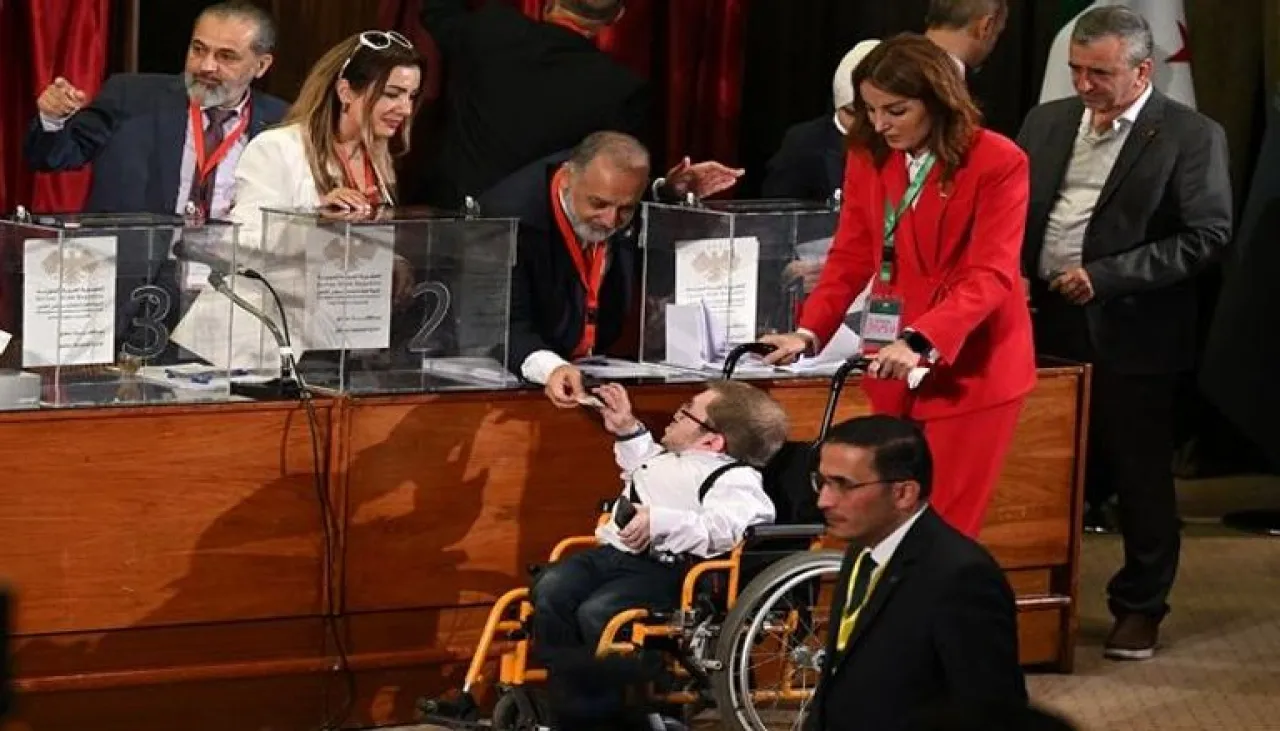
Khaberni - Nouar Najmeh, the spokesperson for the High Elections Committee, announced on Monday the preliminary lists of the successful candidates in the People's Council elections, stating there were 119 winners and confirming that “the high level of integrity was the most distinguishing feature of the electoral process that took place in 49 electoral districts across Syria”.
He pointed out that the results are final and not subject to appeal, also confirming that any challenges will be directed at the electoral process and not at the members themselves.
Regarding the reasons for the delay in announcing the results, the spokesperson for the High Elections Committee said that the voting count delay in Damascus was a positive issue, and care was taken to prevent any share allocation.
As for the date of the elections in Sweida, Hasakah, and Raqqa, the Syrian official confirmed that a meeting will be held tomorrow to discuss conducting the elections in these three provinces.
The committee clarified in its decision that the door for appeals on the electoral process (electoral campaigning, voting, and vote counting) will remain open until the end of official working hours on Monday.
The committee in its decision noted that any interested party is entitled to challenge the preliminary results of the winners in the election of the People's Council members concerning their electoral district before the special appeals committee of the concerned province.
According to Najmeh, the High Elections Committee of the Syrian Parliament “ensured that people with special needs and victims of the Syrian revolution were represented in these elections by 4%”.
He called on Syrians to work seriously in the coming phase, adding: Our assessment of the electoral process is positive, as it was conducted with integrity and transparency.
There were 1578 people from electoral bodies across 49 electoral districts in Syria, including 14 percent women who ran in these elections.
The parliament will be formed, and its term is thirty months, renewable, based on a mechanism specified by the Constitution, and not by direct elections from the people. Under the mechanism, regional bodies formed by a high committee appointed by Sharia will elect two-thirds of the council members, numbering 210, while the president appoints the remaining third.
Syrian President Ahmed Al-Shara spoke at the National Library in front of the electoral committee members in Damascus on Sunday saying, “Although the electoral process is incomplete (...) it is a moderate process that suits the current Syrian condition and circumstances, and also matches the transitional phase”.
Previously, Al-Shara considered the elections as "a temporary step until a secure and political environment is available for conducting direct elections with the participation of all Syrians", which is currently unfeasible due to "loss of documents", and many of them being abroad without documents.
In August, the High Committee announced a postponement in selecting council members in the provinces of Sweida, Raqqa (north), and Hasakah (northeast) due to "security challenges".
However, in September, sub-election committees were formed in some areas under the control of the authorities in Raqqa and Hasakah.
The temporary election system requires that the candidate must not be "a supporter of the former regime or advocate for division or separation".