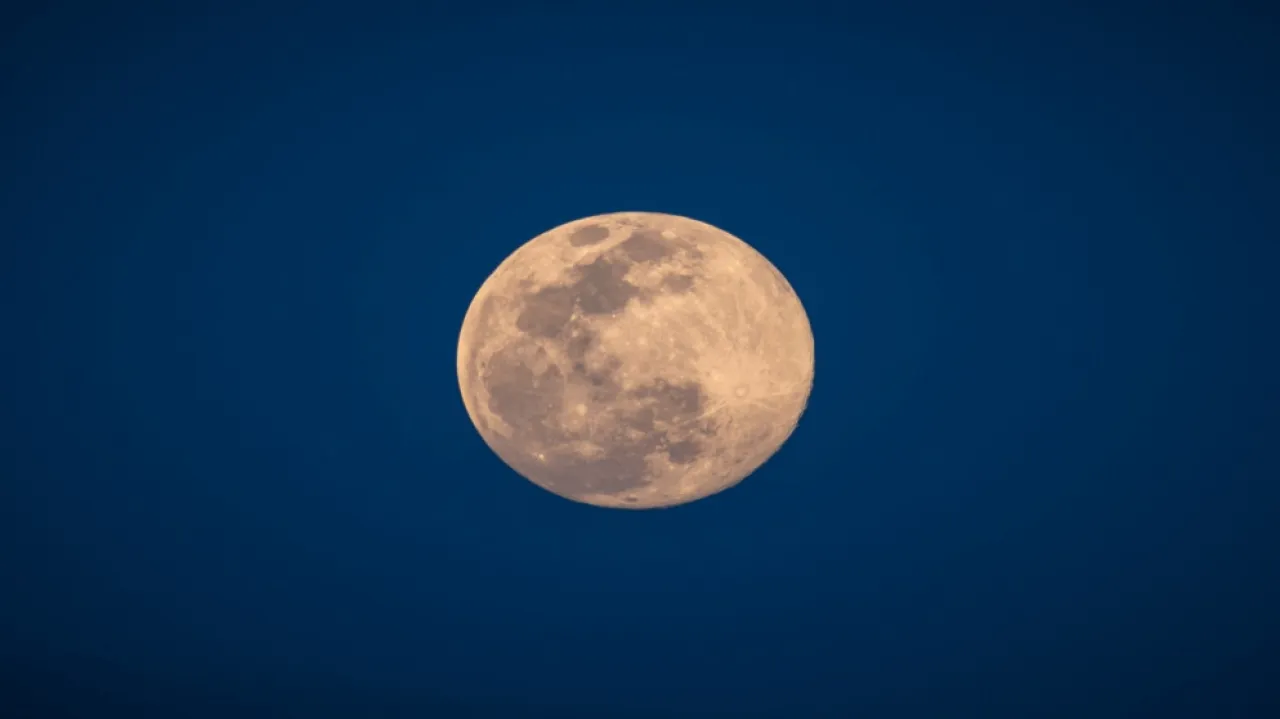
Khaberni - Next Tuesday, the Jordanian sky will witness an astronomical event in which the moon will be exceptionally full, known as the "supermoon," which is considered the first, largest, and most luminous in 2025.
The supermoon will appear after sunset with its distinctive red color, providing a unique opportunity for photographers and astronomy enthusiasts to enjoy the beauty of the sky and reflect on the precision of celestial movements.
Astronomy experts have invited those interested to take advantage of this occasion to observe and photograph the phenomenon, noting that the local weather and the clarity of the sky play a role in the quality of the observation, according to Petra.
The president of the Jordanian Astronomical Association, Dr. Ammar Al-Sakaji, said that the "supermoon" phenomenon will be complete at 6:47 AM on the upcoming Tuesday, Jordan time, about 10 minutes after the moon sets with its red color from the western horizon of the kingdom's sky.
He added that the moon will appear in the Pisces constellation upon completion, noting that this moon is the first, largest, and brightest in 2025, and will be followed by two more supermoons on November 5 and December 4.
He explained that it is called the "Harvest Moon" as it is closest to the autumn equinox that occurred on September 22. This naming dates back to the harvest seasons in Anglo-Saxon civilizations, and the moon also tends to appear at times close to a day or two before or after Tuesday, especially in higher latitudes.
He pointed out that this moon appears low on the horizon, making it ideal for photography and enjoying the autumn morning or evening skies, as it sets at 6:36 AM on Tuesday, then rises again at 6:17 PM on the same day, with slight variations in times depending on geographic location, elevation above sea level, and other topographical factors.
Dr. Al-Sakaji noted that the moon remains in the sky almost all night, due to its rise coinciding with sunset and its setting close to sunrise, which is a typical duration during the full moon period.
He added that the Harvest Moon usually appears in most years during September, but approximately every 3 years it appears in October, and when it occurs in September, it replaces the "Corn Moon," while if it falls in October, it takes the place of the "Hunter's Moon."
He affirmed that the supermoon (Khaberni) appears larger and more luminescent than the regular full moon, when its completion coincides with being 90 percent or closer to the "lunar perigee," the closest point of the moon to the Earth in its elliptical orbit. In this case, the moon appears about 14 percent larger and 30 percent brighter compared to the ordinary full moon when at the "lunar apogee" (the farthest point from the Earth).
He pointed out that astronomical calculations have proven that this moon is a supermoon, as its distance on Tuesday equals 361,458 km, while the subsequent apogee distance is 406,445 km, and the subsequent perigee distance is 359,819 km. Based on this, the relative distance of the moon from apogee to perigee is 96.5 percent, making it gigantic according to astronomical standards.
He mentioned that the effect of the supermoon on tidal phenomena is slightly higher than usual because of the moon's proximity to Earth at perigee, with a slight increase in tide height reaching 18 centimeters in the Gulf of Aqaba compared to regular spring tides, along with increased nighttime illumination that enhances visibility at night.
He confirmed that the supermoon does not cause radical changes or environmental disasters, but its effects are limited to minor differences in tides and a 30 percent increase in nighttime lighting compared to the ordinary full moon, potentially affecting the natural behaviors of some nocturnal animals, such as bats, migratory birds, and insects, and some humans might notice minor sleep disturbances due to the high brightness.
He stated that the supermoon is an amazing natural astronomical phenomenon that reminds us of the beauty and precision of the cosmic system, without being a source of superstitious or astrological effects.
Meanwhile, the professor of astrophysics and space sciences at Al-Balqa Applied University, Dr. Ali Al-Ta'ani, confirmed that this year will witness three appearances of the supermoon, making it a year rich with these distinct astronomical sights, as follows: The first of these occasions will be on October 7, when the moon appears fully illuminated and brighter than usual.
The peak will come on November 25 this year, when the moon reaches its closest distance to Earth during the year, making it the largest and brightest among the full moons of this year, and the last supermoon will be on December 4, concluding the year with an impressive astronomical scene that highlights the accuracy and movement of celestial bodies.
He explained that the supermoon garners interest for several reasons: its apparent larger size than we are accustomed to, its stronger light that makes the sky brighter, and the ease of observing it with the naked eye without the need for telescopes, offering an ideal opportunity for astrophotography and monitoring the natural changes in the sky.
He noted that there are no effects of the appearance of the supermoon on the climate or even on eye health when observed.
The astrophotographer Mahmoud Abdel Hadi said that one of the most wonderful moments one can witness is observing the "supermoon," which appears larger and closer than usual.
He added that the role of the photographer here is to choose the right location for capturing the image, whether it’s the top of a mountain, a wide plain, or an open horizon, giving the moon its majestic presence.
He explained that distance and the angle of capture are fundamental elements that determine how the moon interacts with the scene, making it a living part of the visual story, noting that the beauty of moon photography is not limited to its apparent size, but is more manifest in its ability to blend with the surrounding environment.
He confirmed that when the scene is captured in front of historical or religious sites, and the moon rises or sets behind them, the photograph transforms into a painting that carries additional meaning and evokes special emotions in the viewer.
He pointed out that these moments are not just a passing snapshot but become a scene that links the grandeur of the moon with the spirit of the neighboring place.