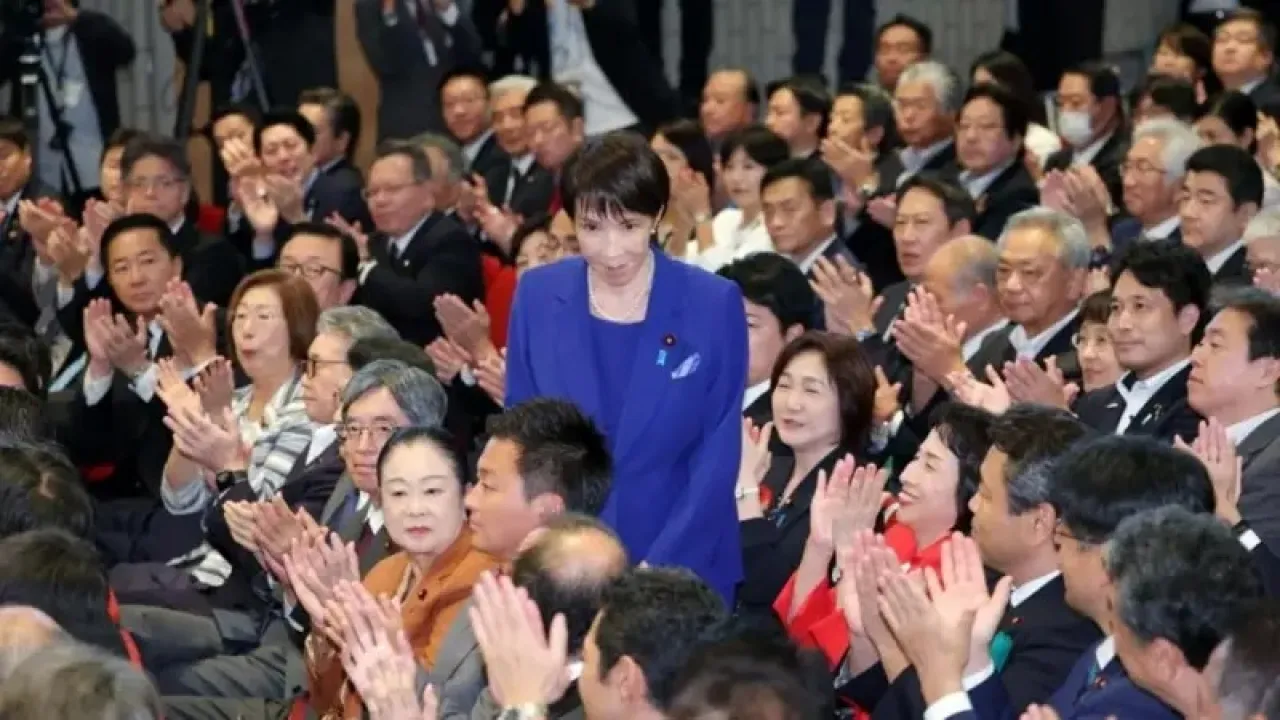
Khaberni - A respected figure: Baroness Margaret Thatcher. Personal goal: To become the "Iron Lady" in Japan.
After two failed attempts, Sanae Takaishi finally achieved her long-sought ambition.
At the age of sixty-four, she was elected leader of the ruling Liberal Democratic Party in Japan, on the seventieth anniversary of the party’s founding - putting her on the path to becoming the country’s first female Prime Minister.
Takaishi, a former minister and television presenter, who was also a drummer in a heavy metal band, now faces the challenge of leading a party still struggling to regain voter confidence after successive scandals, amidst the rise of the far right.
Sanae Takaishi was born in Nara Prefecture in 1961, her father was a company employee, and her mother was a police officer. Politics was not part of her upbringing or family environment.
She was previously a passionate heavy metal drummer, famous for carrying a large number of sticks because she would break them during vigorous playing. She also practiced diving and was fond of cars - her beloved Toyota Supra is currently on display at a museum in Nara.
Before entering the world of politics, Takaishi worked briefly as a television presenter.
She developed her political passion in the 1980s, during the peak of trade tensions between the United States and Japan. With the aim of understanding the American perspective of Japan, she worked in the office of Democratic Representative Patricia Schroeder, known for her sharp criticisms of Japan.
Takaishi noticed that Americans often confuse Japanese, Chinese, and Korean languages and cuisines, and saw how Japan is treated as one bloc with China and South Korea.
She concluded from her experience, saying: "Unless Japan can defend itself, its fate will always be at the mercy of superficial American opinion."
Takaishi first ran for parliament in 1992 as an independent, but she lost.
However, she did not give up; she won a seat in parliament the following year and joined the Liberal Democratic Party in 1996. Since then, she has been elected a deputy ten times, losing only once, building a reputation as one of the most prominent conservative voices within the party.
Takaishi held high government positions, including Minister of Economic Security, Minister of State for Trade and Industry, and achieved a record duration in her role as Minister of Internal Affairs and Communications.
In 2021, she entered the race to lead the party for the first time but lost to Fumio Kishida. She tried again in 2024, leading the first round of voting, but ultimately lost to Shigeru Ishiba.
This year, she succeeded on her third attempt, paving the way for her to become the first female Prime Minister of Japan, pending parliamentary ratification of her appointment.
She said during her recent campaign to a group of school students: "My goal is to become the Iron Lady."
Takaishi is known to be a conservative hardliner, always opposing legislation that allows married women to keep their premarital names, considering it to undermine traditions. She also opposes same-sex marriage.
Nevertheless, she has recently softened her tone. During her recent campaign, she pledged to make child care service fees partially tax-deductible and proposed tax incentives for companies that provide internal child care services.
Her policies are based on her family and personal experiences, as she advocates for expanded hospital services related to women's health, greater recognition for family support workers, and improved care options for the elderly in the Japanese community.
She said: "I have gone through the experience of nursing and caring for patients three times in my life. Therefore, I am more determined to reduce the number of people forced to leave their jobs due to caregiving, raising children, or their children's refusal to go to school. I want to create a society in which people do not have to give up their careers."
As a close political associate of the late Prime Minister Shinzo Abe, she pledged to revive his economic vision "Abenomics," based on big public spending and low interest rates.
Takaishi is a regular visitor to the controversial Yasukuni Shrine, which honors Japanese war dead, including convicted war criminals.
She also called for easing the constitutional restrictions on Japan's Self-Defense Forces, which prevent them from having offensive capabilities.
Since its establishment in 1955, the Liberal Democratic Party has dominated the political scene in Japan, but it is facing a decline in popularity today amid economic slowdown, declining birth rates, and rising social dissatisfaction.
Takaishi belongs to the right-wing faction within the party, and through her election, the party hopes to regain the support of the conservative base, which has recently been drawn to the far-right party Sansaito.
Sansaito has recently made a significant leap, raising the slogan "Japan First," and moved from one seat to 15 seats, contributing to the erosion of the Liberal Democratic Party's base, which lost its majority in both houses of parliament.
Takaishi acknowledged this crisis in a speech after her victory in the first round of voting, saying: "We received particularly harsh criticism from our core base - the conservatives and party members."
She added: "The Liberal Democratic Party must change for the present and future of Japan. We will always put the national interest first and govern the country with balance and responsibility."
Parliament is expected to ratify her appointment as Prime Minister on October 15th of this month.