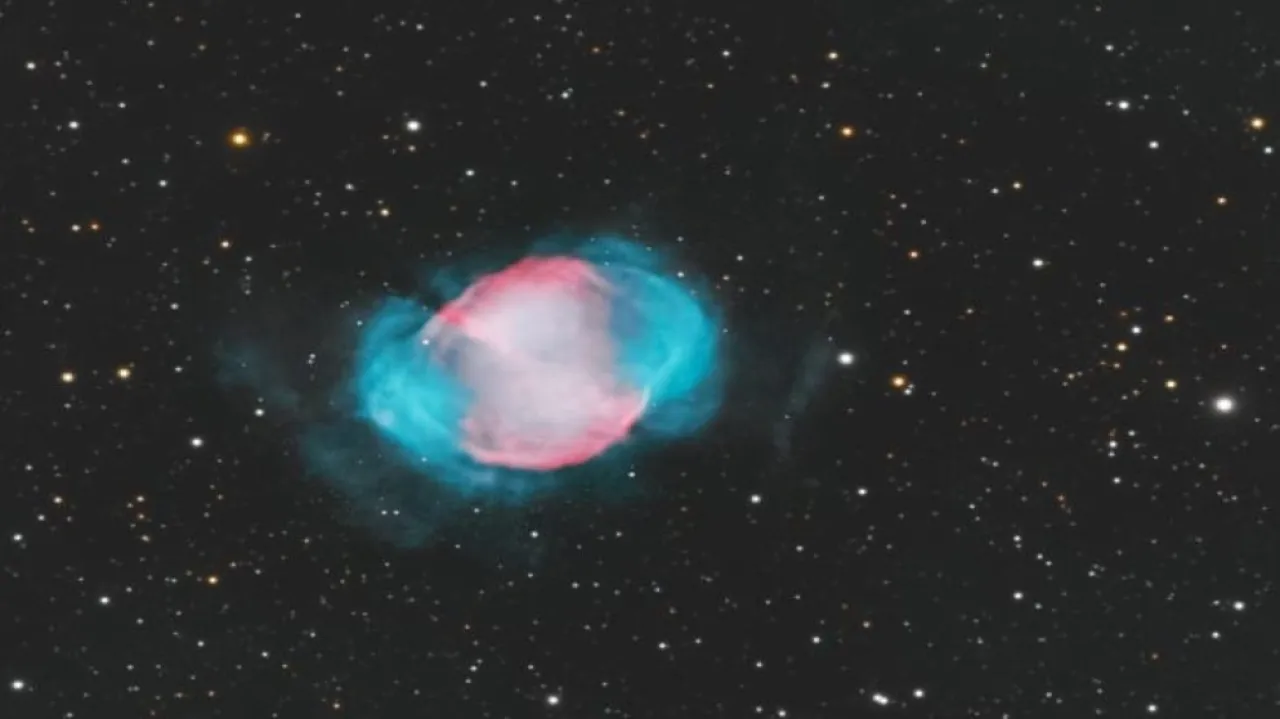
Khaberni - A team of Jordanian astronomers and amateurs using smart and simple computerized telescopes in Jordan, the UAE, Qatar, and the United States successfully observed and photographed the Dumbbell Nebula (Messier 27 – NGC 6853), with an exposure that extended to 13 hours, four minutes, and thirty seconds, comprising 4707 consecutive images, with each image lasting 10 seconds.
The astronomical observation was executed by Anas Odeh, Makthum Abu Allan, Haitham Hamdi, and Ammar Al-Sakaji.
The work on processing thousands of astronomical images took about 10 hours by Haitham Hamdi; this work enabled constructing a high-quality, high-resolution image of this planetary nebula, which showed some beautiful details such as the faint outer halos and the small gas nodes inside the central structure.
Ammar Al-Sakaji, president of the Jordanian Astronomical Association, said that the significance of this work lies in that it is a clear proof of the Jordanian astronomers' ability to actively participate in producing beautiful scientific and astronomical data, and that cooperation in the field of astronomy has become a scientific and cultural necessity, especially in light of the challenges of light-polluted skies and the need for data accumulation across multiple geographic locations.
He explained that the Dumbbell Nebula is not an ordinary object; it is one of the most famous and most studied planetary nebulae and represents an ideal model for understanding the fate of medium-mass stars like the sun. When the fuel of the original star was depleted, its core collapsed and transformed into an ultra-hot white dwarf with a temperature exceeding 85,000 Kelvin, while its outer layers were expelled into space forming a glowing gas cloud. The ultraviolet radiation coming from the white dwarf is what lights up this cloud, ionizing its atoms.
He continued, "When the electrons return to their orbits, distinct emission lines are emitted that make the nebula glow with colors we recognize: red from hydrogen, blueish-green from doubly ionized oxygen, and dark red from nitrogen,"
He clarified that these physical processes make the Dumbbell Nebula a fundamental reference in studying cosmic plasma physics.
He indicated that observationally, the Dumbbell Nebula is 1360 light-years away from Earth; that is 13 trillion kilometers, spans an area of about eight arc minutes in the sky, and its true diameter is estimated to be about 2 to 2.5 light-years, characterized by an expansion speed of about 25 kilometers per second.
He explained that these numbers indicate that the nebula's age does not exceed ten thousand years, which is short when compared to the age of the galaxy and stars, and estimates the temperature in its gases range between eight thousand and twelve thousand Kelvin, while the electron density ranges in the hundreds of electrons per cubic centimeter, a low density but sufficient to maintain a strong and clear emission.
He indicated that the inner structure of the nebula is much more complex than its simple dumbbell shape, with doubly ionized oxygen emission dominating the bright central core, while bipolar lobes extend as a result of interaction between fast winds from the central star and slower previous winds.
He pointed out that this interaction generates intermingling shocks that accelerate the gas and sculpt the lobes distinctively. On the edges, there are faint outer halos that are remnants of gas shells expelled at different stages, and surrounding the nebula are many nodules and small gas strands that appear relatively dense and cooler.
He explained that these structures are linked to hydrodynamic instability and the possibility of magnetic fields directing the movement of gas, and that infrared images published in various researches also showed dusty areas and remnants of H₂ molecules, which clarify that the nebula contains not only ionized gas but also cold and molecular remnants from the history of the star.
He added that the lessons presented by the Dumbbell Nebula are not limited to stellar physics but extend to understanding the matter cycle in the galaxy; as medium-mass stars scatter their layers into space, enriching the interstellar medium with heavy elements like carbon, nitrogen, and oxygen.
He pointed out that these elements are the basic building blocks of planets and life, thus the death of a star turns into a cosmic fertilization process contributing to the formation of new generations of stars, which makes planetary nebulae like M27 central to understanding galaxy evolution and cosmic physics.
He continued, "The Dumbbell Nebula was not always this clear in the past, it was first discovered in the 18th century and considered a puzzle for astronomers, as the concept of planetary nebulae had not yet evolved. William Her...