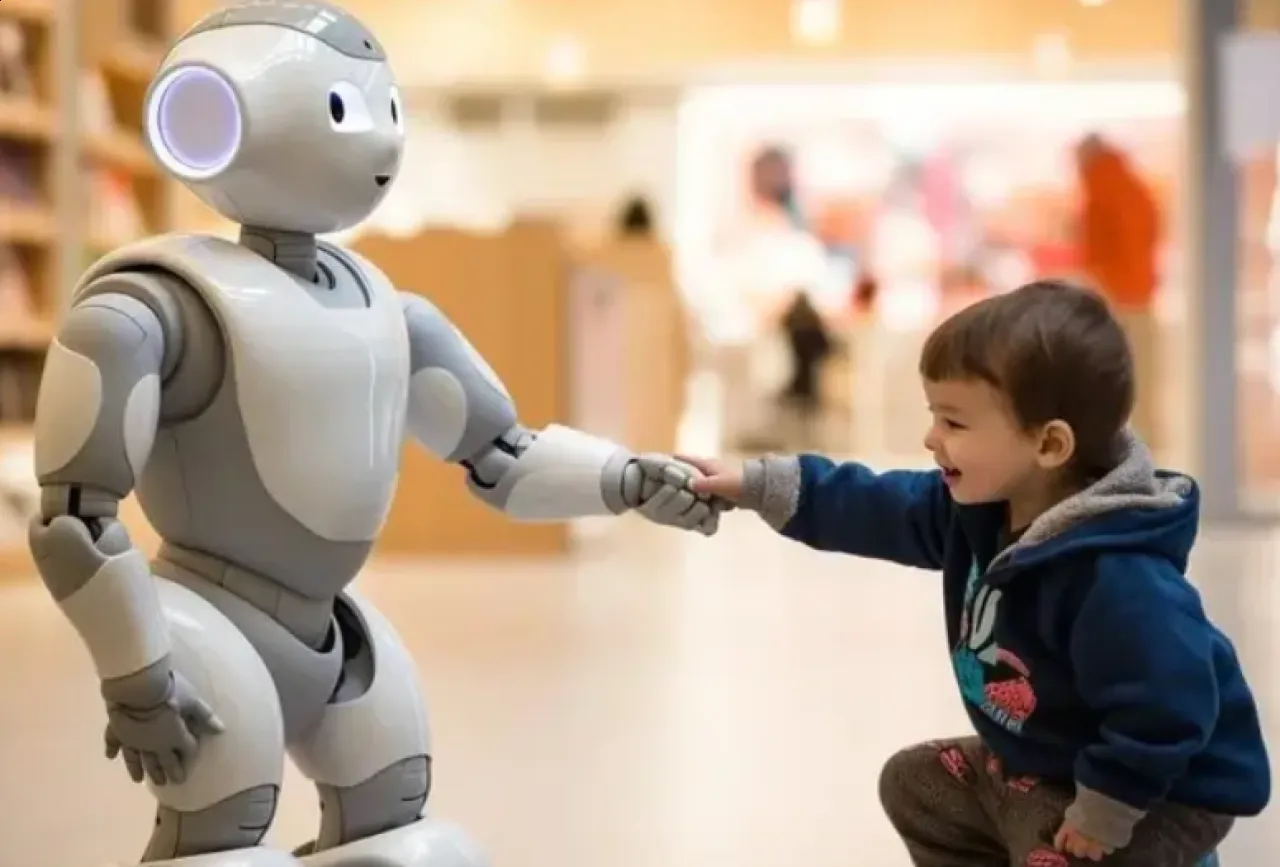
Khaberni -Najran University has developed an innovative project titled "Autism Robot," a scientific achievement that adds to the record of Saudi universities, marking an unprecedented step in using technology to support children with autism and their families.
Associate Professor of Psychiatry at the College of Medicine at Najran University, Dr. Hussein Al-Emad, in a statement to "Alarabiya.net," mentioned that the project integrates two smart applications; one in a smartwatch worn by the child, and the other on a phone belonging to one of the parents or their teacher. It develops linguistic skills, enhances the brain's executive functions, regulates emotional expressions, and ensures the child's protection and safety.
Recognizing the gap
Al-Emad explained that the idea came from recognizing the existing gap in post-clinic and training center care, saying, "As a consultant in child psychiatry and behavioral therapist, and based on my previous experience in technological innovation, I aimed to integrate cognitive-behavioral therapy techniques with sustainable smart solutions that provide real support for the child and their family."
The application helps non-verbal children to communicate by choosing pictures that express their needs, which are directly sent to the parent's or teacher's app, and it encourages the child to use language through recorded sentences and sounds, in return for which they receive points (motivational stars) that encourage them to gradually develop their language.
Supporting executive functions
Regarding supporting executive functions such as task ordering, parents or teachers can record simplified, numbered videos to explain specific important steps, like brushing teeth or dressing, to help the child execute them in the appropriate sequence, thus enhancing their mental organizational capabilities.
In terms of emotional expressions, the application assists the child in recognizing their feelings and expressing them, either by sending them to the caregiver, or selecting skills to manage them, which minimizes harmful behaviors like self-harm.
Safety element
The safety element is among the strongest points of the project, featuring a smart tracking option through Google maps, with the ability to set a "safe zone" for the child, and if they leave this area, the system sends an immediate alarm to the caregiver to prevent any potential danger.
Despite the significant progress, the journey has not been entirely smooth, as the team faced technical challenges, the most important being finding a programming language to connect the smartwatch with the application. However, support from Najran University facilitated the establishment of an international partnership with the "Guangzhou" Institute and the Chinese Academy of Sciences to enhance research collaboration and benefit from artificial intelligence technologies.
Achieving global reach
Today, the project aims to expand globally, as the app's language is currently being translated into Chinese and English, with requests from many countries to take advantage of these solutions, placing the Kingdom on the global map in the field of e-health and smart technologies for people with disabilities.
Al-Emad affirms that this project falls within the goals of Saudi Vision (2030), improves the quality of life for children with autism and their families, and enhances Najran University's status as an effective scientific institution, as the project was recognized in the World Summit on the Information Society in Geneva among the top 20 global projects in the field of e-health.
Quality initiatives
In the context of Saudi Arabia's commitment to the rights of individuals with autism spectrum disorder, with 8 pillars established, and amid rapid global developments in artificial intelligence and smart technologies, such quality initiatives emerge in Saudi Arabia, seeking to utilize these tools to address complex humanitarian issues, notably autism spectrum disorder.
Saudi Arabia grants those affected the right to education, health, play, social interaction, protection, communication, support, rehabilitation, care, and the right to participate, ensuring they can obtain cards with features to serve them from the Ministry of Human Resources and Social Development.
Multidisciplinary interventions
This disorder represents one of the most significant developmental challenges of the modern age and has become a global focus, requiring multidisciplinary interventions that extend beyond medical treatment to behavioral, social, and technical support.
According to the Secretary-General of the Saudi Charitable Society for Autism, Dr. Talat Al-Ouzaina, autism spectrum disorder is among the escalating developmental challenges globally. He notes that recent estimates suggest there is one autism case among every 100 children in the Kingdom, with the highest rates in major urban areas like Riyadh, Jeddah, and the Eastern Province, due to better diagnostic services and reporting.
Al-Ouzaina, in a special interview with "Alarabiya.net," mentioned that the Society – the first national entity specialized since its establishment in 1996 – currently serves about 700 beneficiaries across four main centers distributed throughout the Kingdom, adopting a scientific approach that combines behavioral intervention and the use of technology.
Introducing technologies
Al-Ouzaina confirms that the Society was pioneering in introducing modern technologies into the training environment, such as interactive screens and smartphone applications, to improve interaction and develop the linguistic and social skills of children, in addition to some families depending on alternative communication applications like AAC to enhance the child's ability to express and communicate effectively at home and in the community.
Tangible results
Studies – as Al-Ouzaina mentions – indicate that using technology in training children with autism has shown tangible results, including a British study that revealed a 60% improvement in social skills during a short training period, while studies from world-renowned universities like Stanford have demonstrated the role of virtual reality programs in reducing anxiety and improving emotional regulation in this group.
Between virtual reality applications, interactive robots, and smart solutions like "Autism Robot," Saudi Arabia proves it is steadfast in leveraging technology to serve humanity, particularly those most in need of support.