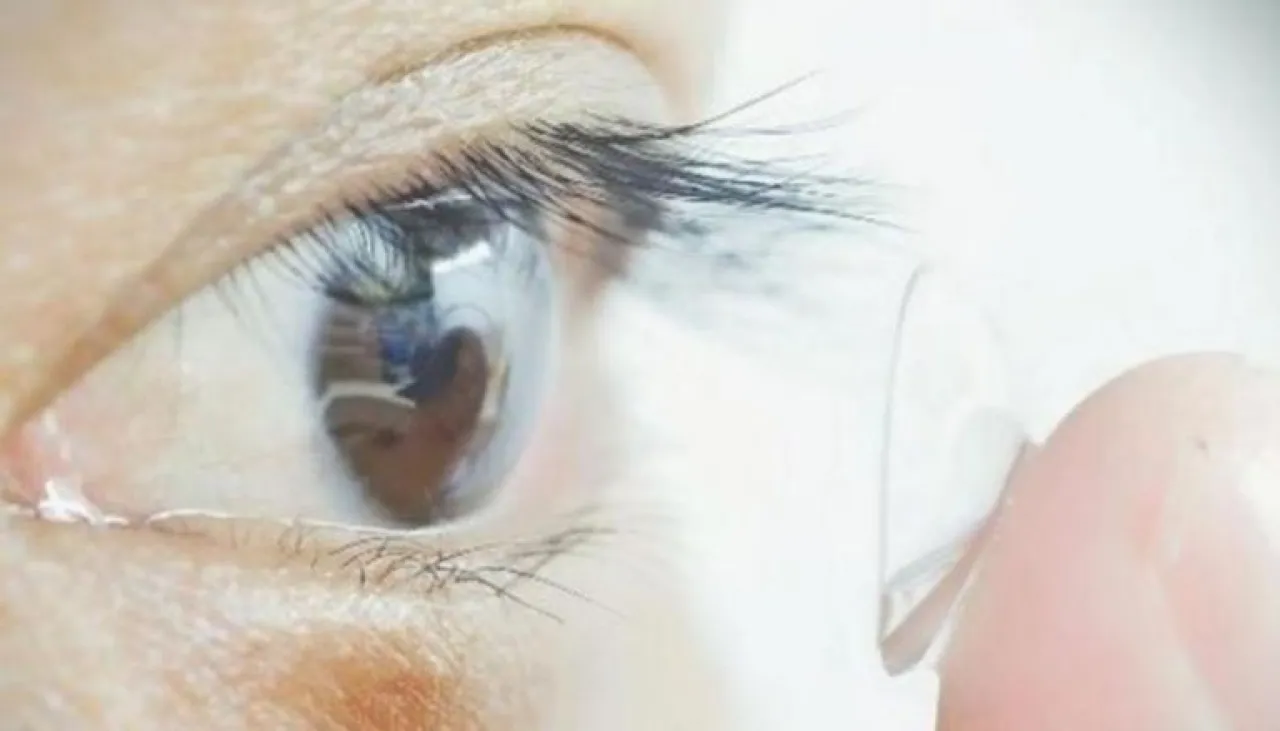
Khaberni -Khaleej Times - An international team led by Chinese scientists has developed contact lenses that allow humans to see near-infrared light, according to a study published in the scientific journal "Cell".
The study combines the science of visual neuroscience and rare earth elements to innovate transparent, wearable lenses that can convert invisible infrared light into visible images.
It is known that the human eye's ability to sense light is limited to wavelengths ranging from 400 to 700 nanometers, which obscures it from much of nature’s information. Near-infrared light, however, with wavelengths ranging from 700 to 2500 nanometers, is characterized by its ability to penetrate biological tissues with minimal radiation damage.
Researchers from the University of Science and Technology of China, Fudan University, and the Massachusetts Medical School have designed rare earth elements capable of converting three different infrared wavelengths into visible red, green, and blue light.
Previously, the scientific team had developed a nanomaterial that enabled mammals to see near-infrared radiation when injected into the retina. However, since this method is not suitable for humans, the scientists opted to develop a non-surgical solution consisting of soft contact lenses that can be easily worn. According to the study, the researchers modified the surface of the nanoparticles of rare earth elements, allowing their incorporation into polymer solutions and their use in manufacturing highly transparent contact lenses.
Experiments showed that volunteers who used the lenses were able to identify patterns and temporal codes of infrared radiation and even distinguish between three different "colors" of infrared light, thus expanding the range of human vision beyond its natural limits.
This non-surgical technology opens new horizons for potential applications in medical imaging, information security, rescue operations, and treating color blindness.
The lenses differ from night vision goggles in that they do not require a power source and provide a more natural vision in low-light conditions such as fog or dust.
Although this technology is still in the proof-of-concept stage, researchers believe it may pave the way towards future visual solutions that assist individuals with impaired vision, and reshape how humans interact with the invisible light spectrum.