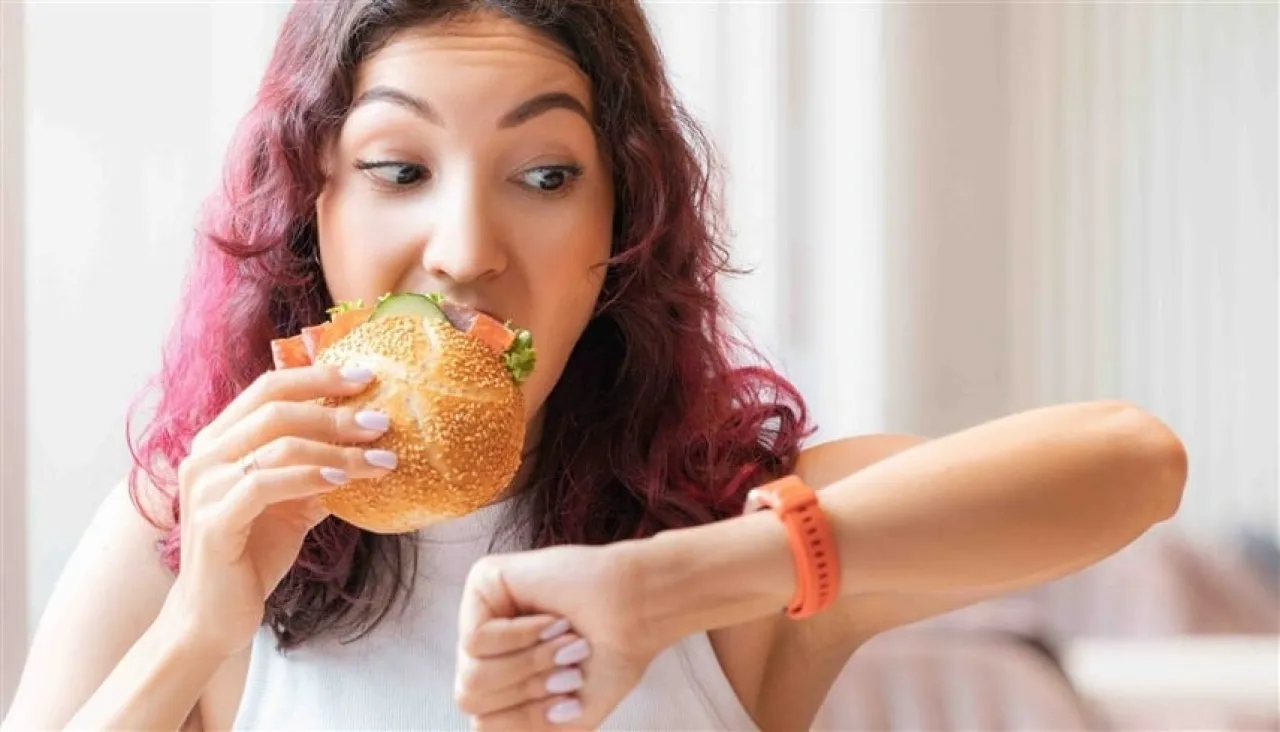
Tell me - Researchers from Fujita Health University have found that the type of food consumed affects the speed of its consumption, and that meals served in individual portions, consumed using utensils, prolong the duration of the meal, increase the number of chewing instances, and enhance the speed of chewing compared to fast food, regardless of whether vegetables are included in the meal first or last.
Typically, these types of meals are rich in fats and sugars, which can activate reward circuits in the brain, encouraging rapid consumption and addiction.
In the experiment that involved 41 people, aged between 20 and 65, each participant consumed 3 different meals over 12 weeks.
Comparison of 3 meals
The first meal consisted of a microwave-prepared pizza slice, eaten by hand.
After 4 weeks, the participants consumed a bento meal consisting of a burger steak slice with broccoli and rice, and they were asked to eat the vegetables first.
After another 4 weeks, they had the same bento meal, but were asked to eat the vegetables last.
Using video analysis and measuring chewing behaviors with a wearable BiteScan device, meal time and chewing speed were determined.
According to "Medical Express", the analysis showed that the bento meals led to much longer eating periods compared to pizza.
The average difference in duration was 182 seconds when eating the vegetables first, and 216 seconds when eating them last, both with minimal statistical significance.
The sequence of vegetable consumption did not significantly affect the meal duration.
Chewing speed
The bento meals divided into sections led to a significant increase in the number of chews and chewing speed, compared to pizza.
The number of bites did not differ noticeably between meals. No correlation was found between meal duration and body weight.
Impact of utensils
The researchers concluded that choosing meal types that require utensils and are served in individual components can effectively prolong meal time. This result may have implications for nutritional counseling and obesity prevention.
This means that the structural composition of meals and eating utensils affect behavior more reliably than the sequence of meals.
Previous experiments had determined that eating vegetables before carbohydrates is better. While this approach has proven its benefits in regulating blood sugar levels, its impact on meal duration and chewing patterns is unclear.