



Khaberni - An Israeli platform revealed a significant Egyptian move to deploy military forces and prepare bases in Somalia, a strategic step aimed at encircling Ethiopia and thwarting any potential Israeli influence in the Horn of Africa region.
The Israeli platform "Natsef Net" stated that local sources in Somalia confirm that Egypt has begun to prepare bases in anticipation of deploying military forces in the country.
The Hebrew platform added that the reports surrounding the deployment of Egyptian forces and the establishment of bases in Somalia represent a significant geopolitical earthquake in the Horn of Africa, indicating that this initiative aims to create a balance of terror against Ethiopia, which is strengthening its power amid intersecting interests related to Israel, Turkey, and Arab countries.
It pointed out that the main backdrop for this move is the strategic defense agreement signed between Egypt and Somalia, and Egypt's joining the new African Union peacekeeping mission in the country, which carries two main strategic implications:
First:
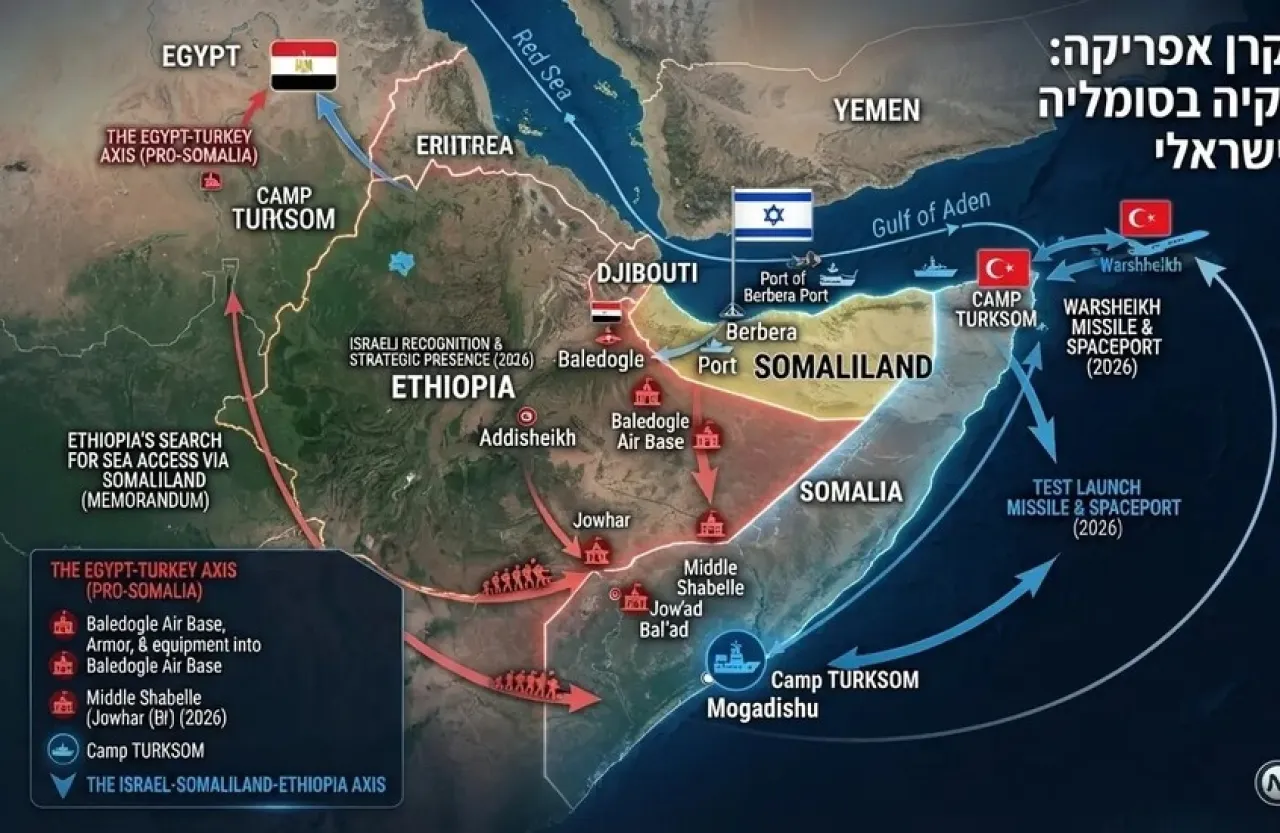
The direct confrontation with Ethiopia regarding the Renaissance Dam and the maritime outlet, where Egypt has a long-standing dispute with Ethiopia over sharing the waters of the Nile and the Renaissance Dam. When Ethiopia signed a memorandum of understanding with the separatist Somaliland region to obtain an outlet to the Red Sea and a naval base, Somalia saw this as a violation of its sovereignty.
Egypt seized the opportunity and stood by Somalia, initiating the flow of weapons and thousands of troops, potentially reaching about ten thousand individuals and advisors, to encircle Ethiopia from the east.
Secondly:
The response to the Israeli recognition of Somaliland, as in December 2025, Israel became the first country in the world to officially recognize the independence of Somaliland. The Egyptian military step is part of broader Arab concerns that include Saudi Arabia, regarding cementing an Israeli-Emirati-Ethiopian axis controlling the navigation routes in the Red Sea.
Egyptian positioning sites in Somalia:
The Hebrew platform stated that Egypt is not building a single base from scratch but is seizing and equipping several existing military camps and air bases previously vacated by peacekeeping forces like the Burundian forces.
The Egyptian forces, which include infantry, armored vehicles, Mi-24 attack helicopters, and drones, are concentrated in the following areas:
Balidogle Air Base:
A main strategic base located about one hundred kilometers northwest of Mogadishu.
Shabelle Middle Region:
Towns such as Jowhar, Bal'ad, and Mahaday.
Some forces are deployed near the western border with Ethiopia to form a direct deterrent force.
Connection to the Turkish missile base:
The Egyptian base does not physically join the Turkish base, but the two operate in close strategic coordination.
Turkey owns its largest military base outside its borders in Mogadishu, Somalia. Additionally, Turkey is building a space and strategic missile base at a cost of about 350 million dollars in Warshikh, seventy kilometers north of Mogadishu.
Officially, this is a civilian spaceport, but intelligence reports have revealed that the site will serve as a testing ground for long-range ballistic missiles belonging to Turkey, benefiting from a safe launch path over the Indian Ocean and proximity to the equator.
The essence is that Turkey and Egypt, which have normalized their relations, are integrating their forces in Somalia. While Turkey provides maritime protection through an agreement to guard the Somali coast and technological capabilities and missiles, Egypt provides the land presence and direct military response against Ethiopia.
Implications for Israeli presence in Somaliland:
The Hebrew platform indicated that the Israeli recognition of Somaliland has opened the door to a dramatic change in Israel's spatial security, which can be summarized in the following axes:
Shortening the range for the Houthis:
The presence at Berbera International Airport shortens the Israeli Air Force's flying distance to Yemen from one thousand eight hundred kilometers to only five hundred and fifty kilometers. The impact of the Egyptian-Somali move is reflected in Egypt and Somalia's attempt to exert political and military pressure to prevent renting Berbera or establishing a permanent base for Israel.
Strategic depth and air defense:
The deployment of radars, sensors, and interception tools in the Horn of Africa allows for the detection and interception of missiles at the acceleration stage. Establishing the Turkish missile port and Egyptian bases in southern Somalia aims to balance this capability and act as a threat card against Israeli assets in the region.
Training and cooperation:
Israel already offers training to the army and police forces in Somaliland. Somaliland is now under threats of invasion by the Somali government, supported by Egyptian and Turkish arms, placing Israel before the choice of strengthening the military alliance and protecting its new ally or avoiding direct confrontation with Cairo.
The Hebrew platform concluded its report stating that the Horn of Africa is turning into a direct confrontation arena between the Israel-UAE-Somaliland-Ethiopia axis and the Arab-Islamic axis represented by Egypt, Turkey, and Somalia.
The military reinforcement by Egypt and Turkey in Somalia is a direct attempt to restrict the military and intelligence freedom that Israel seeks to gain on the Gulf of Aden shores.
It is worth noting that the Horn of Africa is recently witnessing a marked escalation in regional and international competition for influence, as Egypt seeks to strengthen its strategic alliances to protect its water and national security against the Ethiopian Renaissance Dam, while Turkey is trying to expand its military and economic influence in the region.
Meanwhile, Israel seeks a new foothold in the Horn of Africa region through rapprochement with Somaliland to compensate for the direct absence of access to the Red Sea, making Somalia and its coasts a theater for a complex geopolitical conflict where Arab, Turkish, and Israeli interests intersect.