Khaberni - Palestinian President Mahmoud Abbas condemned the United States' decision not to grant him and members of the Palestinian delegation visas to attend the United Nations General Assembly meetings in New York in person, describing the move as "punitive measures." He also warned of the occurrence of "another catastrophe and massacres" against Palestinians, calling on world leaders to act to prevent displacement and protect civilians, and affirmed that the Palestinian people will not leave their land and will not accept others deciding their future on their behalf.
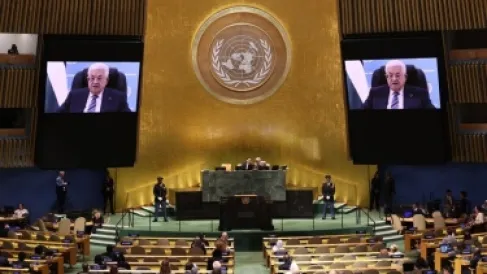
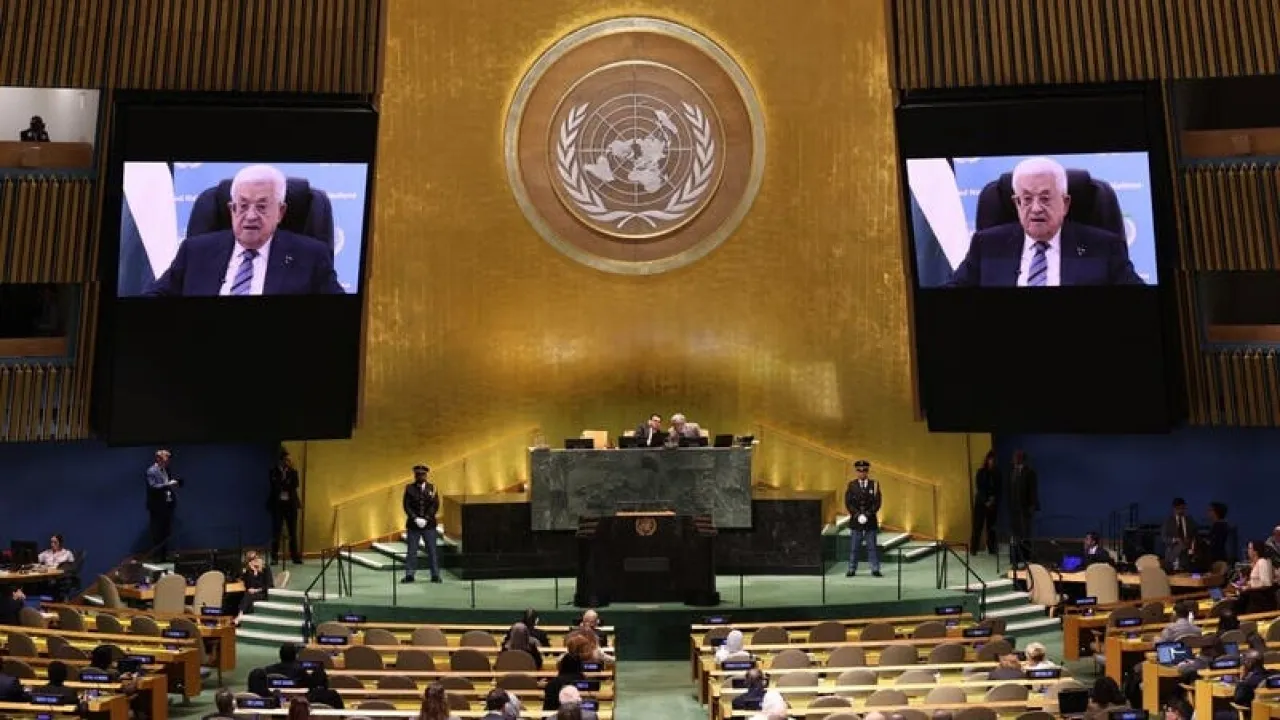
Abbas said in a speech delivered via video at the General Assembly: "We reject the measures that prevented the Palestinian delegation from attending the United Nations meetings," after he was unable to travel to New York to participate in the 81st session of the General Assembly.
Washington had refused to grant Abbas and several members of the Palestinian delegation visas to enter the United States to participate in the high-level meeting week. "Associated Press" confirmed days ago that Abbas was among the Palestinian officials who did not receive visas, while the American administration approved the entry of Iranian officials to participate in the meetings.
A non-armed state
Abbas also affirmed that Palestinians want to establish an unarmed Palestinian state living side by side with Israel, within a two-state solution framework.
In domestic affairs, the Palestinian President announced that legislative elections would be held in November (November) next, a step that comes within his talk about the future of Palestinian institutions and arrangements for the next stage.
In related context, Abbas warned that Israeli policies, in his words, no longer just threaten the chances of implementing the two-state solution and establishing the Palestinian state, but now threaten "the life and existence of the Palestinian people" on their land.
We will not accept displacement
Abbas stressed that the Palestinian people "will not leave their homeland and will not accept displacement," emphasizing the rejection of any party deciding the future of the Palestinians on their behalf, and clinging to a peace based on international legality, which ensures, according to his vision, freedom and independence for the Palestinians, and security and peace for all peoples of the region.
He said: "We will not continue to wait, and we will not accept what the governments of the Israeli occupying state determine for us," adding that permanent security cannot, according to his position, be based on occupying another people and depriving them of their rights.
He explained that the Palestinian national project is based on protecting Palestinians from displacement, preserving the unity of the land, democratically renewing institutions, leading to the establishment of an independent Palestinian state with sovereignty and its capital in East Jerusalem, while sticking to the refugee issue according to UN resolution 194.
"Do not allow another catastrophe"
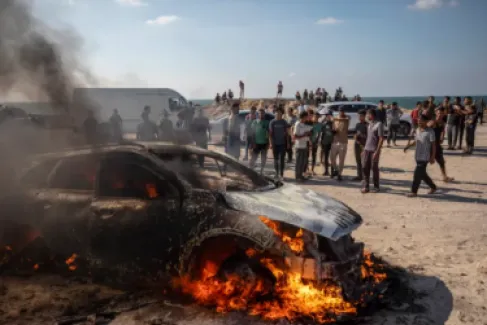
Abbas addressed world leaders saying, "Do not allow another catastrophe and massacres like those that occurred in 1948," adding: "Do not allow terror gangs protected by the occupation forces to burn Palestinians' homes while they sleep in them, and do not allow our children to live under fear and threat."
He considered what is happening in the Gaza Strip and the West Bank, including East Jerusalem, not isolated incidents, but part of what he described as a plan aimed at forcing Palestinians to leave their land compulsorily.
Abbas also emphasized that he does not want "a new process of managing the conflict," but rather a path that ends the occupation and ensures freedom and self-determination for Palestinians, and security and peace for Israelis and the countries of the region.
The third phase for Gaza
In the Gaza file, the Palestinian President called for the speedy implementation of the second phase of President Trump's plan, warning that the transitional phase could become a permanent or open situation without a clear time and political horizon.
He said that this phase must end with the reunification of the Gaza Strip and the West Bank, including East Jerusalem, under the jurisdiction of the State of Palestine and its institutions, according to the principle of "one state, one government, one law, and one legitimate weapon."
Abbas returned to the issue of not granting the Palestinian delegation visas to reach New York, describing the measures as "punitive and illegal," and called on the American administration to backtrack on them and return to dialogue and cooperation with the Palestinians and the international community for the implementation of the two-state solution.
Palestinian-American dispute
The American administration justified its decision with accusations against the Palestinian Authority related to resorting to international institutions and courts in their conflict with Israel, in addition to other issues of dispute between Washington and Ramallah. In contrast, the Palestinian Authority considered the American measures punitive and affecting its ability to participate in the work of the United Nations.
The current session of the General Assembly is convened amidst a significant focus on the Palestinian issue. The general debate in New York started on September 22 and continues until the 28th, with the participation of heads of states, governments, ministers, and high-level representatives.
Gaza and the West Bank in the forefront of meetings
Abbas's speech comes as the situation in the Palestinian territories occupies a prominent place in the deliberations of world leaders in New York. Guterres called at the opening of the general debate for a ceasefire and the entry of humanitarian aid, also warning that violence, displacement, and settlement expansion in the West Bank undermine the chances of a two-state solution.
Palestine holds the status of a non-member observer state at the United Nations, allowing it to participate in the organization's activities without possessing full membership rights.
With Abbas absent from New York, his recorded speech served as the platform through which he presented the Palestinian position to world leaders, while the visa issue added a new chapter to the conflict between the Palestinian Authority and the American administration.