




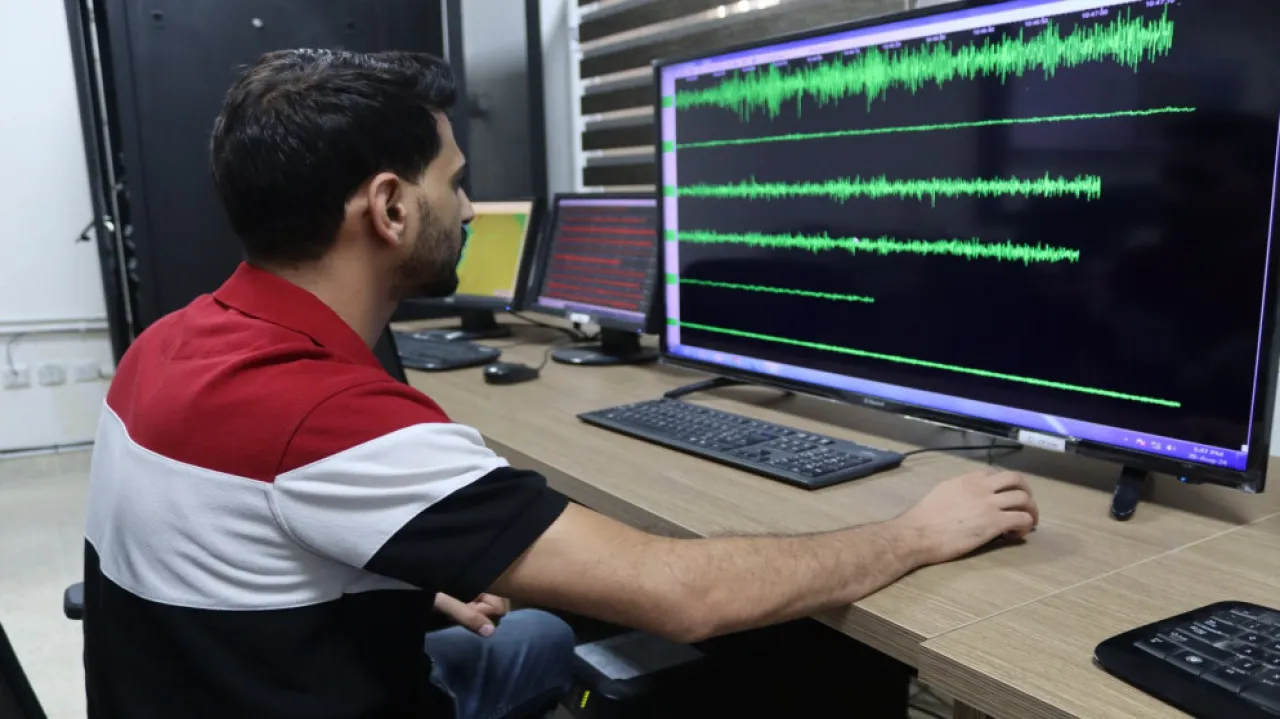
Khaberni - The Jordanian Earthquake Observatory confirmed that the seismic activity in Jordan and the world is stable, with the observatory having recorded 324 local and distant earthquakes from the beginning of 2026 until August 16.
The director of the observatory, Ghassan Sweidan, said that the seismic activity in Jordan is currently stable, ranging from weak to moderate, noting that 63 local earthquakes have been recorded since the beginning of 2026 until August 16, compared to 71 earthquakes during the same period in 2025, a decrease of about 11.3%.
He explained that the seismic activity along the Dead Sea Fault and the destruction pit ranges from weak to moderate, confirming that there has been no radical or unnatural change in the seismic activity along the pit.
Sweidan pointed out that the recent discussions about an increase in global seismic activity are mainly due to advancements in earthquake monitoring and recording technologies, which now allow for the detection and documentation of small and undetectable earthquakes.
Regarding the earthquakes recently experienced in Venezuela, Colombia, and Indonesia, Sweidan said they are tectonic events resulting from natural movement in areas of high seismic activity, where the nature of the tectonic movement stores a large amount of seismic energy that is released violently and destructively when an earthquake occurs.
He noted that the occurrence of earthquakes in different areas is a natural matter, linked to tectonic movements and the convergence and interconnectedness of seismic activity belts, indicating that each seismic region has its specificity in terms of the nature of its structures, seismic history, and type of tectonic movement.
He indicated that the assessment of these earthquakes underscores the need for full readiness from all entities to mitigate the effects of similar earthquakes.
Sweidan confirmed that strong and destructive earthquakes can stimulate the occurrence of earthquakes in other areas, explaining that the seismic belts around the world are greatly interconnected, and the arrival of seismic waves from destructive earthquakes to active faults and fractures may activate them and cause earthquakes to occur, citing the 2023 Turkey earthquakes as an example.
Sweidan said that the maps and seismic monitoring records available at the Jordanian Earthquake Observatory show that the annual rate of earthquakes is stable and within natural rates in terms of number and strength locally, regionally, and globally.
The Jordanian Earthquake Observatory has recorded 261 distant earthquakes since the beginning of the current year, concentrated in the Indian Ocean, Pacific Ocean, and Atlantic Ocean, in addition to Indonesia, the Philippines, Colombia, the Kamchatka Peninsula, the Kuril Islands, Japan, and China.
Sweidan indicated that the observatory recorded the strongest earthquake since the beginning of 2026 in the Philippines, with a magnitude of 7.8 on June 7, while the strongest earthquake recorded during the same period of 2025 in the Kamchatka Peninsula in Russia, reached a magnitude of 8.7, on July 29, 2025.