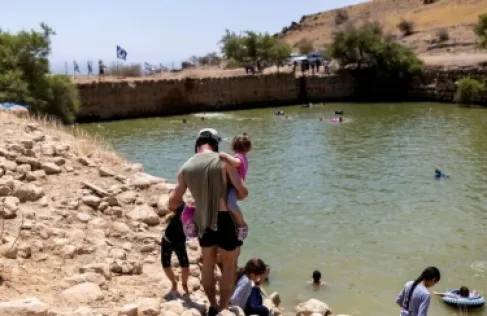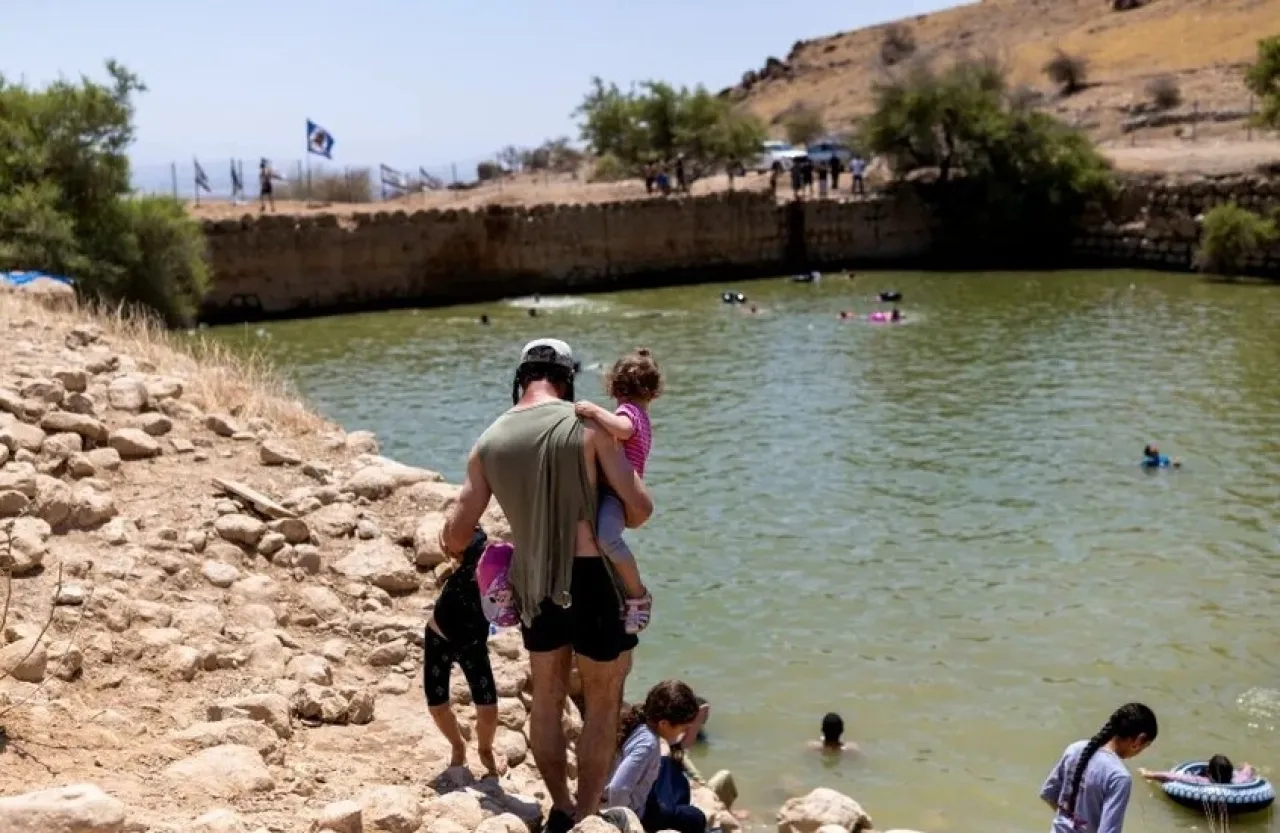
Khaberni - Israeli settlers wage a silent war on Palestinian water resources, recently initiating the conversion of water springs into exclusive pools for Jews.
All of this comes within a systematic plan aimed at displacing the population and strangling their agricultural economy.
In the village of Fasayil in the fertile Jordan Valley, Palestinian farmer Saad Nimer provides a vivid picture of this suffering. Three months ago, settlers seized the irrigation pipeline on his land, redirecting the water flow to an old pond at a nearby archaeological site, leaving his fields that were thriving with eggplants, zucchini, and watermelon to face drought.
Nimer says: "They cut off the water line and took it over... Three months have passed and not a single drop of water has reached us to enable farming." The damage extended not only to the crops but also threatened the livelihoods of whole families, amidst physical assaults and threats targeting the workers and farmers who tried to approach the spring.
Instead of compensating the farmers, the settlers promoted the site as an "Israeli tourist landmark" named "Herod's Pools," backed by substantial financial funding from the extreme right-wing Israeli Finance Minister Bezalel Smotrich, who allocated 3 million shekels (about one million dollars) for what he called "restoration and development" of the site. Despite Nimer owning official ownership documents and maps registered since 1957 proving that the spring and pond are within his land, appeals to the specialized Israeli military authorities were completely ignored.
These practices are not limited to the village of Fasayil but represent a widespread pattern. According to United Nations data, Israeli settlers have launched attacks on at least 160 water and sanitation sites across the West Bank this year.
In an interview with "SwissInfo", Adel Yassin, the General Director of Planning at the Palestinian Water Authority, describes these practices as a "war on water," considering it "a silent attack without bullets, but more deadly; a bullet kills an individual, whereas cutting off water kills an entire community."
In this context, Palestinian field researcher Fares Faqha estimates that settlers currently control about 95% of the water springs in the northern Jordan Valley, leading to forced displacement waves of the local population. The forms of water blockade vary, as in the town of Qusra, settlers imposed a stifling blockade on several homes by cutting off their water and electricity, while hundreds of them flocked to "Wadi al-Badhan" near Nablus, one of the last remaining water retreats for Palestinians, and dominated its sessions and streams.
The settlers' statements on the ground reflect the extent of their arrogance and violation. During one of his visits for swimming in the pool of Fasayil, settler Yishai Schreiber (21 years old) boasted that the intense Jewish presence now terrifies Palestinians and prevents them from approaching, claiming that "the West Bank belongs to the Jewish people, and the Palestinians should leave if they do not accept Jewish authority."
To justify this seizure, settlers employ historical narratives, where settler leader Eliav Libi - subject to international sanctions - posted video clips of filling the pond, claiming that it belonged to King Herod in the biblical era
. However, Israeli archaeologist Alon Arad from the human rights organization "Emek Shaveh" disputes this narrative, confirming that the origin of the pond is unclear, and that settlers are using archaeology as a political tool to create an impression that the West Bank is "exclusively Jewish", pointing out that filling the archaeological site with water causes grave damages to the history of the region.