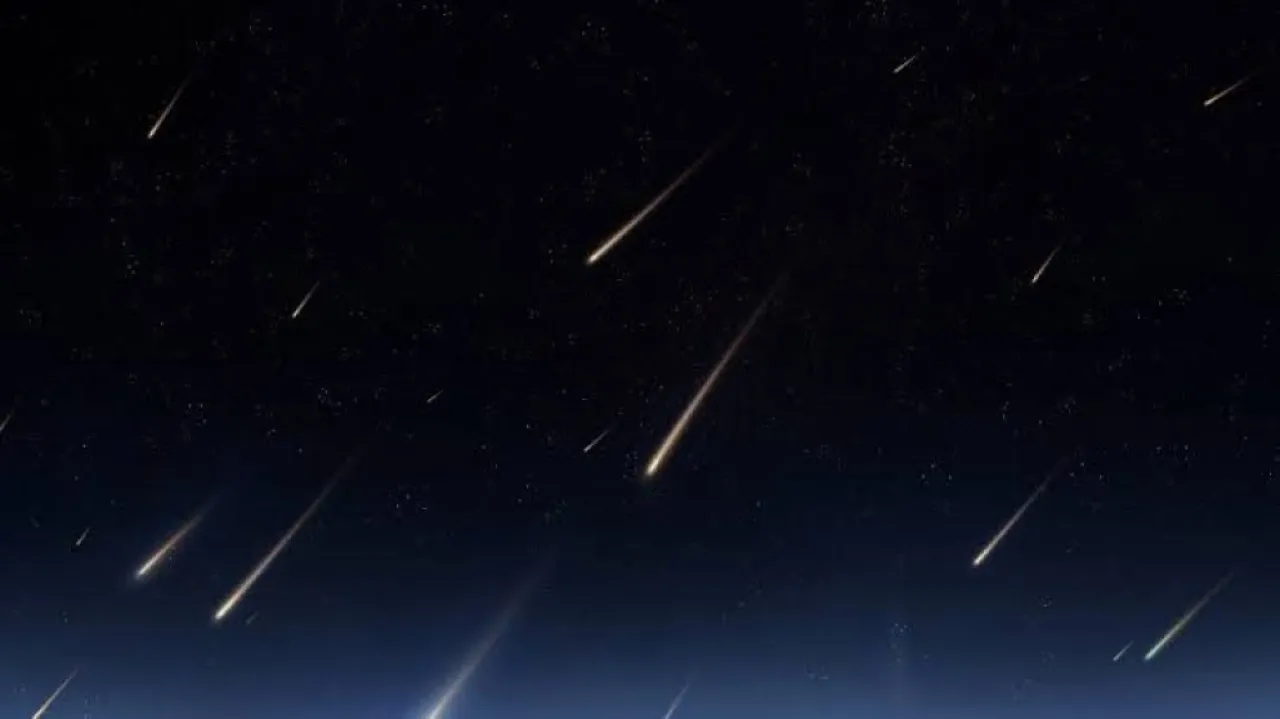
Khaberni - The skies of Jordan and the Arab world are getting ready to witness the peak of the Perseid meteor shower during the night of Wednesday/Thursday, 12–13 August, which is one of the notable annual astronomical phenomena. The Jordanian Astronomical Association expects that around 60 meteors per hour could be observed in Wadi Rum just before dawn, which is the best time to watch the shower.
According to Ammar Al-Sakaji, president of the Jordanian Astronomical Association, the Perseid meteor shower began its activity on 17 July and will continue until 24 August, reaching its peak on the night of 12–13 August.
He explained that most of the Perseid meteors are bright and fast-moving, and some leave a light trail that lasts for several seconds after the meteor has disappeared, because of the ionization of gases in the upper layers of the atmosphere as the particles of the shower enter at a speed close to 59 kilometers per second.
He added that the Perseid meteor shower is considered one of the periodic meteor showers, and its source is the periodic comet "Swift-Tuttle," which completes an orbit around the sun approximately every 133 years. Annually, in August, the Earth crosses a belt of rocky particles and dust left by the comet, which glow when they enter the atmosphere. He assured that there is no danger from these meteors.
He indicated that the theoretical zenithal hourly rate (ZHR) of the Perseids is about 100 meteors per hour. However, this figure is calculated under ideal observing conditions, which include extremely dark skies, absence of moonlight, the radiant of the shower being at the zenith, and a clear atmosphere.
He noted that the Jordanian Astronomical Association conducted a study to estimate the expected number of meteors that a single observer in Wadi Rum could see during the peak of the shower, based on the methodology used by the International Meteor Organization (IMO), considering the geographical location of Wadi Rum, the new moon conditions, the level of light pollution, and results of astronomical simulations using the "Stellarium" software, along with the application of mathematical equations for predicting meteor rates and conducting computer modeling supported by artificial intelligence.
According to the study's results, the meteor rate is expected to start at about 11 meteors per hour at 10 PM, increasing to about 36 meteors per hour at 1 AM, then to approximately 55 meteors per hour at 4 AM, before reaching about 60 meteors per hour in the period just before dawn.
Al-Sakaji advised not to just look towards the constellation Perseus, but to any dark part of the sky, as meteors could appear in various directions, although they seemingly radiate from the constellation Perseus.
He also recommended allowing the eyes approximately 20 to 30 minutes to adjust to the darkness, avoiding looking at mobile phone screens or bright light sources, and preferably lying down or using a reclining chair to broaden the field of view and increase the chances of observing more meteors.