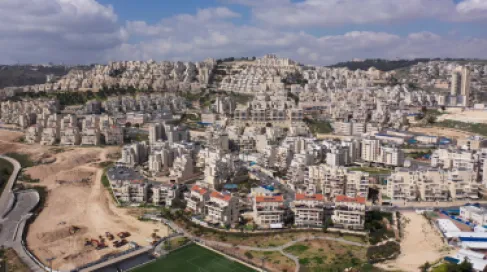
Khaberni - The National Office for the Defense of Land and Resistance to Settlement stated in its periodic report, today Saturday, that the occupation authorities employ "military orders" to expand the areas of influence of settlements.
The report explained that the occupation authorities have issued a total of 114 military orders since that date for the establishment or expansion of settler areas of influence, a number almost equal to the total of orders issued over more than twenty previous years.
It added that these orders, according to Israeli estimates, added more than 25,000 dunams to the areas of influence of settlements, paving the way for the establishment of 53 settlements, including 39 new ones and 14 arising from administrative separation from existing settlements, along with 11 cases of expansion of existing areas of influence.
The report pointed out that although these orders usually do not receive wide media attention, they have become a pivotal stage in the settlement expansion process, as including land within the area of influence of a settlement earmarks it for future development, turning it into a base for planning infrastructure and expanding construction operations.
It mentioned that in many cases, these orders precede the actual establishment of settlements by years, but they determine the future of the land from the moment they are issued.
In this regard, a recent report by the Israeli human rights organization "Bimkom" noted a significant development during the year 2026, which involved designating settlement influence areas on lands previously inhabited by Palestinian communities that were displaced in recent years. Among these, for example, were the communities of Ein Samia and Al-Ma'rajat Al-Wusta, whose residents had to leave their lands following persistent and increasing pressure from settlers.
According to the organization, areas of new settlement influence were later designated at these sites, creating significant legal and planning obstacles against any future possibility for the displaced residents to return to their lands.
The report added that the impact of these military orders includes not only the expansion of existing settlements but also the consolidation of Israeli control over areas emptied of their Palestinian inhabitants, turning temporary displacement into a permanent reality.
The report of the Israeli human rights organization, which is concerned with "promoting social justice, equality, and human rights in the fields of spatial planning and housing and land policies," also highlighted military orders issued during the year 2026 to designate areas of influence for new settlements in parts of the northern West Bank that had previously been free of settlements.
The organization observed that the cumulative effect of these actions exceeds the boundaries of each settlement individually, as establishing new settlement influence areas in strategic locations in the West Bank leads to further fragmentation of Palestinian space, restricting future Palestinian urban development possibilities, and strengthening the occupation's control over vast areas of the region classified as "Area C."
The report added that Palestinian communities in Area "C" still lack similarly recognized areas of influence, significantly limiting the ability of local Palestinian authorities to plan and expand housing, develop infrastructure, and provide basic services to the population.
The report noted that the situation is not limited to Area (C); it also extends to Areas classified (A) as well.
It pointed out that “Israel Hayom” newspaper revealed last Monday hidden orders within a settlement plan to control about 100 strategic points within Area (A) under the Palestinian Authority in the occupied West Bank, considering this a serious shift in the course of the Israeli annexation policy.
The newspaper said that a plan being prepared by settlement movements in the West Bank aims to bring about a radical change in the map of the region by targeting the areas classified (A). It explained that the plan, led by the "Settlement Farmers Union" and the "Habita" (Homeland) forum, and published by the newspaper for the first time, outlines a mechanism for positioning forces at about 100 strategic points in the West Bank, in what is called "Order Day" or "Execution Day."
It added that these points are located deep within the areas classified (A) under civilian and security control by the Palestinian Authority pursuant to the Transitional Stage Agreement of 1995, noting that the plan was presented to Israeli government ministers and figures close to Prime Minister Benjamin Netanyahu.
This plan coincides with the continuation of the Israeli army in establishing a military site within Area classified (A) in the city of Jenin, after seizing, by military orders, Palestinian-owned lands.
The report added that the plans to control the West Bank are based on this premise, according to a systematic plan that had been prepared in advance, turning what was merely settlement expansion into a process of actual annexation and a comprehensive restructuring of reality, undermining any future prospect of establishing a contiguous Palestin...