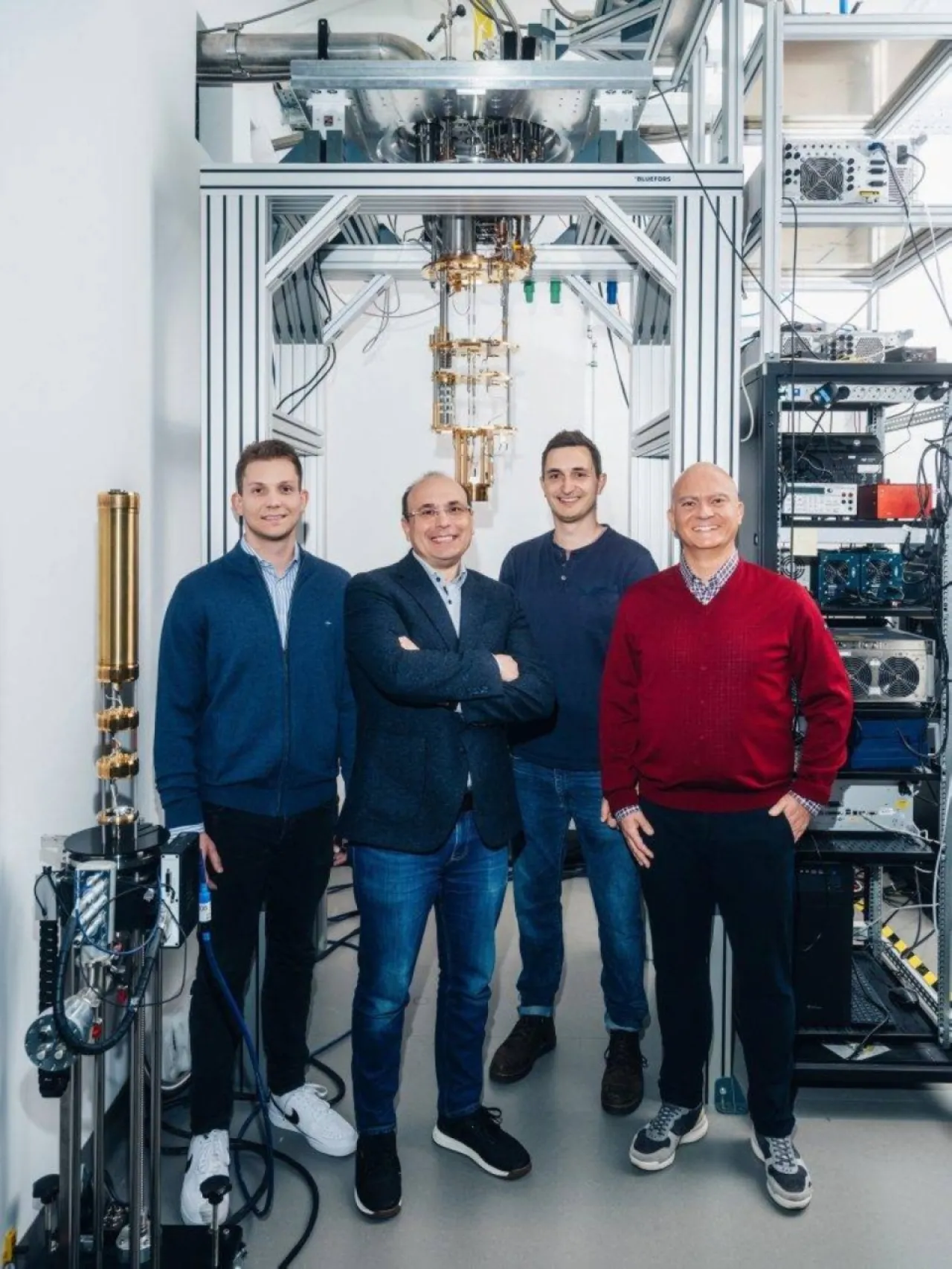
Khaberni - An international team of scientists, led by researchers from the University of Vienna, achieved a scientific breakthrough that may change the future of quantum computing by successfully overcoming one of the biggest challenges in the field, which is the short lifespan of the magnetic particles known as magnons.
Magnons are tiny magnetic waves that travel within solid materials and can be used to transmit quantum information.
However, the problem that scientists faced over the years was that they disappeared very quickly, as their lifespan did not exceed a few hundred nanoseconds, which is a very short period that did not allow for their use in running quantum computers according to scitechdaily.
According to the study, which was published in the journal Science Advances, the researchers managed to extend the lifespan of these particles to about 18 microseconds, which is nearly 100 times the duration previously recorded by studies.
Although this duration may seem extremely short in our daily lives, it represents a significant leap in the world of quantum physics, as it provides magnons with enough time to transfer information more efficiently.
The scientists hope that this development will contribute to the design of smaller and more efficient quantum computers, as magnons have the ability to move within very small chips, which may allow in the future the development of quantum circuits similar in size to smartphone chips, and possibly the development of quantum computers no larger than a metal coin.
To achieve this milestone, the researchers used a special type of magnons that are less affected by defects on the surfaces of crystals, and they resorted to cooling the material used in the experiments, yttrium iron garnet (YIG), to a temperature close to absolute zero, which significantly reduced the thermal effects that lead to the rapid disappearance of magnons.
The results showed that the main reason for the short lifespan of these particles was not due to the laws of physics themselves, but to the quality of the material used in their manufacture.
The purest samples recorded a longer lifespan for magnons, which suggests that improving material quality could open the door to achieving better results in the future.
The researchers believe that magnons may eventually become an effective means to store or transfer quantum information between hundreds of quantum computing units within a single chip, which could help build more powerful and efficient quantum computers. They can also act as a linker between different quantum technologies, which could accelerate the development of the next generation of quantum computing devices and bring them closer to practical use.