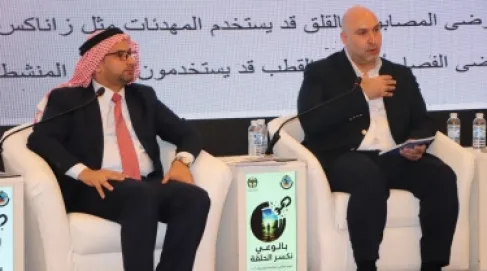
Khaberni - Two specialists confirmed on Monday that reducing pharmaceutical waste in Jordan requires an integrated system that includes unifying therapeutic protocols, enhancing the role of the clinical pharmacist, and electronically linking healthcare systems between the public and private sectors, as well as raising community awareness regarding the prudent use of medications.
They emphasized during their talk on the program "Voice of the Kingdom" that pharmaceutical waste is not limited to financial cost, but extends to serious health effects, the most notable being antibiotic resistance and increased treatment costs.
They pointed out that Jordan has an advanced pharmaceutical system and a leading national industry, which have contributed to ensuring pharmaceutical security and the continuous availability of medications even during crises, affirming that the Jordanian pharmaceutical sector has become a pillar of the national economy and an ambassador for the Kingdom in dozens of global markets, while efforts continue to develop legislation, enhance the investment environment, and expand export markets.
Dean of Pharmacists Dr. Wasfi Al-Nawafleh, said that the term "pharmaceutical waste" has become widely used, and it means patients obtaining medications beyond their need, stating that this problem has multiple causes and addressing it requires practical measures, foremost of which are unifying and developing therapeutic protocols across various health institutions.
Al-Nawafleh clarified that the Ministry of Health has already begun unifying therapeutic protocols, especially for cancer patients, so that a patient receives the same treatment whether in the King Hussein Cancer Center or the Ministry of Health or the Royal Medical Services, confirming that this step will save significant amounts of medications, and can later be generalized to other chronic diseases, reflecting positively on the treatment bill.
He added that among the key solutions is also activating the role of the clinical pharmacist, which has proven in many developed countries its role in reducing treatment costs and improving medication use, stating that this role has started to expand in Jordan but has not yet reached the desired level.
Al-Nawafleh confirmed that it is also essential to complete the electronic linking between all health institutions in the public and private sectors, so that a doctor can access the complete medication file of a patient, know the medications previously dispensed to them, and thereby prevent the same treatment from being dispensed by more than one entity, significantly reducing pharmaceutical waste.
He explained that electronic linking is currently partial, but completing it will address an important aspect of the problem, as it will enable a doctor to know whether a patient has received the same treatment from another health center or hospital, and thus prevent its repetition.
He pointed out that raising the level of awareness among citizens is a fundamental component in reducing waste, urging patients to avoid visiting more than one health center to obtain the same medication, and emphasizing the importance of having a unified health file to prevent duplicate prescriptions.
Meanwhile, President of the Jordanian Association of Pharmaceutical Manufacturers Khalid Harb, stated that pharmaceutical waste is not linked to one entity alone, but it is the result of an integrated system that starts with community and patient culture and does not end at the doctor or pharmacist or regulatory bodies, explaining that the community has become accustomed to storing quantities of medications at home, alongside some patients' belief that a doctor does not provide good treatment unless they prescribe an antibiotic or multiple medications in one prescription.
He explained that the improper use of antibiotics not only leads to medication wastage, but it raises the rates of bacterial resistance to antibiotics, which subsequently necessitates resorting to more expensive treatments, and may require admitting patients to hospitals or intensive care, thus doubling the burdens on the healthcare system and the state.
He said that the discourse on pharmaceutical waste must be viewed from two angles; the first is health-related concerning patient safety, and the second is economic related to the rising treatment bill borne by the government due to improper medication use.
Al-Nawafleh noted that there are currently no accurate statistics on the extent of pharmaceutical waste in Jordan, although there are estimates that speak of tens of millions, explaining that the public sector spends about 300 million dinars annually on purchasing medications, but the waste is not limited to the public sector, it also includes the private sector, where some citizens purchase medications they do not need and store them at home.
He called on citizens to maintain continuous communication with the pharmacist, considering them the closest advisor regarding medications, emphasizing the importance of regularly reviewing the medications available at home, verifying their validity, and using them before their expiration if they are still valid and needed by someone else, thus contributing to reducing waste.
In terms of pharmaceutical production, Harb asserted that discussions about the existence of a surplus in medication production are not accurate, clarifying that pharmaceutical manufacturing differs from many other industries as it is based on demand and not for the purpose of storage or display in markets.
He said that the size of the Jordanian pharmaceutical market is about 700 million dollars, equivalent to nearly 500 million dinars, and production is based on the demands of the local market and export markets, explaining that pharmaceutical companies rely on accurate studies of market demand and market share before setting production plans.
He added that the rate of damaged medications does not exceed 3%, and it is mostly due to expiration within warehouses or the return of some categories from pharmacies for not being sold, affirming that the culture of pharmaceutical waste is not linked to an excess in production, but to consumer behavior and how they use medications.
He mentioned that some patients insist on obtaining an antibiotic even in cases of viral infections, and if a doctor or pharmacist refuses to dispense it, they go to another doctor or pharmacy, reflecting the need to enhance community awareness about the proper use of antibiotics.
He confirmed that the least harm of pharmaceutical waste involves purchasing a medication that the patient does not need and then disposing of it after its expiration, while the greater harm lies in the excessive use of antibiotics, which leads to bacterial resistance that makes treating diseases in the future more difficult and costly.
Al-Nawafleh touched on the efforts to combat antibiotic resistance, explaining that Jordan began implementing the national plan to combat antibiotic resistance in 2016, with the participation of the Ministry of Health, the Jordan Food and Drug Administration, government and private hospitals, the National Center for Epidemic Control, health unions, and with support from the World Health Organization.
He added that the Jordan Food and Drug Administration applied a global classification for antibiotics dividing them into 3 levels; the first includes traditional antibiotics that are dispensed when needed by prescription, the second includes antibiotics that are subject to stricter control over their prescribing and dispensing, while the third is limited to strong antibiotics that are only dispensed in hospitals and by prescription from a specialist in infectious diseases.
He confirmed that the Jordan Food and Drug Administration monitors prescriptions for antibiotics and requires pharmacists to retain them, specifying certain types of antibiotics that should not be available in pharmacies or are allowed under specific controls, noting that surveillance has significantly improved over recent years, although achieving a compliance rate of 100% remains challenging.
He explained that about 80% of the problem of antibiotic resistance is linked to their use in the animal sector, not just in humans, pointing out that there is coordination with the Ministry of Agriculture and the Veterinary Doctors Syndicate to set foundations to curb this phenomenon.
In the pharmaceutical industry sector, President of the Jordanian Association of Pharmaceutical Manufacturers Dr. Khalid Harb stated that the Jordanian pharmaceutical industry is one of the leading sectors with experience extending to about 60 years, explaining that the first pharmaceutical factory in the Kingdom was established in 1966, and that these accumulated experiences have made Jordan a regional leader in this field.
He said that His Majesty the King has given special attention to the pharmaceutical sector, not just as an industrial sector, but as a pillar of pharmaceutical security, a driver of economic growth, and an ambassador for Jordan in more than 88 countries where Jordanian pharmaceutical exports reach.
He explained that no country in the world has 100% pharmaceutical self-sufficiency, not even the United States, which has a pharmaceutical market size of about 700 billion dollars, and imports approximately 240 billion dollars worth of medications, affirming that the concept of pharmaceutical security differs from the concept of pharmaceutical self-sufficiency.
He mentioned that the Jordanian pharmaceutical industry covers about 60% of the local market's needs in terms of drug units, and about 40% of the market value, including most drug groups for chronic diseases and various medical conditions, affirming that the Kingdom did not experience any drug shortages during the coronavirus pandemic or during recent regional crises, as local production continued and medications were available in pharmacies without interruption.
He added that the remaining percentage of market needs is largely linked to innovative drugs, explaining that Jordanian companies produce generic drugs, while developing innovative drugs requires investments of billions of dollars, and a comprehensive system involving governments, universities, scientific research centers, and pharmaceutical companies.
He noted that generic drug companies allocate about 5% of their sales for research and development, aiming to develop and improve products, affirming that drug production is not limited to manufacturing the active substance, but includes a comprehensive system of scientific studies and tests that take between four and a half to five years before launching the drug in the market.
He explained that these stages include stability studies, bioequivalence studies, preparation of registration files, and their review by regulatory authorities, to ensure that the drug is safe, effective, and maintains its quality throughout its validity period.
Regarding generic drugs, Al-Nawafleh confirmed that a substitute drug is the drug that carries the same scientific name but is manufactured by another company, noting that local and international laws and regulations allow the pharmacist to dispense the drug substitute, taking into account the patient's preference and certain special cases, especially chronic medications and drugs with a narrow therapeutic margin.
He explained that there are drugs where it is preferable not to change them, especially those that rely on very precise doses, because some patients, especially the elderly, are accustomed to a specific type and feel reassured by it, affirming that the pharmacist clarifies to the patient that the substitute carries the same active ingredient, the same concentration, and the same specifications, while ultimately respecting the patient's preference.
On his part, Harb emphasized that Jordanian generic drugs are completely equivalent to the original drugs in terms of quality and effectiveness, explaining that this is proven through bioequivalence studies conducted in independent centers that compare the generic drug with the original drug before allowing its registration and marketing.
He added that any drug that does not prove its bioequivalence is not allowed to be launched in the market, confirming that regulatory authorities do not approve any drug category without ensuring its safety, effectiveness, and fulfillment of all quality requirements.
He explained that the strength of the Jordanian pharmaceutical industry is also linked to the strength of the Jordan Food and Drug Administration, which not only plays a supervisory role, but also represents a strategic partner in developing the industry, through updating legislation and maintaining international recognition of the Jordanian regulatory system, which contributes to the continued export of Jordanian medicine to dozens of global markets.
Regarding the presence of Jordanian medicine in foreign markets, Harb confirmed that Jordanian medicine enjoys great confidence among regulatory authorities, healthcare practitioners, and patients in more than 88 countries, explaining that the Kingdom is no longer limited to exporting medicine, but has also begun exporting technical knowledge and expertise in the field of pharmaceutical industries.
He said that Jordanian pharmaceutical companies have entered into partnerships with factories in several countries, through which they transfer technical knowledge and manufacturing mechanisms, affirming that the competition is no longer limited to exporting the product, but has also come to include exporting Jordanian expertise and competencies.
He added that Jordan exports its pharmaceutical products to advanced markets, including the United States, Europe, Gulf countries, and Africa, reflecting the level of confidence enjoyed by Jordanian medicine and its commitment to international standards.
Regarding the availability of medications, Deputy Dean of Pharmacists Dr. Wasfi Al-Nawafleh confirmed that Jordan is one of the countries that suffer the least from drug shortages, explaining that what sometimes occurs is related to some old categories that global companies have stopped manufacturing in the country of origin, although there are therapeutic alternatives available.
He mentioned that biologics and medications for chronic diseases are available in the Kingdom, and any shortage that may occur is related to production stopping in the country of origin and not to the Jordanian market, confirming that the Kingdom has not experienced a real shortage of essential or life-saving medications.
On his part, Harb explained that the interruption of some categories may be due to technical or regulatory reasons, such as discovering manufacturing problems or the emergence of side effects that necessitate temporarily stopping production, although Jordan remains one of the countries least facing such cases, thanks to the efforts made to ensure continuity of supply.
In the pharmaceutical media sector, Al-Nawafleh explained that the pharmacy and drug law requires that the pharmaceutical media representative be a pharmacist holding a bachelor's degree, and undergo scientific and marketing training within the company, affirming that all scientific and promotional materials presented by representatives of pharmaceutical companies are subject to approval by the Jordan Food and Drug Administration, in addition to the Pharmacists Syndicate.
He added that any study, pamphlet, or scientific material cannot be used before obtaining the necessary approvals, confirming that Jordan is one of the most disciplined countries in this field and also exports specialized competencies in pharmaceutical media to many countries.
Regarding drug prices, Harb explained that drug pricing in Jordan is based on scientifically and internationally accepted principles, and that companies do not set prices independently, but this is done according to specific mechanisms that take into account reference prices, manufacturing costs, and quality standards.
He mentioned that raw materials and packaging materials make up only between 10 and 15% of the cost of a drug, while the larger percentage goes to quality assurance procedures, scientific studies, control, and tests that ensure the drug's safety and effectiveness.
He confirmed that Jordanian pharmaceutical companies achieve net profit margins ranging from 5 to 6% in the best cases, which is less than the global rates for generic drug companies, noting that the companies sell their products to the public sector with very limited profit margins to support national pharmaceutical security.
On his part, Al-Nawafleh explained that the pricing committees in the Jordan Food and Drug Administration adopt drug prices in reference countries, taking into account the economic level of the Kingdom, noting that the prices of many drugs have decreased in recent years, and that more than 40% of the drugs available in the market cost less than five dinars.
He mentioned that some modern biological drugs remain costly globally due to the intellectual property protection enjoyed by the developing companies, although their prices decrease gradually after the protection period expires.
Harb confirmed that about 85% of the production of Jordanian pharmaceutical companies is directed tolexport, and that the price of Jordanian medicine in foreign markets is linked to its price in the country of origin, which limits the possibility of making significant price differences between the domestic market and export markets.
He added that the companies, in cooperation with the Jordan Food and Drug Administration, implement programs to support patients who are unable to afford medications, in addition to maintaining competitive prices in the local market, confirming that the goal is to ensure access to treatment for all patients while maintaining the sustainability of the national industry.
Harb confirmed that the investment environment in the Jordanian pharmaceutical industries sector possesses strong elements, foremost among which are qualified human competencies, which represent one of the most important factors attracting investment, emphasizing the need to enhance cooperation between the government, universities, scientific research centers, and the private sector to support research and development and update legislation in line with global developments.
He mentioned that the sector does not face obstacles as much as it faces natural challenges that require joint work between various related entities, confirming that everyone is working to turn these challenges into opportunities to enhance the status of the Jordanian pharmaceutical industry locally and globally.