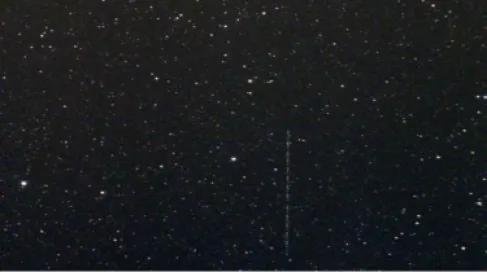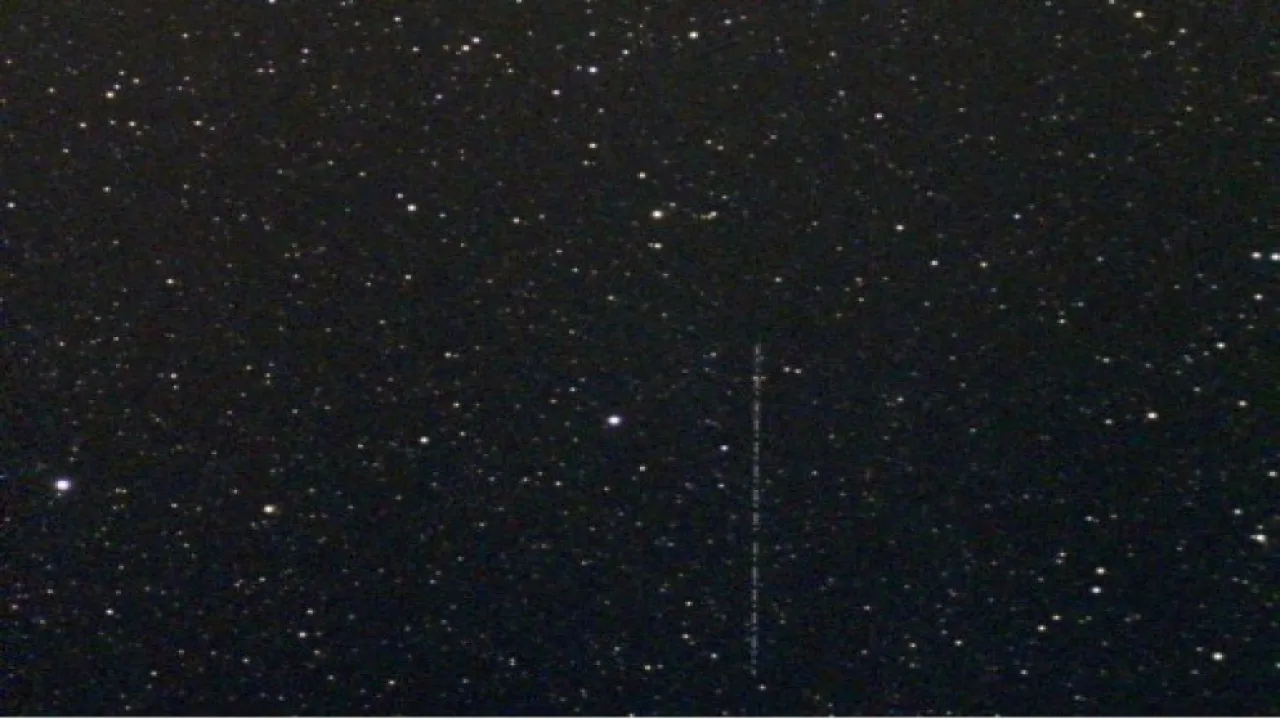
Khaberni - The Jordanian Astronomical Society was able to monitor and photograph the asteroid (152637) 1997 NC1 from the skies north of the capital Amman, and it is classified as a potentially hazardous asteroid (PHA), belonging to the Aten group of near-Earth asteroids. It was discovered within the NEAT project at the Haleakala Observatory on the island of Hawaii on July 5, 1997.
According to astronomical observations and monitoring conducted from Jordan, the asteroid will pass closest to Earth safely at 2:14 PM on Saturday, Jordan time, without posing any danger to our planet.
The asteroid appears in two photos taken by Ammar Al-Sakaji, president of the Astronomical Society from north Amman, as a discontinuous linear trace due to its apparent motion among the stars during photography and assembling, while the stars remained fixed in their places, which confirms the asteroid's transit across the sky during the observation period.
This passage is the closest approach of the asteroid to Earth, reaching a minimum distance of about 2,591,020 kilometers, roughly 6.7 times the average distance between the Earth and the Moon, while its relative speed amounted to about 31,992 kilometers per hour.
The asteroid is currently located in the constellation of Virgo, and has an apparent magnitude of about 10.38, making it a suitable target for observation with small to medium astronomical telescopes, while it cannot be seen with the naked eye. Its estimated diameter is approximately one kilometer, and it remains on the list of near-Earth asteroids that are continuously monitored by observatories and global space and astronomical agencies, although its current passage will be completely safe and pose no threat to Earth.