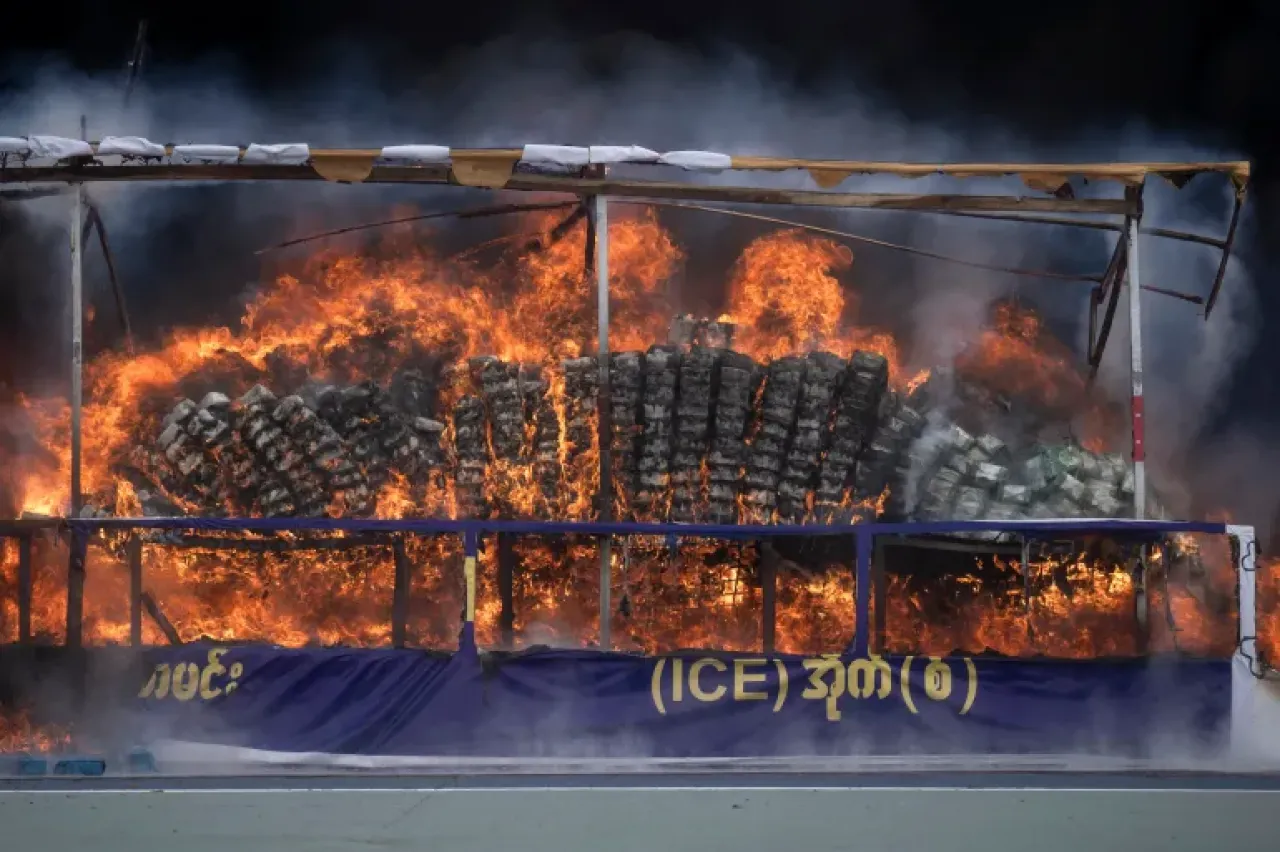
Khaberni - Under skies covered with thick black smoke, an illegal fortune estimated at $600 million was burned on the outskirts of Myanmar's largest city this Friday, where authorities executed tons of heroin and methamphetamine.
This symbolic scene reflects the depth of the crisis in a country where the drug trade has become a lifeline fueling armed conflicts and the civil war that has ravaged the nation following the overthrow of the democratic government.
Myanmar, also known as Burma, has a long history in drug production, being a major source of illegal drugs heading to East and Southeast Asia. Despite repeated efforts to eradicate it, it has remained for many years one of the world's largest producers of heroin and methamphetamine.
How did the story begin?
Following the military coup in 2021 - which led to a civil war between the military government and its democratic-supporting opponents alongside armed ethnic groups and subsequent political unrest - drug production significantly increased, according to experts.
In January, the military government said it was carrying out the largest-ever drug and drug manufacturing equipment seizure in the country, which were confiscated from a total of 12 drug production sites during a series of raids in the northern part of Shan State.
What is different this year, according to police Colonel Aung Myat Soo’s statement, is that the market value of drugs this year is double that of the previous year.
Aung Myat Soo stated that in Yangon alone, 31 different types of drugs worth about $321 million were burned.
Events were also held in Mandalay, and in Taunggyi, the capital of Shan State in eastern Myanmar - areas closer to the drug production locations - on the occasion of the United Nations International Day Against Drug Abuse and Illicit Trafficking.
Out of Control
Many areas in Myanmar are under the control of long-standing militias organized by various ethnic groups in the country, many of which are engaged in fighting against the military-run government in a bloody civil war, alongside pro-democracy groups that emerged after the military took power from democratically elected Aung San Suu Kyi in 2021.
In the elections concluded earlier this year, which international observers said were neither free nor fair with major opposition groups banned, the military leaders achieved a sweeping victory.
In return, the government says the militias in the country are using illegal drugs to fund their rebellion, and are not willing to participate in any peace process because they do not want to give up the lucrative drug trade.
It is well known that some groups are currently and have been involved in the drug trade, but other groups have also sought to eliminate drugs.
For example, the "Tang" National Liberation Army, an ethnic armed faction in Myanmar, announced yesterday, Thursday, that it would destroy seized drugs worth about $5.5 million in its controlled areas.
The faction had seized large areas of northern Shan State before signing a ceasefire agreement with the army in October.
Shadow Economy
Myanmar records a record high in drug cultivation according to a United Nations Office on Drugs and Crime (UNODC) report from a survey conducted in 2025 on opium, with opium poppy cultivation in the country reaching its peak in the last decade.
The cultivated areas increased by 17% compared to 2024, jumping from 45,200 to 53,100 hectares, placing Myanmar as the world’s primary source of illicit opium, taking advantage of the continuous decline in cultivation within Afghanistan.
The geographical distribution played a significant role, as all regions saw an increase in cultivation, with the largest increases in East Shan (32%) and Chin State (26%), while South Shan remained the most densely cultivated area, accounting for 44% of the opium fields in the country, and for the first time, including the Sagaing area (552 hectares), shifting the crisis focus to Myanmar’s western border with neighboring countries.
Regarding economic factors, prices were a significant incentive, as opium prices saw a massive jump due to deteriorating economic conditions; the price per kilogram "from the farm" doubled from $160 in 2019 to $365 in 2025.
In contrast, the UN report attributes the increased reliance of farmers on opium as a flexible cash crop to rising prices and the need to survive.
Despite the increased cultivated areas, the productivity per hectare did not rise (especially in North Shan and Kachin), and the reason is due to intensified armed clashes and insecurity which made it difficult for farmers to tend their fields or obtain fertilizers and agricultural inputs, yet, overall production remains at historically high levels.
Internationally, the report observed indications of heroin flow from Myanmar to European markets which previously relied on Afghanistan, through cases of smuggling with travelers.
While authorities burn tons of drugs in a symbolic celebration, the UN office warns of the continued growth and deepening cycle of poverty and dependence on drugs unless alternative and sustainable livelihoods for farmers are provided, emphasizing that what happens in Myanmar will reshape drug markets regionally and internationally.