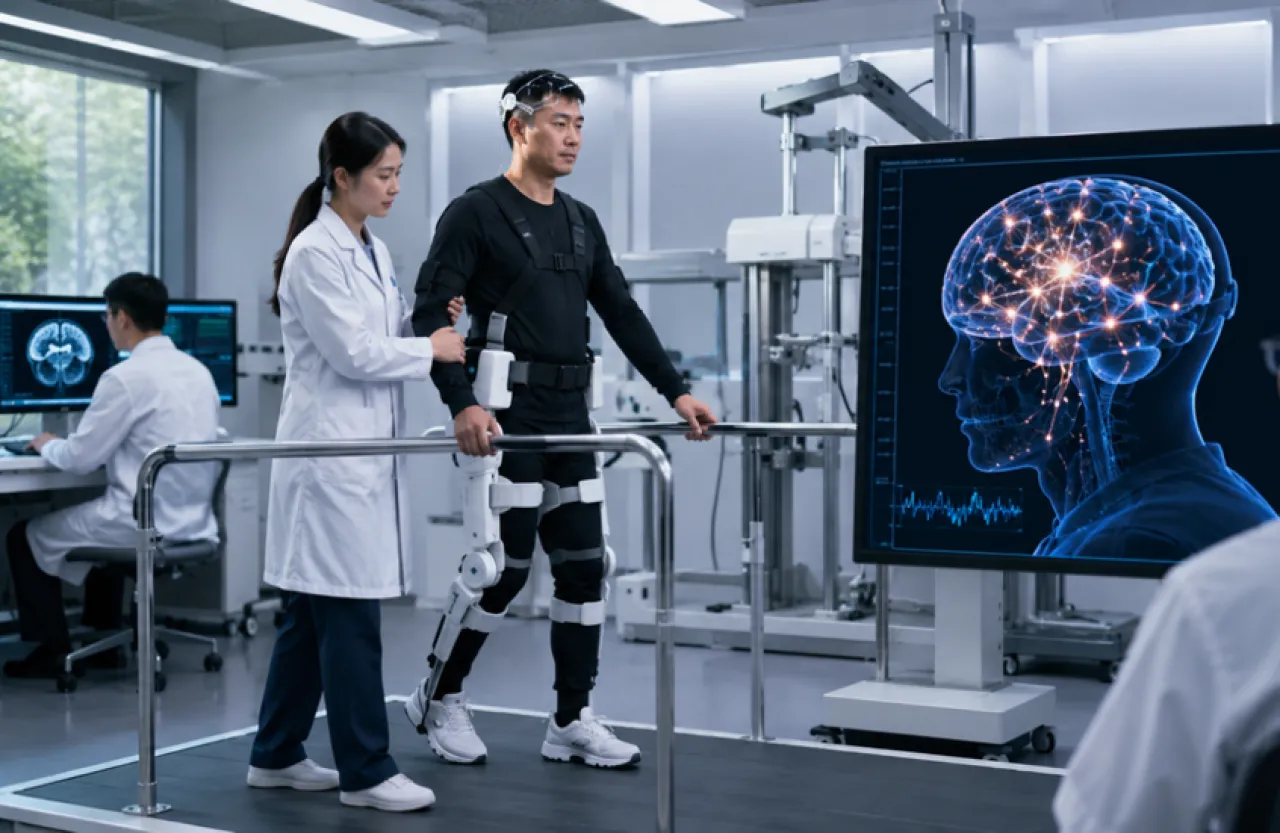
Khaberni - A Chinese citizen regained the ability to walk after being paralyzed for five years following an accident, thanks to an advanced neural implant that relies on brain signals.
In May 2024, the patient underwent the implantation of the "Beinao-1" system, developed by the Chinese Institute for Brain Research in cooperation with NeuCyber NeuroTech. The technology uses a chip equipped with electrodes that are implanted inside the skull without directly touching the brain tissue, capturing nerve signals through the protective membrane of the brain, then transferring them to a spinal cord stimulator and an external supporting frame, bypassing the damaged area.
After five months of training, the patient was able to independently control his legs, while some neural pathways regained their ability to transmit signals, which was previously thought to be impossible in cases of chronic spinal cord injuries.
The "Beinao-1" system belongs to the category of semi-invasive neural interfaces, where the electrode unit is surgically implanted inside the skull, while the electrodes are placed on the external surface of the brain's protective membrane, without penetrating its tissue directly.
Zhang Li, the director of the Device Engineering Center at the Chinese Institute for Brain Research (CIBR), said that these electrodes "are capable of creating a communication bridge between the brain and the external world."
According to the developers, the "Beinao-1" system has been implanted in about 30 patients so far. The technology has also helped individuals who have lost the ability to speak to pronounce approximately 100 commonly used Chinese words.
The Chinese news agency "Xinhua" reported that this case raises questions about the prevailing concept that assumes the effects of chronic spinal cord injuries cannot be reversed.