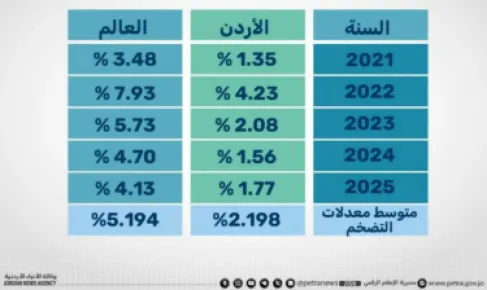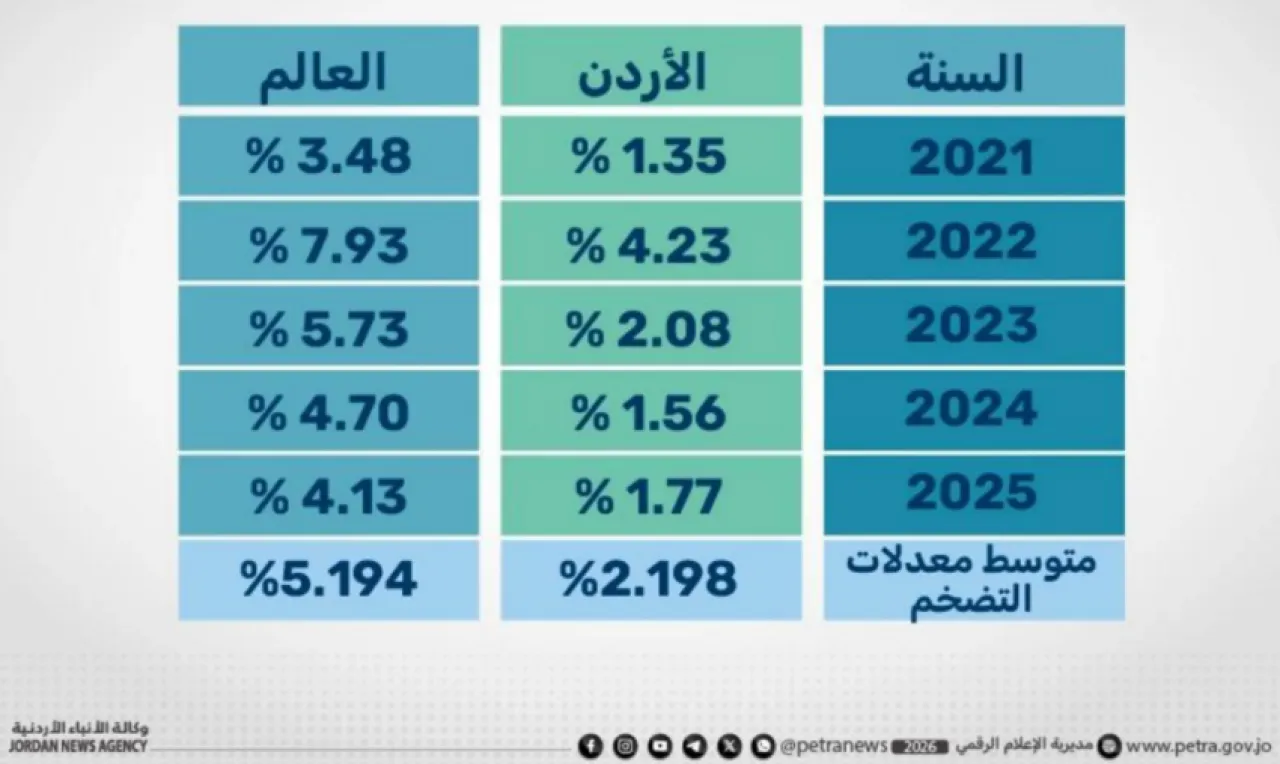
Khaberni - Local and global statistical data have shown that inflation rates in the Kingdom over the past five years have generally been lower than their global counterparts, with the rate in the Kingdom reaching 2.198 percent, compared to 5.194 percent globally.
According to a report by the Jordanian News Agency, the data clearly indicates that Jordan has managed to control the wave of inflation that has engulfed the world in recent years, extending from 2021 to the end of last year 2025.
According to the report, the inflation crisis globally began in 2021 with the return to normal life after the recession of the coronavirus pandemic and the increase in demand for goods, where the global inflation rate rose to 3.48 percent, while it remained low in Jordan at only 1.35 percent.
In 2022, the world faced the real peak of the crisis due to maritime shipping problems and rising energy prices globally, pushing the global inflation rate to peak at 7.93 percent.
Despite this, Jordan showed significant resilience, and the inflation rate rose to 4.23 percent thanks to measures taken by the Kingdom and support provided for some basic goods and petroleum products, alongside decisions by the central bank.
During the pandemic, which is considered the largest health crisis the world faces, the local market did not experience a shortage of goods and merchandise despite disruptions in supply chains and transportation and rising shipping costs, while the industry wheel kept turning, providing many essential products needed by citizens, especially sterilization, cleanliness, and food supplies.
With the onset of 2023, central banks around the world began raising interest rates to calm the markets, leading to a decline in global inflation to 5.73 percent, while inflation in Jordan declined more rapidly to stabilize at 2.08 percent, due to the prudent policies adopted by the central bank as per the report.
This stability continued into 2024, where Jordan recorded a further decrease in inflation to 1.56 percent, benefiting from improved global shipping and supply movements, which recorded a total inflation of 4.70 percent.
By the end of last year, 2025, while the global inflation rate was registering around 4.1 percent with continued inflation in service sectors in advanced countries, Jordan for the entire year 2025 saw a slight increase and stood at 1.77, due to developments in prices of non-essential goods for citizens.
The path of inflation rates in the Kingdom over the past five years indicates that the proactive steps and flexible monetary policies of the Central Bank of Jordan have succeeded in keeping prices within safe and acceptable limits for citizens and commercial sectors, providing a stable economic environment despite all the challenging and unstable conditions in the region.
According to the Central Bank of Jordan, the inflation rate in the Kingdom last year was in line with its estimates at below 2 percent, with expectations for it to stabilize around this rate for the current year 2026, maintaining buying power and enhancing the investment environment.
Since the onset of tensions in the region at the end of last March, the region has experienced a severe economic shock, the largest in decades resulting from military operations and navigation stoppages in the Strait of Hormuz, leading to a wave of inflation and threatening supply chains, where shipping costs increased, fuel and fertilizer prices doubled, and growth decreased, leading to strong inflationary pressures that threatened food security in importing countries.
According to the latest report from the World Bank, the outbreak of war in the Middle East and the supply chain shock have caused global inflation to spike again, pushing the overall price index toward 4 percent for 2026, driven by rising energy and basic goods prices by 22 percent and a spike in shipping and marine insurance costs.
According to the latest report by the General Statistics Department, the local inflation rate has declined during the first five months of this year, reaching 1.88 percent compared with 1.97 percent for the same period last year.
To this end, international statistical figures show that inflation in Turkey reached 32 percent in the past month of May, and 13 percent in Egypt, while in Tunisia, Russia, and Brazil it reached 5.5, 5.3, and 4.4 percent respectively.
Inflation rates during the past month of May this year, in both Australia and the United States, registered 4.2 percent in each, followed by South Africa with a rate that stabilized at 4 percent.
In the Eurozone and Sultanate of Oman, the indices recorded during the past month of May matched at 3.2 percent while South Korea’s inflation rate reached 3.1 percent, and the rates in Canada and the United Kingdom stabilized at 2.8 percent respectively.
Conversely, the Kingdom of Saudi Arabia and the Kingdom of Morocco recorded the same lowest rate during the past month of May this year among these countries, at 1.7 percent each, while the inflation rate in the United Arab Emirates during the first quarter of this year was 1.4 percent.