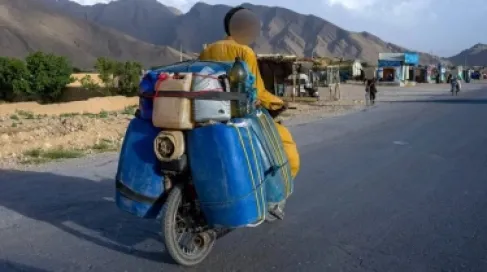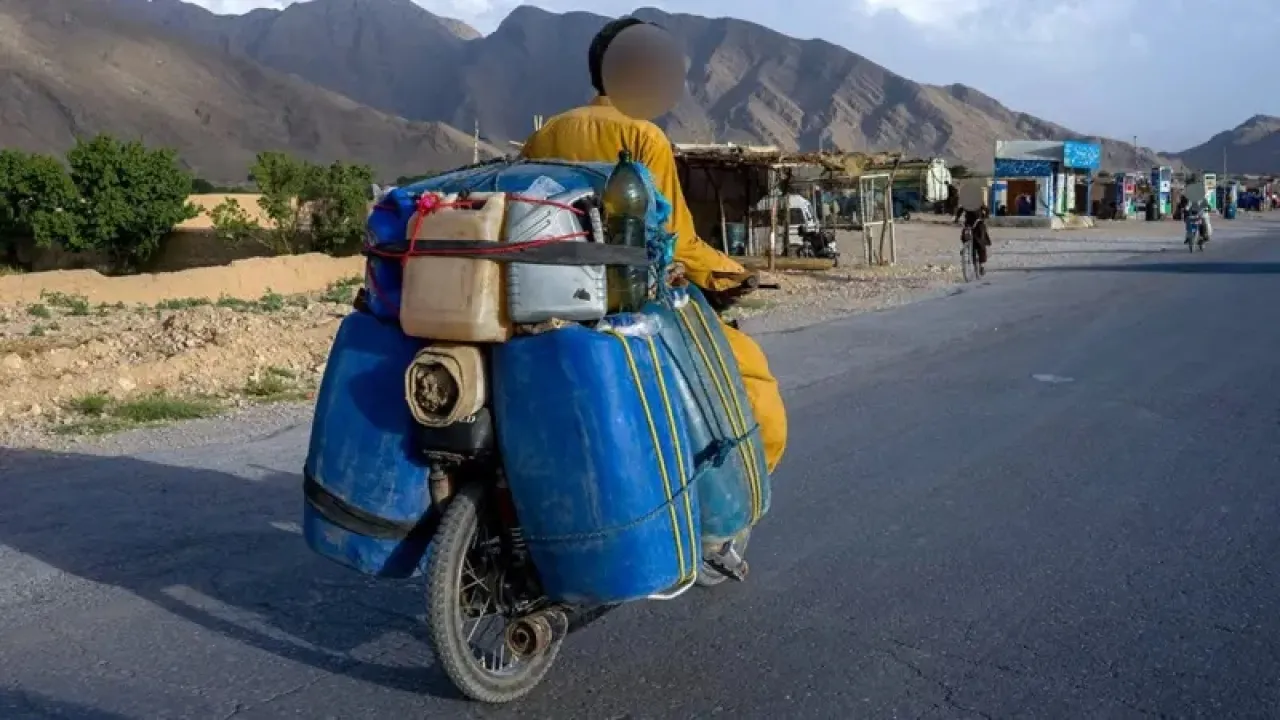
Khaberni - A small motorcycle at Mazar shrine carries numerous plastic containers filled with gasoline, to the extent that he barely finds a place to sit.
His dilapidated bike carries five containers, each with a capacity of 70 liters, and their total weight is about 272 kilograms.
The fuel containers dangle dangerously from the sides of the bike, secured with ropes and strings.
Mazar bought the fuel from an open market in Mastung, in Balochistan, Pakistan's largest and poorest province where he lives.
Small trucks loaded with plastic containers arrive at the market to sell fuel, after it has been smuggled across the border from Iran.
The smuggling of petroleum products from Iran to Pakistan has been happening illegally for decades, but there are indications that these operations have increased in recent months due to the American-Israeli war on Iran.
The severe disruption in the flow of oil through the Strait of Hormuz due to the war has led to rising fuel prices, which has boosted demand in Pakistan for cheaper smuggled Iranian gasoline and diesel.
Like thousands of smugglers in Balochistan, Mazar, a pseudonym used here to protect his safety, transports fuel to other open markets and informal fueling stations.
He prepares to travel 218 miles through one of the world's hottest regions to transport fuel to the neighboring province of Sindh.
Temperatures in Balochistan can reach 50 degrees Celsius, causing the plastic fuel containers to expand and soften.
If the containers crack or if fuel leaks from their caps while Mazar is driving, the fuel could ignite or explode. Smugglers often die in this way.
There are other risks as well.
For decades, Balochistan has seen clashes between Pakistani forces and armed separatist groups demanding more autonomy. Activists say thousands of people have disappeared in the midst of this conflict.
Mazar tells BBC World Service: "We do this job because there is no other choice for us."
He adds: "The weather is hot, and the prices are high, and we spend our days and nights on the roads."
While the exact size of smuggling operations is unknown, Nikkei Asia news site reported in 2024 that a leaked Pakistani intelligence report estimated the value of fuel smuggled annually from Iran to Pakistan at about one billion dollars, approximately 745 million British pounds.
In May of this year, Pakistan's five major oil refineries said the flow of petroleum products across the border was increasing, and they sent a message to the government asking for intervention.
This month, the Oil Companies Advisory Council, which represents the Pakistani oil sector, wrote to the government saying official sales of petroleum products have dropped to their lowest level at this time of year in 27 years, partly due to increased smuggling.
Mazar, who is nearing forty, is the main provider for a large family that includes his only child and several siblings.
He says he started working in fuel smuggling three or four months ago, after a drought prevented him from continuing farming.
About 2.4 million people in Balochistan are estimated to be involved in smuggling fuel between Iran and Pakistan, according to the leaked Pakistani intelligence report seen by Nikkei Asia.
Fuel smuggling is illegal in Pakistan, and penalties range from fines and vehicle confiscation in minor cases to imprisonment in larger operations.
However, Fida Hussain Dashti, former president of the Chamber of Commerce and Industry in Quetta, Balochistan, believes that this trade is vital for the region's economy amid scarce job opportunities.
Balochistan, located on the border with Iran to the west and Afghanistan to the north, accounts for about 44 percent of Pakistan's land area, but only six percent of the country's population lives there.
Despite its wealth in mineral resources, Balochistan records poverty rates similar to some of the world's poorest regions, which has caused widespread anger in the region.
Dashti says: "The people are helpless and have no other option," indicating that the Pakistani government should have done more to provide job opportunities in the region.
He adds: "Even a student who graduates with a master's degree ends up working in fuel trade."
Irfan, whose name we have also changed here to protect his safety, says he cannot work in another field because of his disability.
After suffering from polio, one of his legs and one of his hands have very limited mobility.
Irfan has also been smuggling for several months.
He transports diesel because it is safer than gasoline and less flammable.
He says: "I cannot transport gasoline, what if it ignites? If I cannot stand up, I would suffer serious burns."
The smuggling operations are surrounded by complex political calculations, especially since Pakistan plays a mediating role between Iran and the United States in an effort to bring about a permanent end to hostilities.
Pakistan has launched campaigns against this illegal trade at various stages, but smuggling rates have rebounded.
Completely stopping smuggling is difficult, as monitoring remote border areas, which stretch for 900 kilometers, is not easy.
The Pakistani government also recognizes that this work represents a lifeline for many in Balochistan.
Oil companies do not deliver fuel to some areas of the province due to transportation costs, security concerns, and competition with cheaper smuggled products.
Iran blames criminal groups for the smuggling. These groups can buy fuel at low prices because the Iranian authorities sell gasoline and diesel to citizens at subsidized prices.
But Paddy Jane, from the "Global Initiative Against Transnational Organized Crime," which monitors illicit markets, says: "We believe that the main smugglers are either part of the Iranian Revolutionary Guard or have close ties to them."
He adds that their goal is "of course to circumvent the sanctions imposed by the United States."
Jane believes that groups linked to the Iranian authorities are now trying to smuggle larger amounts of fuel to benefit from the price increase caused by the war.
BBC asked the Iranian government to comment on the allegations related to its involvement in smuggling fuel, but it has not received a response.
"The war started and we lost everything."
Several smugglers told BBC officials and security forces members in Pakistan turn a blind eye to smuggling operations in exchange for bribes.
The Pakistani government denies any involvement of its institutions or security forces in fuel smuggling.
It says Prime Minister Shahbaz Sharif has issued directives to law enforcement agencies to intensify their campaign against smuggling, and that security forces confiscated fuel worth about 1.3 billion Pakistani rupees last year, approximately five million dollars.
Mazar says the war has increased his work costs.
The price he pays to buy smuggled gasoline has risen, while the selling price has remained the same.
After deducting the costs of fuel, food, and renting the bike, his net daily income was five thousand rupees, about 13 British pounds, but it has dropped to three thousand rupees, about eight British pounds, which is about twice the minimum wage in Pakistan.
He says: "The war started and we lost everything."
As Mazar and a group of 11 motorcyclists departed from Mastung area in Balochistan returning to their homes, they were struck by a heat wave, a prolonged hot spell accompanied by dust storms.
When asked about the risks of injury or death, Mazar said: "I don't worry about that."
He added: "I have to die someday. I may die now, who knows? That is God's decision, whether he keeps me alive or takes my life."