Khaberni - Just before our national team's match against the Austria team, the Khaberni site provides you with a brief about the European country.
General Information:
Official name: Republic of Austria
Capital: Vienna
Official language: German
Recognized minority languages: Hungarian, Slovenian, Croatian, Czech, Slovak, Romani, Austrian Sign Language
Independence: July 27, 1955
Government system: Parliamentary federal republic
President: Alexander Van der Bellen (since January 26, 2017)
Currency: Euro
Area: 83,879 square kilometers
Population (2015): 8,579,747 people
Gross Domestic Product (2015): $380.56 billion
Per capita GDP (2015): $44,475.59
Unemployment (2015): 5.8%
Inflation rate (2015): 1.2%
Major industries: Construction and machinery, autos and auto parts, food products, metals and chemicals, wood and wood processing, paper and cardboard, telecommunications equipment, and tourism.
Major imports: Machinery and equipment, autos, chemicals, metal goods, oil and oil products, food products.
Major exports: Machinery and equipment, motor vehicles and parts, paper and cardboard, metallic goods, chemicals, iron and steel, textiles, food products.
** Nature and Geography
Austria is famous for its enchanting nature, making it a haven for nature lovers and winter sports enthusiasts:
The Alps: They dominate the geographical landscape and include the country's highest peak, Großglockner, which rises 3,798 meters above sea level.
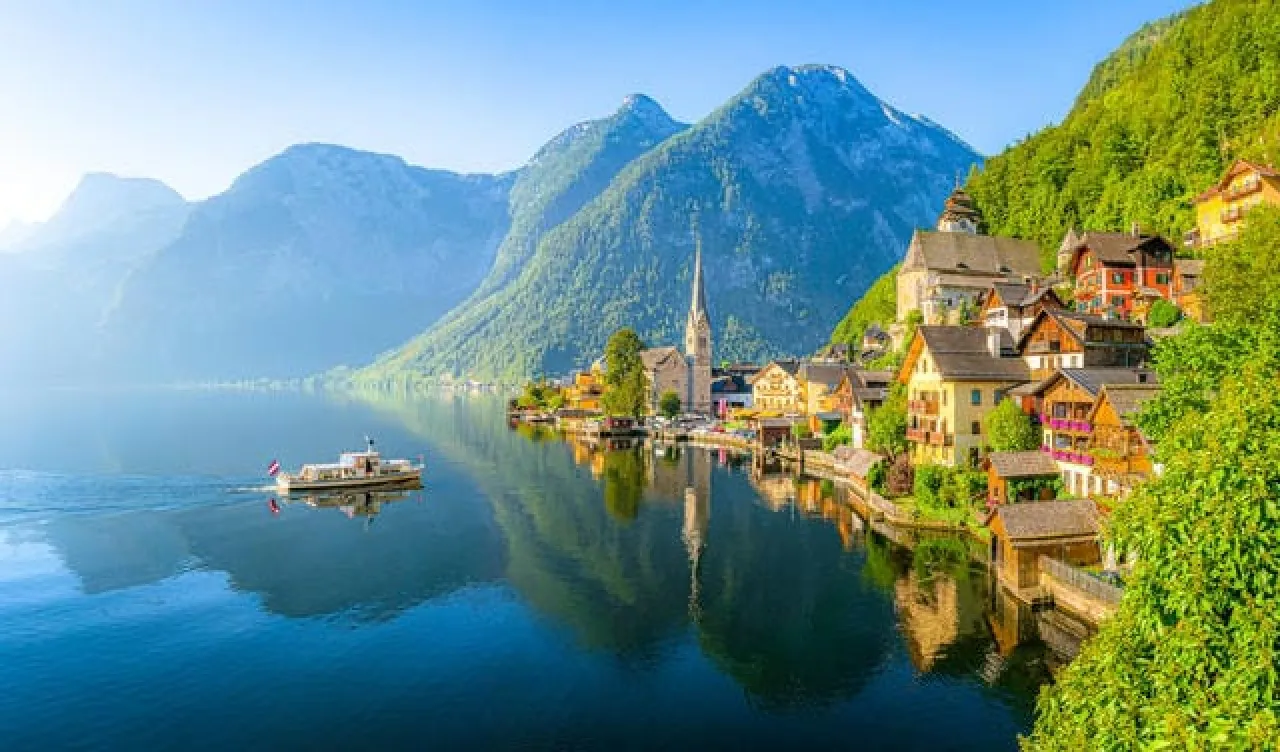
Lakes and rivers: Austria is crossed by major rivers, most notably the famous Danube River. It also includes captivating mountain lakes like Lake Hallstatt.
Culture and Arts (Capital of Classical Music)
If Italy is the cradle of painters, Austria is undeniably the home of classical music. It has been home and thrived great composers in history such as:
Wolfgang Amadeus Mozart (born in Salzburg, Austria).
Ludwig van Beethoven (German-born but spent most of his creative life in Vienna).
Franz Schubert and Johann Strauss (creator of The Blue Danube Waltz).
The Political System in Austria
The Second Republic was established in Austria in 1945 based on a parliamentary system that balances three main institutions at the federal level:
1. The President (the highest representative of the state)
• Nature of position: Nominated by parties but acts with neutrality transcending party loyalty for the supreme interest. Can be removed by a popular referendum if he violates the constitution.
• Main powers:
o Representing the state abroad and concluding international treaties.
o Appointing the Federal Chancellor (usually the leader of the strongest party) and government members (with the right to refuse).
o Summoning Parliament to convene, ending its sessions, and dissolving it under certain circumstances.
o Supreme command of the federal army and approving the constitutionality of laws.
2. The Parliament (Federal legislative power)
Responsible for legislating laws and overseeing the government (with the right to withhold confidence from it and topple it), consists of two chambers forming together the "Federal Assembly" (whose duty is to swear in the President):
• National Council (183 deputies): Elected every 5 years by proportional representation. A party needs at least 4% of the vote to enter Parliament to prevent fragmentation.
• Federal Council (64 members currently): Includes deputies sent by the nine provincial councils based on the population of each province.
• Election conditions: Voting rights are guaranteed for citizens from 16 years old (including expatriates), and candidacy from 18 years old.
• Direct democracy: Citizens have the right to request legislative procedures through opinion surveys, and any comprehensive amendment to the constitution requires a popular referendum.
3. The Chancellery and the Federal Government (Executive authority)
• Leadership: The government is headed by the Federal Chancellor in cooperation with his deputy and the ministers for managing the state's daily affairs.
• Working mechanism: The voting power within the government is limited only to ministers (excluding state ministers), and consensus is required for decision-making.
• Legislative task: Drafting law proposals and referring them to Parliament for discussion.
Austria Team:
The Austria team combines past glory as the world's strongest team, long periods of absence, and ongoing efforts at rejuvenation in modern times.
1. The Golden Era: "The Miracle Team" (Wunderteam)
In the 1930s, the Austria team was not just a strong team, but a tactical revolution that changed football concepts. Under the legendary coach Hugo Meisl, Austria introduced a playing style that relied on short, fast passes and smart off-the-ball movement (the legitimate forebear of Dutch "Total Football" and later Barcelona's Tiki-Taka).
Between 1931 and 1932, this team played 14 consecutive unbeaten matches, overwhelming Europe's giants (such as defeating Germany 6-0 and 5-0, and trouncing Hungary 8-2). They entered the 1934 World Cup as the top favorite but lost in the semifinals to host Italy amid broad refereeing controversy, settling for fourth place.
2. Noteworthy Historical Achievements
Although Austria has not won a world or major continental title, its historical record holds remarkable figures:
• Third place in the World Cup 1954: This is considered the best achievement in Austrian football history, where they presented a terrifying offensive tournament, winning the match for third place against Uruguay (then holders of the title) with a score of 3-1.
• Silver medal in the Berlin Olympics 1936: They lost the final to Italy after extra time.
• Century match in World Cup 1954: Austria defeated Switzerland with a score of 7-5 in the quarterfinals, a match that still holds the record for the highest number of goals in a single World Cup match.
3. Prominent Legends of Austrian Football
Over the years, Austria has had players ranked among the best in the world during their times: