Khaberni - Sign language is the main means of communication for millions of deaf and hard of hearing individuals worldwide. Despite the advancements in artificial intelligence technologies, the gap in daily communication between the deaf community and others remains due to the limitations of current translation devices.
Traditionally, research has focused on the use of "Smart Gloves" or computer vision systems based on cameras. However, these systems face significant challenges; gloves are impractical for continuous daily use and raise concerns about social appearance and comfort, while cameras are restricted by viewing angles and lighting conditions.
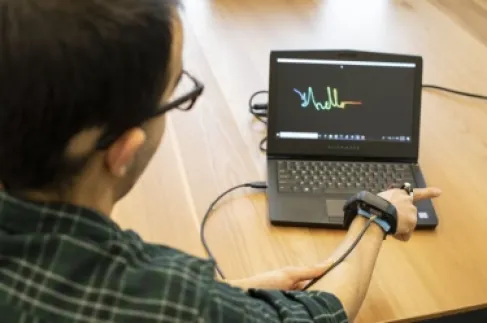
Thus, there emerged a need for more flexible, less intrusive solutions, leading researchers at the University of Washington's Wearable Computing Labs in collaboration with the Georgia Tech Institute to develop a revolutionary system based on a network of synchronized smart rings that capture hand gestures with precision comparable to complex systems.
The System's Structural Design and Operating Mechanism
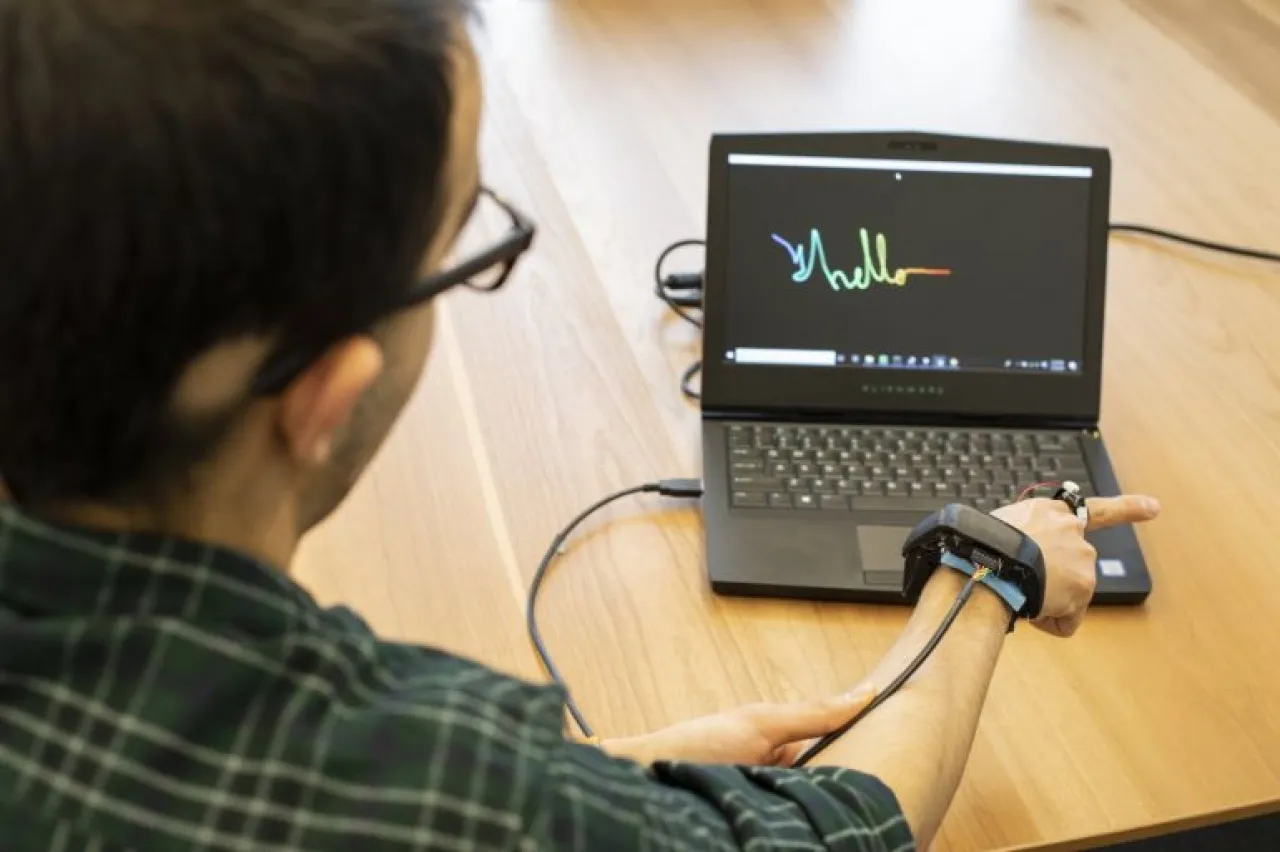
The joint project between the two universities relies on the concept of "Miniaturized Wireless Body Sensor Networks". The system consists of five independent smart rings worn on the fingers, operating in precise temporal synchronization as motion and dynamics sensors (IMU Chips), with each ring containing an ultra-miniature measuring unit. This unit includes:
– Accelerometer: Measures the speed and direction of each finger's movement in three axes (X, Y, Z).
– Gyroscope: Monitors the bending and rotation angle of each finger joint as the sign is made.
The wireless communication and synchronization protocol, according to papers published by the Wearable Computing Labs at the University of Washington, was developed using a low-energy Bluetooth technology (Bluetooth Low Energy – BLE) designed for Mesh Networks.
This protocol integrates the data streamed from the five rings and sends it as a unified data packet to the smartphone's central processing unit at a refresh rate exceeding 100 readings per second, ensuring no noticeable delays affecting the immediate translation.
Data Processing and Artificial Intelligence
Here, the pivotal role of the Artificial Intelligence department at Georgia Tech comes into play, where a custom deep learning model was constructed to process the dynamic sequential signals.
A. Recurrent Neural Networks and Temporal Context
The developed algorithms rely on Long Short-Term Memory networks or miniaturized Transformer models designed for Edge AI technology.
These networks do not interpret movement as static snapshots but rather study the "temporal context" of the movement, as a specific gesture's meaning could change based on the preceding or following motion.
B. Addressing the Problem of "Interference and Noise"
One of the major challenges artificial intelligence solves in this innovation is distinguishing between "random daily movements," like holding a cup or moving hands while walking, and actual "sign language gestures". According to reports from Georgia Tech, the model has been trained to classify patterns accurately, ignoring any sensor movements that do not adhere to the grammatical structure of sign language.
According to laboratory experiments published, the synchronized ring network achieved a translation accuracy exceeding 93% for classifying isolated letters and words in American Sign Language (ASL), with a response time under 50 milliseconds, technically qualifying as real-time translation.
Existing Challenges and Future Development Prospects
Despite the impressive technical success of this joint model, the report identifies several challenges that research teams are working to overcome before launching the technology as a commercial consumer product, including:
- Integration of Facial Expressions: Engineering sources indicate that sign language relies on facial expressions and upper body movements for up to 30% to convey contexts like negation, exclamation, or questioning. Researchers are currently working on integrating ring data with lightweight smart glasses equipped with lower face tracking cameras to complete the contextual picture.
- Diversity of Sign Languages and Dialects: Current development focuses on American Sign Language (ASL). Transitioning to other languages (like Unified Arabic Sign Language or local dialects) requires building entirely new motion databases and retraining neural models on them.
- Sustainable Power Management: The challenge lies in reducing the size of batteries inside the rings to keep them comfortable, while ensuring they operate for a full day without needing constant recharging.
The experts affirm that this research collaboration between Wearable Computing Labs at the University of Washington and the Artificial Intelligence department at Georgia Tech represents a new cornerstone in the assistive technology sector.
The shift from bulky devices to a "synchronized ring sensor network" proves that the future of integrating deaf and mute technology lies in invisible smart systems that seamlessly meld into the details of daily life without imposing restrictions on users, paving the way for a more inclusive and equitable global communication environment.