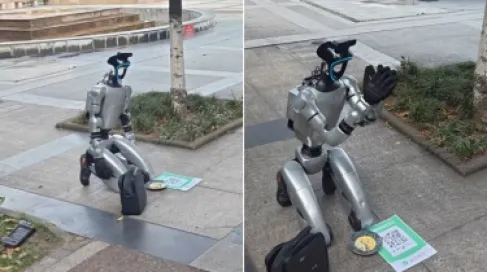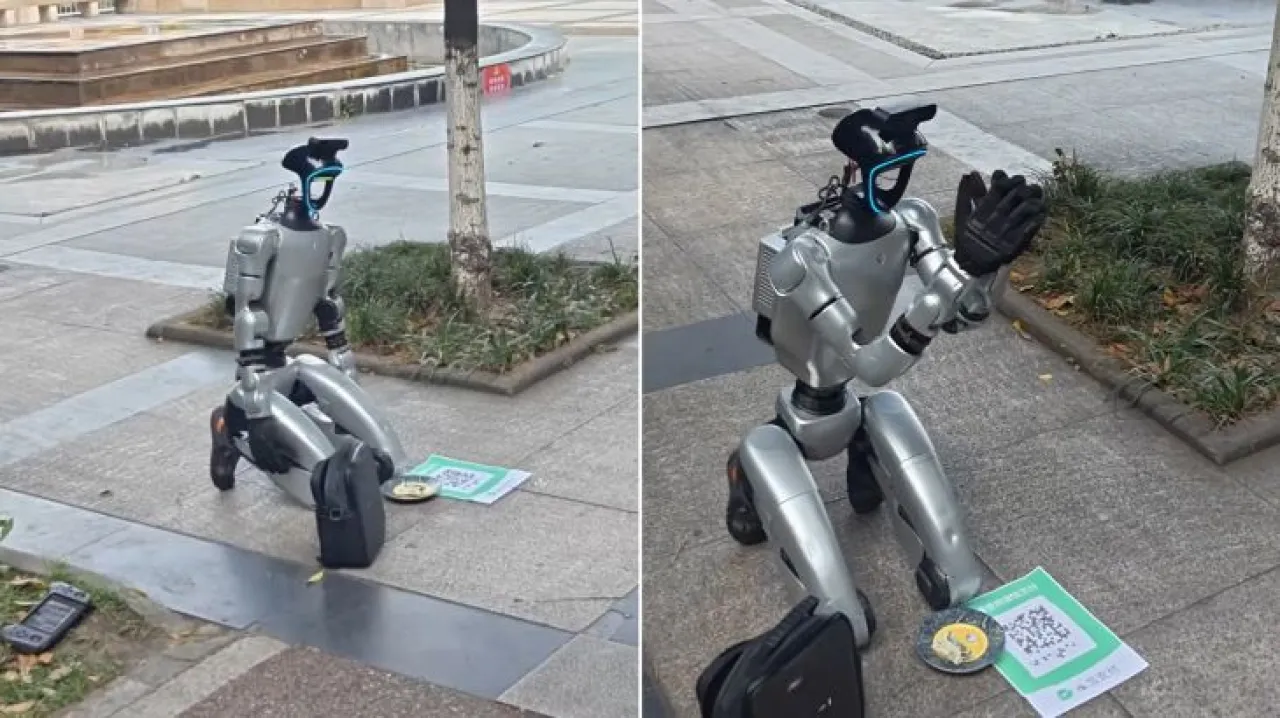
Khaberni - Robots have invaded the Chinese streets and their presence has become commonplace for pedestrians. However, people on the streets of China were surprised by the appearance of a human robot sitting and begging on its feet using a series of clear signals, demanding donations via a QR code in front of it, according to video clips circulated on social media.
The robot justifies its request for money due to high maintenance and electricity costs, making living difficult, and it interacted with all the pedestrians as seen in the video.
The robot in the clips belongs to the Chinese company "Unitree", specifically the "G1" model which is one of the company’s best-selling human-like robots, according to the sales report released last March, priced at about $16,000.
"Unitree" develops the "G1" robots as a versatile class of robots that can be programmed directly by researchers and scientists and trained to perform many functions.
Widespread Appearance
This is not the first time that the “Unitree G1” robot has appeared in promotional videos; the model has been featured in many promotional clips developed by the company and even clips from users and researchers.
One of the most famous of these clips is the promotional display that participated in the opening of the Chinese Spring Festival several months ago, presenting a highly synchronized dance.
The robot also appeared in a musical performance at the Doha Web Summit in 2026 as part of the conference activities, in addition to being present on the conference floor in direct advertising with users.
"Unitree" offers a large number of human-like robots, even dog-like robots, and other industrial robots, being one of the most prominent Chinese robot companies offering many different models.
Recently, the company introduced a massive robot that resembles those seen in science fiction movies and the famous "Avatar" movie, where humans can ride inside the robot and control it.
Robots with Human Interactions
While there are no official sources explaining the reason behind this action from the “Unitree” robot, and whether the company had a hand in it or if it was merely a human effort, scanning the QR code takes you to the "WeChat Pay" page, a popular way to receive money in China.
The idea of begging was part of a show or programmed experiment to attract attention and display the capabilities of human-like robots. Reports suggest that it was programmed to perform this behavior as part of a social experiment or show, which made the video go viral and sparked discussions on the future of robots and artificial intelligence in everyday life.
The behavior mimicked in the video reflects a direct simulation of typical human behavior like begging and appealing to passerby's empathy, a job category that has existed throughout different eras but traditionally relied on eliciting human compassion.