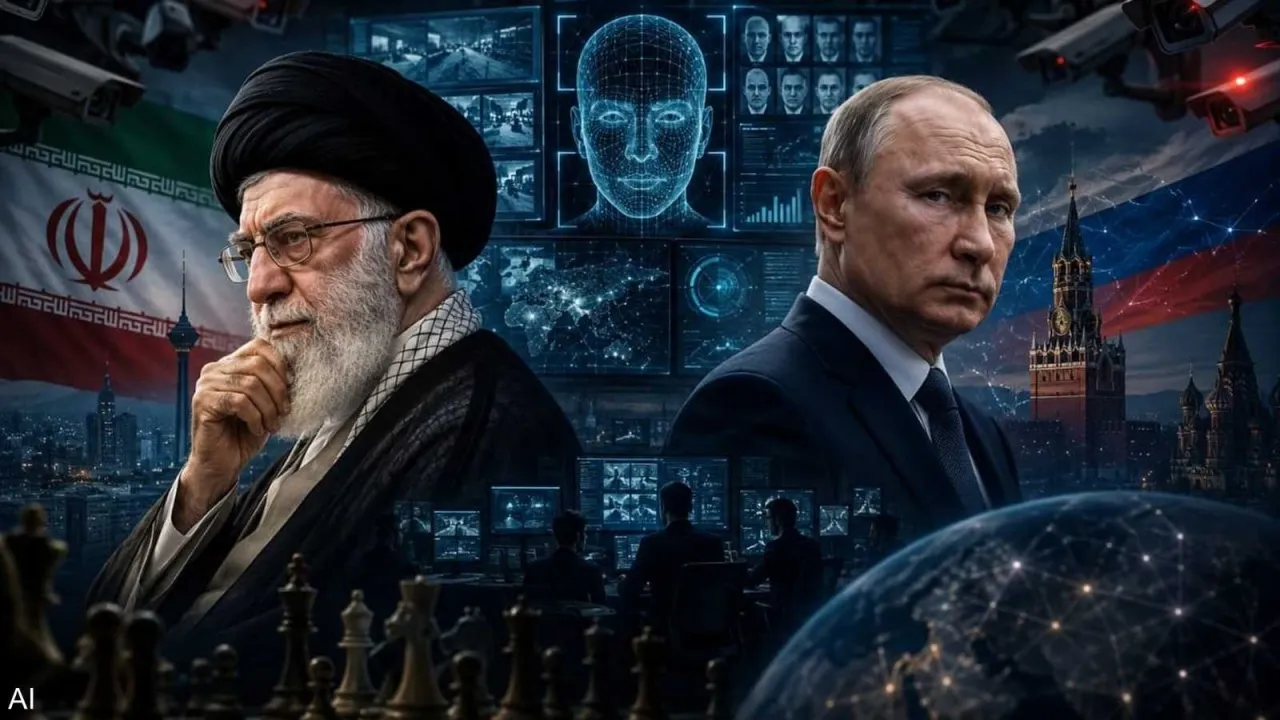
Khaberni - The British "Financial Times" newspaper revealed on Monday that the Russian security services shut down part of the special surveillance system that protects Russian President Vladimir Putin and his senior aides, following the assassination of the former Iranian leader Ali Khamenei in Tehran.
The newspaper reported from two informed sources that the system, which relied on about 300,000 cameras to monitor citizens in Moscow, was reactivated after engineers examined it and isolated it from the internet.
These exceptional measures were taken after the Israeli intelligence managed to collect huge amounts of footage from Iranian traffic cameras, helping to pinpoint the exact location and timing of a meeting held on February 28 between Khamenei and his closest aides, where a number of senior security officials were killed during that meeting in the opening strike of the joint war between the United States and Israel against Iran.
The newspaper considered the assassination of Khamenei in the presidential compound as dramatic evidence of the emerging technological leap and the use of artificial intelligence to analyze millions of hours of video recordings collected by thousands of cameras to locate and monitor specific targets.
The director of the Russian Federal Security Service, Alexander Bortnikov, said that the extensive surveillance system in Russia has become a vulnerability, as surveillance systems have turned into a loophole that could be exploited by enemies.
Bortnikov clarified last May, according to what the Russian media reported: "The recent elimination of senior Iranian officials by the American-Israeli coalition represents a clear warning sign. The locations of the victims were partially identified through backdoor software in Tehran's video surveillance systems."
Governments have long realized that surveillance cameras can be easily hacked by professional hackers or intelligence agencies, such as elite Israeli signal intelligence units. However, recent developments in artificial intelligence have made it possible to identify specific behaviors and patterns within the huge sets of visual data produced by these cameras.
Israeli intelligence officers have used these developments to create a complex map of the city of Tehran, discover patterns of behavior of personal guards for senior officials, and efficiently isolate targets among millions of hours of footage through thousands of cameras. They also integrated this information with other intelligence sources, including human sources.
A number of people familiar with the complex mathematics behind these technologies said that the visual capabilities of artificial intelligence have become much more powerful since 2023, and have seen an additional leap about a year ago. They are much more advanced than traditional machine learning algorithms used in facial recognition or the detection of weapons or tracking vehicles by their type or plates.
Interviews with about 12 people, including current and former intelligence officers and senior security officials in four countries, revealed increasing concern about this new capability. It practically turns billions of dollars spent on surveillance systems, especially traffic cameras, into a loophole through which opponents can scan entire cities and fortified facilities and extract patterns and secrets on an industrial scale.
Once a target person is identified, these systems can quickly build detailed files about their activities spanning months, allowing the reshaping of their lifestyle and the relationships of the people they interact with.
These systems can also collect information not only from surveillance cameras but also from social media, breached communications, and sounds captured by microphones in smart devices, and travel records.
The Russians were already concerned about Putin's personal safety, especially after threats from Ukrainian intelligence services that succeeded in hacking traffic cameras inside Russia and used mobile phone location data to facilitate the assassination of Russian military officials in the heart of Moscow.