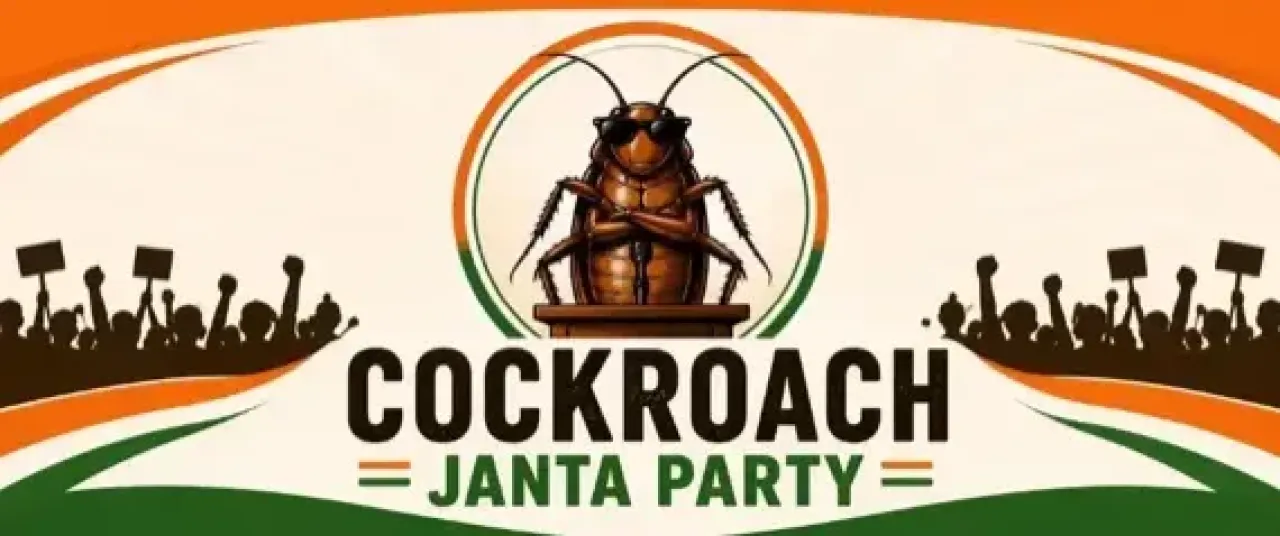
Khaberni - Indian youth Abhijit Deepki proved that what shakes systems is not merely guns and social discontent, but humor can also become a catalyst capable of driving India into an unexpected turn.
Within just a few days, this young man—30 years old and a public relations graduate from Boston University in the United States—managed to keep the eyes of his country's ruling authorities fixed on what was happening on social media.
Overnight, Deepki found himself leading a satirical political movement called the "Cockroach Party," in the latest youth-led digital uprising in South Asia, where they had previously succeeded in overthrowing governments in Sri Lanka, Nepal, and Bangladesh.
So what about India and what is the story of the "Cockroaches" and what specifically do they want?
What angered the "Cockroaches"?
It seems that India did not take lessons from what happened in neighboring countries, where the Chief Justice of the Supreme Court, Suria Kant, was unaware that his harsh statements would rebound on state institutions when he described—in a public session—young groups as "parasites" and "cockroaches," who failed to secure jobs but persisted in directing their discontent and criticisms at the system on social media.
Despite clarifications later offered by the Chief Justice stating his words were misunderstood, and that he meant those with fake degrees, not the general youth who he described as "pillars of developing India"; the millions of youth did not hesitate to express their reservations and even took to the streets.
Like in Bangladesh and Nepal, the moving scene in India was led by internet users from Generation Z who are suffering from unemployment, inflation effects, and sharp religious divisions after 12 years of Prime Minister Narendra Modi's Hindu nationalist government.
As anger escalated on social media, Abhijit Deepki tweeted on "X" saying: "What if all the cockroaches came together?", thereby increasing the pressure on the Chief Justice and the government behind him.
"Cockroach Janata" on the path of the ruling party
A day after the Chief Justice's statements on May 15th, Deepki launched a satirical platform named "Cockroach Janata" which mimics the ruling "Bharatiya Janata Party," benefiting from artificial intelligence tools like "Cloud" and "Chat GPT" in designing the platform's identity and manifesto.
The party set satirical criteria for joining the movement, including the lazy, the unemployed, and those who are good at complaining, turning it into a digital phenomenon across India within a few days.
As of last Sunday, the party successfully attracted about 23 million followers on its Instagram page, surpassing the accounts of political parties, including the ruling party which is considered the largest party in the world, by about nine million followers.
The "Cockroach Party" also attracted the attention of prominent political figures, including Mahua Moitra, an opposition parliamentarian from West Bengal, and Kirti Azad, a former parliamentarian from neighboring Bihar, alongside the president of the "Samajwadi Party," Akhilesh Yadav.
In statements to Al Jazeera from Chicago, USA, Deepki said: "Those in power think the citizens are cockroaches and parasites. They should know that cockroaches breed in corrupt places. This is the state of India today."
Regardless of the tools Deepki used, his initiative did not fail to follow a long-standing tradition of global political movements against mainstream culture, which use satire and absurdity to rebel against ruling systems.
"Inherent Hostility"
In a country full of contradictions, there is plenty to push Deepki and his generation in India to raise their voices, as this country—the most populous in the world—faces a multitude of escalating problems. While India's economy has seen massive growth, experts say that income disparity—alongside unemployment and rising living costs—has reached record levels.
Although the number of university graduates in India exceeds eight million annually, the unemployment rate among them reaches 29.1%. This figure becomes more significant when we know that the millennial generation makes up more than a quarter of India's population, and is also the largest generation in the world, revealing the magnitude of the risk for the Chief Justice.
And the crisis was further ignited when his remarks came in a week that saw student protests due to leaks in national tests, forcing the government to cancel the medical entrance exam.
In statements to Al Jazeera, lawyer Prashant Bhushan—a prominent lawyer in the Supreme Court and a human rights activist—says the Chief Justice's comments reflect bias and inherent hatred towards activists and youth in general, adding that India needed a popular uprising because "its economy and society are bleeding for the benefit of capitalists like Ambani and Adani," referring to the Indian billionaires close to Modi.
Breaking the Silence
Like Bhushan, many experts in India believe that the Cockroach Party campaign reflects the desire of millions to break the silence and hold Modi's government accountable. The platform, through satirical images and political comments, raised issues like unemployment and leaked exam papers and education, while about 6 million of its followers signed a petition demanding the resignation of the Union Education Minister Dharmendra Pradhan due to alleged failures in the education system, especially because of the leakage scandal in the tests.