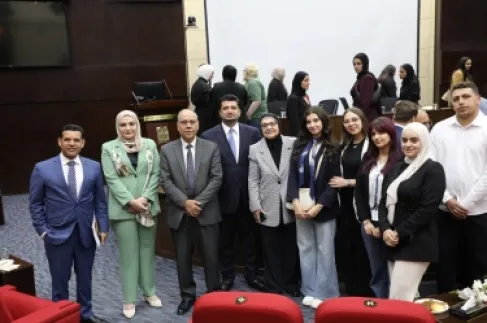
Khaberni - As part of Arab Amman University's continuous efforts to enhance academic quality and solidify standards of institutional excellence, national and international accreditation, the Faculty of Law at the university organized a specialized workshop titled "Requirements and Standards of International Accreditations." It was presented by Dr. Ahmed Al-Badawi, Assistant Dean for Quality and Accreditation Affairs, and Dr. Sara Naser Al Din, Assistant Dean of the Pharmacy College, with the presence of Professor Dr. Mohammed Al-Dhnaibat, Dean of the Faculty of Law, heads of academic departments, and several faculty members.
During the workshop, the lecturers reviewed the key standards and requirements related to obtaining international accreditations for academic programs, mechanisms for developing the educational environment in alignment with global best practices, and focused on a set of strategic axes that are fundamental in evaluating academic programs internationally. These included educational policies, support standards for students and academic services, measuring learning outcomes, and the efficiency of academic program management, in addition to methodologies for continuous improvement and measuring the effectiveness of educational and professional programs. The workshop also discussed the importance of developing educational policies and program descriptions, activating strategies for attracting international students, enhancing the quality of academic advising, which supports student success and enhances their readiness for the job market and further studies. Dr. Al-Badawi presented a comprehensive specialized discussion on the requirements for international accreditation in law faculties and mechanisms for aligning legal programs with global standards, while Dr. Naser Al Din provided an analytical presentation on the experiences of international accreditation and modern quality systems, contributing to enriching the discussion and enhancing knowledge integration among different disciplines. He further reviewed a number of modern educational practices in the educational process development axis, notably project-based learning, flipped learning, and interactive lectures, contributing to aligning targeted skills with learning outcomes and the needs of various professional sectors.
During the workshop, the lecturers emphasized the importance of building effective strategic partnerships with various academic and professional sectors, enhancing research cooperation, and expanding the scope of academic exchange programs for students and visiting professors, thereby enhancing the international presence of academic programs and instilling the culture of sustainable learning and knowledge openness. In the administration and governance axis, the lecturers affirmed the importance of providing an integrated institutional structure encompassing human resources and logistical capabilities supportive of achieving the goals of academic programs, alongside adopting a quality-based, transparent, and ethical work system, activating mechanisms for periodic evaluation and continuous improvement, ensuring the sustainability of academic excellence and enhancing institutional and educational performance efficiency. The workshop concluded with an interactive discussion session that brought together teaching staff and participating experts, during which experiences and perspectives on the most prominent practical practices to achieve international accreditation requirements were exchanged, confirming that commitment to quality and accreditation standards represents a strategic direction contributing to preparing qualified legal competences capable of competing and excelling at local, regional, and international levels.